

A clothing brand spends months designing a new collection.
Samples are refined. Fabrics are sourced. Product photography is completed. Launch day arrives and orders start rolling in.
Then every order gets shipped in a plain poly mailer because the team assumes customers only care about the clothes.
A few weeks later, the brand’s first TikTok unboxing video appeared online.
The package slides across a kitchen counter.
The customer tears open the bag.
The shirt comes out folded flat.
The video ends.
Nothing memorable happened.
Meanwhile, a competitor’s orders are generating TikTok content almost every week. Not because their garments are better, but because the packaging creates a moment worth sharing.
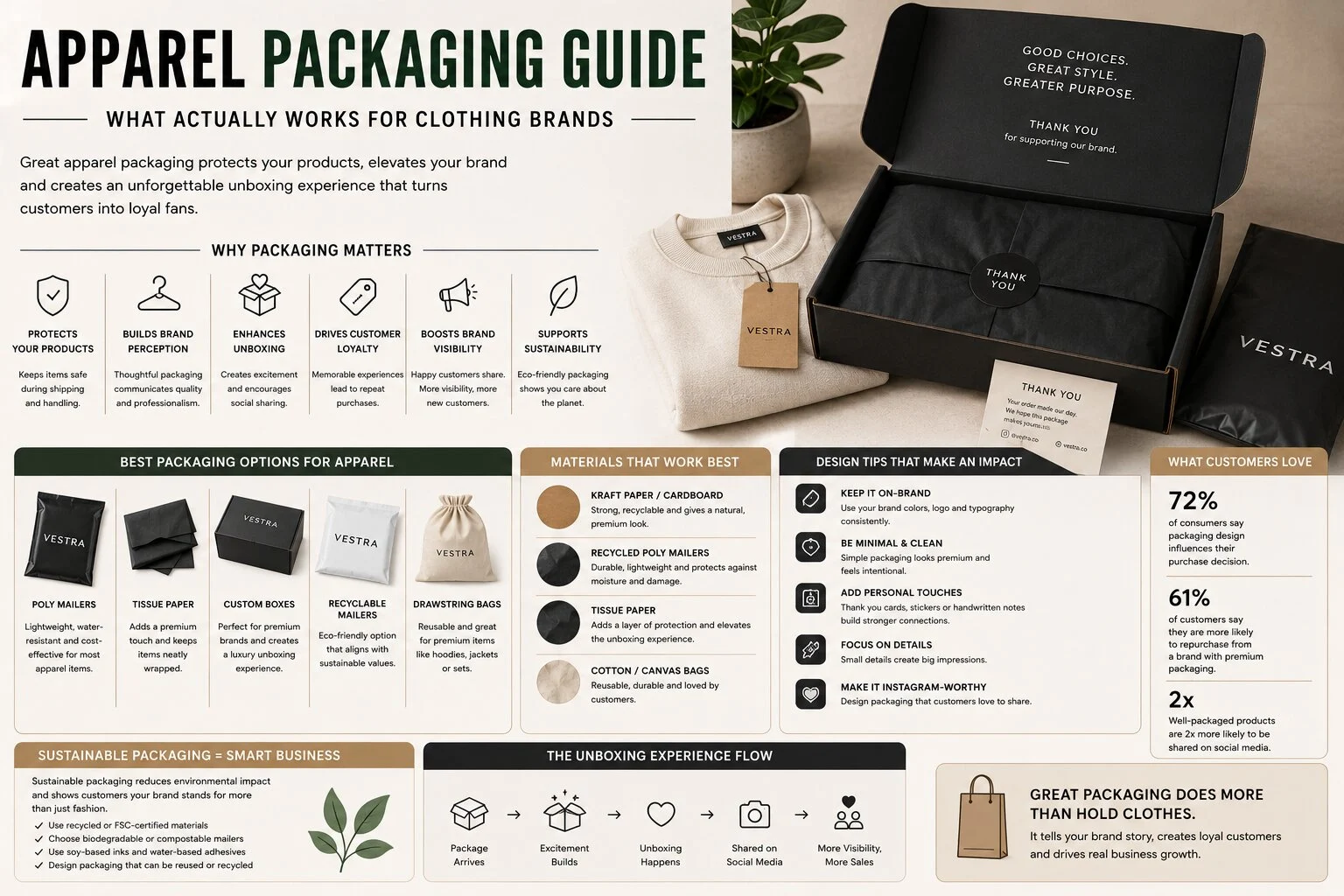
That’s the reality many fashion brands discover as they grow. Apparel packaging isn’t just about getting products from a warehouse to a customer. It’s part of the brand experience.
Fashion unboxing content generates over 5 billion views annually across YouTube and TikTok, making packaging a direct driver of organic brand exposure for clothing brands.
If you’re evaluating apparel packaging, this guide covers what actually works—from boxes versus mailers and garment folding systems to influencer packaging, seasonal collections, wholesale production, and fashion fulfillment strategy.
The Unique Packaging Challenge for Clothing Brands
Fashion brands face packaging challenges that many other industries simply don’t encounter.
A skincare brand ships the same bottle every time.
A candle company may have several vessel sizes.
A clothing brand might ship a t-shirt one day and a heavyweight winter jacket the next.
Wrinkling and Presentation
Garments can arrive looking dramatically different depending on how they’re packed.
A poorly folded garment often arrives with:
- Visible creases
- Distorted presentation
- Reduced perceived quality
Customers notice immediately.
The first impression happens before the garment is even tried on.
Size Variation
Packaging dimensions become complicated quickly.
A slim-fit t-shirt requires completely different packaging than:
- Hoodies
- Denim
- Outerwear
- Multi-item orders
Using one package size for everything rarely works efficiently.
Weight Range
Fashion brands often sell products with enormous weight differences.
For example:
- Baseball cap: lightweight
- Graphic tee: light
- Heavyweight hoodie: moderate
- Winter jacket: heavy
Packaging needs vary accordingly.
Price Point Spread
A $25 t-shirt doesn’t justify the same packaging investment as a $200 premium jacket.
Yet both products should still feel like they come from the same brand.
Finding that balance is one of the biggest challenges in apparel packaging.
The Social Media Expectation
Fashion customers increasingly expect an experience.
Especially in direct-to-consumer ecommerce.
TikTok, Instagram Reels, and YouTube have changed customer expectations.
Today, many shoppers expect the packaging to feel intentional—not just functional.
Apparel Boxes vs Poly Mailers – Which Is Right for Your Brand
This is one of the most common questions fashion founders ask.
The answer depends on your positioning, pricing, and customer expectations.
Poly Mailers
Advantages
- Lightweight
- Low cost
- Water-resistant
- Efficient for bulk apparel shipping
For many businesses, those benefits are significant.
Disadvantages
- Minimal unboxing experience
- Garments arrive folded flat
- Little brand presentation
- Customers can feel underwhelmed
A poly mailer does the job.
It rarely creates excitement.
Corrugated Apparel Boxes
Advantages
- Strong brand presentation
- Better garment organization
- Improved shipping protection
- More memorable unboxing experience
Corrugated structures allow brands to create intentional presentations without moving into luxury packaging budgets.
Disadvantages
- Higher costs
- Larger storage requirements
- Increased shipping weight
Many growing brands find the tradeoff worthwhile.
Rigid Apparel Boxes
Advantages
- Premium presentation
- Excellent structural support
- Reusable packaging
- Outstanding photography performance
These boxes often appear in luxury fashion gifting and influencer campaigns.
Disadvantages
- Significantly higher cost
- Not appropriate for every price point
- More complex fulfillment requirements
When Poly Mailers Still Make Sense
Let’s be honest.
Poly mailers aren’t automatically bad.
They work well for:
- Wholesale apparel shipments
- Budget-focused basics
- High-volume fulfillment
- Brands where packaging isn’t central to the story
When Boxes Become Essential
Boxes often become worthwhile when you’re selling:
- Premium collections
- Limited-edition drops
- Influencer packages
- Subscription apparel
- Gift-focused products
Many brands eventually transition to custom mailer boxes because they balance protection, presentation, and operational efficiency.
Garment Presentation and Folding Systems
This is where apparel packaging becomes unique.
Few product categories spend this much time thinking about folding systems.
But clothing brands should.
Why Presentation Matters
Imagine opening two orders.
The first contains a crumpled shirt inside a plain shipping box.
The second contains a perfectly folded garment wrapped in branded tissue.
Same product.
Completely different first impression.
T-Shirts
Flat Fold
Simple and efficient.
Works well for everyday ecommerce shipments.
Board Folding
Using folding boards creates:
- Sharper edges
- Consistent presentation
- Cleaner photography
Many premium brands use board folding for direct-to-consumer orders.
Hoodies and Sweatshirts
Bulky garments require different handling.
Square Fold
Square folding keeps garments compact while maintaining presentation quality.
Tissue Wrap
Adding tissue immediately improves perceived value.
Ribbon Closures
Particularly effective for gifting and premium apparel collections.
Dresses and Lightweight Garments
These products require special care.
Tissue-Wrapped Flat Fold
Helps reduce creasing.
Avoid Rolling
Rolling may save space, but often creates visible fold lines that customers dislike.
Pants and Bottoms
Waistband-Forward Fold
Creates an instantly recognizable presentation.
Customers immediately understand what’s inside.
Individual Wrapping
Especially useful for multi-item orders.
Why Tissue Matters More Than Many Brands Realize
A common mistake is spending heavily on outer packaging while ignoring interior presentation.
Branded tissue often creates more unboxing impact than expensive structural upgrades.
It’s also significantly more affordable.
Packaging for Different Apparel Brand Positions
Different fashion brands require different packaging strategies.
What works for a luxury label won’t necessarily work for a sustainable basics brand.
Streetwear Brands
Streetwear packaging often benefits from:
- Bold graphics
- Matte corrugated boxes
- Interior all-over printing
- Strong visual branding
These elements translate particularly well to TikTok and Instagram content.
Luxury Fashion Labels
Luxury apparel typically uses:
- Two-piece rigid boxes
- Soft-touch finishes
- Foil logos
- Premium tissue systems
In this category, packaging becomes part of perceived product value.
Sustainable Fashion Brands
Packaging should reinforce environmental positioning.
Popular choices include:
- Kraft corrugated mailers
- Recycled tissue paper
- Minimal printing
- FSC-certified materials
Consistency matters.
Customers expect the packaging to reflect the brand’s values.
Subscription Apparel Services
Subscription brands benefit from:
- Corrugated mailers
- Monthly themed tissue
- Personalized inserts
- Strong interior branding
Many of the same principles discussed in subscription box packaging apply directly to apparel subscription programs.
Direct-to-Consumer Basics
For most growing DTC brands:
- Corrugated mailers
- Exterior logo branding
- Branded tissue
Provide an excellent balance between presentation and efficiency.
Influencer and PR Packaging for Fashion Brands
PR packaging follows different rules than standard ecommerce fulfillment.
The objective isn’t simply delivery.
It’s content creation.
What Makes an Apparel PR Package Worth Filming
Several elements consistently appear in successful influencer sends.
Premium Outer Packaging
The box should immediately communicate brand identity.
Interior Reveal Moments
Products should feel organized rather than simply packed.
Branded Tissue and Ribbon
These details photograph exceptionally well.
Personalized Notes
Handwritten or personalized messages increase engagement.
Clear Garment Arrangement
Products should feel curated.
Not stuffed into a container.
How PR Packaging Creates Organic Content
Influencers naturally focus on experiences that feel intentional.
A well-designed package provides:
- Multiple camera moments
- Better storytelling opportunities
- Stronger visual content
Studies show 52% of consumers say they are more likely to make a repeat purchase from a brand that delivers products in premium packaging.
That’s one reason PR packaging often generates value beyond the initial campaign.
Scaling Without Creating Fulfillment Problems
Many brands overcomplicate PR programs.
A practical approach is creating one premium PR configuration while maintaining a separate ecommerce packaging workflow.
That keeps operations manageable.
Seasonal and Limited Edition Apparel Packaging
Fashion thrives on newness.
Packaging can reinforce that.
Why Seasonal Packaging Works
Limited-edition packaging creates:
- Urgency
- Exclusivity
- Collectability
Customers often share seasonal packaging online because it feels temporary and unique.
Common Seasonal Strategies
Holiday Capsule Collections
Custom holiday graphics and color systems.
Anniversary Editions
Special packaging celebrating milestones.
Collaboration Drops
Co-branded packaging frequently becomes collectible.
Seasonal Color Changes
Simple but effective.
Production Planning Timelines
Plan ahead.
Standard Seasonal Packaging
8–10 weeks.
Collaboration Drops
10–12 weeks.
Anniversary Editions
12–16 weeks.
The earlier planning starts, the more flexibility you have.
Social Media Impact
Limited-edition packaging often becomes part of the conversation itself.
Customers aren’t only sharing the garment.
They’re sharing the experience around the garment.
Wholesale Apparel Packaging – Scaling Fashion Brands
Eventually, growth creates operational complexity.
That’s usually when wholesale packaging becomes attractive.
Signs It’s Time
Consider wholesale apparel packaging when:
- Reordering every 2–3 weeks
- Packaging quality varies between suppliers
- Packaging limits brand storytelling
- Retail expansion is underway
Operational Advantages
Consistent Print Quality
Brand consistency improves.
Better Dimensional Standardization
Shipping becomes more predictable.
Improved Inventory Management
Forecasting becomes easier.
Managing Multiple Garment Categories
Many apparel brands use:
- Small packaging for tees
- Medium packaging for hoodies
- Large packaging for outerwear
This approach balances efficiency and presentation.
Production Timelines
Most wholesale apparel packaging projects require:
- 8–10 weeks for standard production
- Longer timelines for specialty finishes or seasonal projects
Planning inventory early prevents fulfillment disruptions.
Conclusion
Successful apparel packaging balances three priorities: garment protection, brand presentation, and customer experience. Unlike many product categories, fashion brands must also consider folding systems, social media expectations, and the emotional impact of opening an order.
If you’re a direct-to-consumer brand focused on social growth, start with one meaningful upgrade. Branded tissue paper or a logo-printed corrugated box often delivers more value than immediately investing in expensive rigid packaging.
As your business grows, packaging can evolve alongside it. Explore our custom apparel boxes designed for fashion brands, streetwear labels, and clothing subscription services across the United States.