

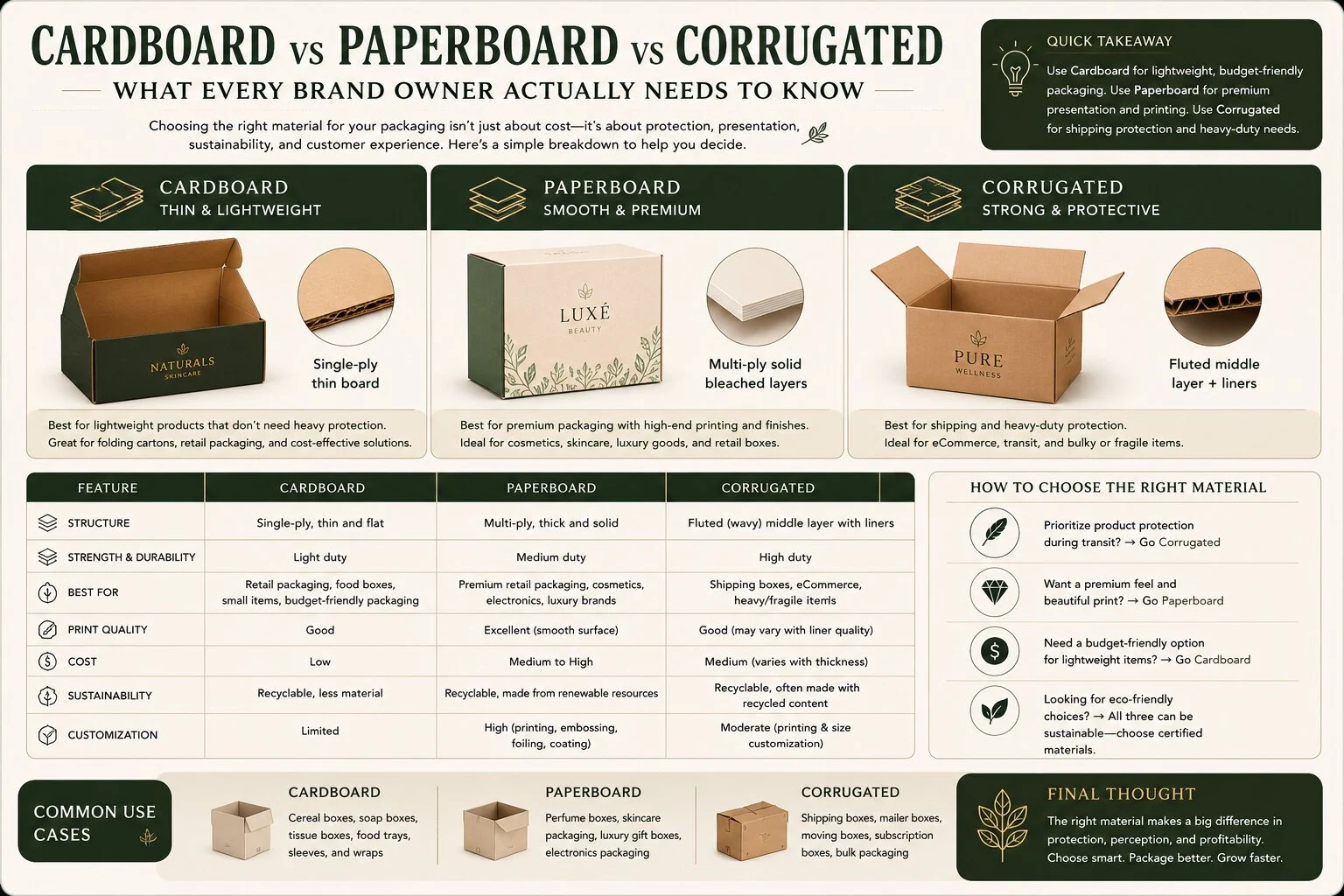
A brand owner recently contacted a packaging supplier with what seemed like a straightforward request.
“We’re looking for custom cardboard boxes for our new product line.”
The supplier replied with a question the brand owner wasn’t expecting:
“Do you mean paperboard cartons, corrugated shipping boxes, or chipboard packaging?”
Silence.
They had no idea there was a difference.
And honestly, that’s completely normal.
“Cardboard” is one of the most commonly misused terms in packaging. It’s often used as a catch-all description for several materials that look similar in photos but perform very differently in the real world.
That confusion can become expensive.
Choosing the wrong material can lead to damaged products, unnecessary packaging costs, disappointing print quality, or packaging that simply doesn’t fit the way your products are sold.
Packaging material selection directly affects both shipping damage rates and customer perception — brands that choose wrong materials often face higher damage rates and lower perceived value simultaneously.
If you’ve ever wondered whether your product needs paperboard, corrugated, or chipboard packaging, this guide will help you understand the differences in plain English.
What People Actually Mean When They Say “Cardboard”
The first thing to understand is that most people aren’t wrong when they say cardboard.
They’re just being imprecise.
Three Different Materials Get Called Cardboard
In everyday conversations, “cardboard” is often used to describe:
- Paperboard (folding cartons)
- Corrugated board (shipping boxes)
- Chipboard (rigid box foundation)
All three are paper-based materials.
All three can appear similar in photographs.
And even packaging professionals occasionally use the terms loosely.
Why the Confusion Exists
Imagine looking at three boxes online.
One is a cosmetic carton.
One is an ecommerce shipping box.
One is a luxury gift box.
To most people, they all look like cardboard.
Structurally, though, they’re completely different.
Why the Difference Matters
Choosing the wrong material can create several problems:
- Packaging failures during shipping
- Higher costs than necessary
- Poor print quality
- Incorrect structural performance
- Customer perception issues
The material should match the job.
A Simple Identification Test
Here’s a quick way to tell them apart.
Paperboard
Can it be flattened and reassembled?
Probably paperboard.
Corrugated
Does it have a visible wavy layer inside?
That’s corrugated.
Chipboard
Does it feel thick, solid, and permanent with no visible layers?
That’s usually a chipboard.
Once you understand these differences, conversations with suppliers become much easier.
Paperboard – The Retail Packaging Workhorse
When most people picture retail packaging, they’re usually looking at paperboard.
What Paperboard Actually Is
Paperboard is a solid paper-based material.
Characteristics include:
- Typically 12–24 point thickness
- Smooth surface
- No fluted inner layer
- Clean folding performance
- Excellent printability
It is manufactured as a single solid sheet rather than a layered structure.
Why Manufacturing Matters
Paperboard is engineered specifically for folding cartons.
Because the surface is smooth and consistent, it accepts printing exceptionally well.
That’s one reason brands love it.
Where Paperboard Performs Best
Paperboard packaging dominates retail shelves.
Common examples include:
- Cosmetic cartons
- Food packaging
- Pharmaceutical boxes
- Consumer electronics packaging
- Personal care products
- Tuck end boxes
Walk through almost any retail store and you’ll see paperboards everywhere.
Why Brands Choose Paperboard
Several advantages make it popular.
Excellent Print Surface
Photography, gradients, and detailed graphics reproduce beautifully.
Fast Assembly
Paperboard cartons work efficiently on automated production lines.
Cost-Effective Production
For large runs, paperboard remains one of the most economical packaging materials available.
Flat Shipping
Before assembly, cartons ship flat and store efficiently.
Paperboard Limitations
No material is perfect.
Paperboard struggles when:
- Products become heavy
- Shipping distances increase
- Moisture exposure becomes significant
This is why many ecommerce brands use paperboard for product presentation and corrugated for shipping protection.
Paperboard Thickness Guide
A practical reference:
12–14pt
Best for:
- Lightweight cosmetics
- Small retail products
16–18pt
Best for:
- Standard retail packaging
- Consumer goods
20–24pt
Best for:
- Premium products
- Heavier retail items
The thicker the board, the stronger the structure.
Corrugated Board – The Shipping Standard
When products need protection, corrugated usually enters the conversation.
What Corrugated Actually Is
Corrugated board uses a layered construction:
- Outer liner
- Inner fluted layer
- Inner liner
That middle fluted layer is the secret.
It’s what creates strength.
Why the Fluting Matters
The wavy layer acts like a built-in shock absorber.
Benefits include:
Compression Strength
Boxes resist crushing during stacking.
Impact Protection
Flutes absorb shock during shipping.
Improved Moisture Resistance
Corrugated generally performs better than paperboard in challenging environments.
Better Stacking Performance
Important for warehousing and shipping.
Where Corrugated Performs Best
Corrugated packaging dominates shipping applications.
Examples include:
- Ecommerce boxes
- Subscription packaging
- Mailer boxes
- Wholesale cartons
- Fragile product packaging
If you’ve ordered something online recently, it probably arrived in corrugated packaging.
Why Corrugated Dominates Shipping
The material offers an excellent balance between protection and weight.
Advantages include:
- Strong protection
- Cost efficiency
- Recyclability
- Shipping performance
Many brands eventually move from standard cartons into custom corrugated boxes as ecommerce sales increase.
For a deeper look at shipping-specific structures, our corrugated packaging guide explores flute types and performance in more detail.
Corrugated Limitations
Corrugated isn’t ideal for every application.
Drawbacks include:
- Heavier weight
- Less refined printing surfaces
- Larger storage requirements
- Less premium presentation
It’s a shipping material first.
A presentation material second.
Sustainability Advantage
Corrugated packaging has the highest recycling rate of any packaging material in the US at over 91%, making it both practical and sustainable.
That’s one reason it remains the preferred shipping material for many ecommerce businesses.
Chipboard – The Rigid Box Foundation
Chipboard occupies a very different category.
This is the material behind luxury packaging.
What Chipboard Actually Is
Chipboard is:
- Thick
- Dense
- Rigid
- Structurally permanent
Unlike paperboard, it isn’t designed to fold repeatedly.
How Rigid Boxes Are Made
The process is different from folding cartons.
The chipboard is:
- Cut to shape
- Permanently assembled
- Wrapped in specialty paper
The visible exterior isn’t usually the chipboard itself.
It’s the decorative wrap applied over it.
Why Chipboard Feels Premium
Several factors contribute.
Weight
Customers associate weight with quality.
Structural Permanence
The box maintains its shape.
No Visible Fold Lines
This creates a cleaner appearance.
Premium Surface Finishes
Wrapped papers provide a refined tactile experience.
Where Chipboard Performs Best
Chipboard is commonly used for:
- Luxury packaging
- Premium gift boxes
- Electronics packaging
- Jewelry boxes
- High-end cosmetics
Many luxury brands rely on custom rigid boxes because the material immediately communicates value.
Chipboard Limitations
There are tradeoffs.
Chipboard is:
- More expensive
- Heavier
- Less storage-efficient
- Unable to ship flat
For everyday retail products, it often represents unnecessary cost.
Choosing the Right Material – Practical Decision Framework
This is the section most buyers actually need.
Use Paperboard When:
Choose paperboard for:
- Retail shelf packaging
- Food cartons
- Cosmetic products
- Consumer goods
- Products under $40–$50
- High-volume production
Paperboard remains the standard for most retail packaging.
Use Corrugated When:
Choose corrugated for:
- Ecommerce shipping
- Subscription boxes
- Fragile products
- Heavy products
- Long-distance shipping
- Wholesale distribution
Protection becomes the priority here.
Use Chipboard When:
Choose chipboard for:
- Premium gift packaging
- Products above $50–$75
- Luxury positioning
- Reusable packaging
- Corporate gifting
Presentation becomes the priority.
Questions to Ask Suppliers
Communicate clearly by asking:
For Paperboard
- What point weight is the board?
For Corrugated
- What flute type is being used?
For Chipboard
- What density or thickness is the board?
These questions immediately improve supplier conversations.
How Material Affects Print Quality
Material selection affects appearance just as much as structure.
Paperboard Print Quality
Paperboard provides:
- Sharp graphics
- Excellent color reproduction
- Fine detail capability
- Consistent print performance
It’s often the best choice for products featuring photography.
Corrugated Print Quality
Corrugated surfaces are naturally textured.
Characteristics include:
- Slightly softer graphics
- Excellent logo reproduction
- Strong branding performance
Modern digital printing has improved corrugated quality dramatically.
E-flute corrugated, in particular, can approach paperboard-level print quality.
Chipboard Print Quality
Remember:
Printing happens on the wrap, not the chipboard itself.
Advantages include:
- Premium finishes
- Superior foil stamping
- Excellent embossing results
- Luxury appearance
This is why premium brands frequently choose chipboard-based packaging.
Matching Material to Design Needs
A practical guide:
Complex photography
→ Paperboard
Simple logos and text
→ Paperboard or corrugated
Luxury finishes
→ Chipboard or premium coated paperboard
Design requirements should influence material decisions just as much as structural requirements.
Sustainability Across Materials
Many brands now evaluate packaging through a sustainability lens.
Each material performs differently.
Paperboard
Benefits include:
- Widely recyclable
- Often FSC-certified
- Uses relatively little material
Excellent for minimizing packaging footprint.
Corrugated
Advantages include:
- Highest recycling rates
- Recycled content availability
- Biodegradability
Ideal for shipping-focused sustainability goals.
Chipboard
The chipboard uses more material initially.
However, many customers keep and reuse rigid boxes.
That extended lifespan changes the sustainability conversation.
Choosing Based on Sustainability Goals
A simple framework:
High-volume shipping + recycling focus
→ Corrugated
Minimal material usage
→ Paperboard
Reusable packaging
→ Chipboard
FSC Certification
All three material categories can be sourced with FSC-certified options, making responsible sourcing possible regardless of structure.
Conclusion
If you’re trying to simplify material selection, remember this framework:
Retail products → Paperboard
Shipping products → Corrugated
Premium gifting → Chipboard
Understanding these differences helps you communicate more effectively with suppliers, avoid costly packaging mistakes, and select materials that match the way your products are actually sold and shipped.
Explore our custom cardboard boxes across paperboard, corrugated, and rigid chipboard formats for retail and ecommerce brands across the United States.