

An ecommerce brand launched a new product line and assumed all shipping boxes were essentially the same.
The team compared prices, selected the cheapest packaging supplier, and shipped roughly 500 orders.
A few weeks later, customer service tickets started arriving.
Corners were crushed.
Products had shifted inside boxes.
Some orders arrived with visible damage.
The surprising part? The products weren’t particularly fragile.
The issue wasn’t the product.
It was the packaging structure.
The boxes simply weren’t designed for real-world shipping loads.
This is one of the most common mistakes growing ecommerce brands make. Many business owners see corrugated packaging boxes as simple cardboard containers when, in reality, structural choices can dramatically affect shipping performance, product protection, fulfillment costs, and customer satisfaction.
Ecommerce returns cost US businesses over $800 billion annually and packaging failures remain one of the largest contributors to avoidable shipping damage.
If you’re shipping products regularly, understanding the basics of corrugated packaging isn’t optional. It helps you reduce damage rates, improve customer experience, and avoid expensive mistakes that become increasingly costly as order volume grows.
What Makes Corrugated Different from Standard Cardboard
Many people use the terms interchangeably.
Technically, they’re not the same thing.
Standard Cardboard
Standard cardboard typically consists of a single flat paperboard layer.
It’s lightweight and useful for many retail applications, but it provides limited protection against shipping impacts.
Corrugated Packaging
Corrugated packaging uses a completely different structure.
It contains:
- An outer liner
- An inner fluted layer
- Another liner sheet
The fluted layer sits between the two flat surfaces.
That middle layer is what creates the strength.
Why the Fluted Layer Matters
The flute performs several important functions simultaneously.
Absorbs Impact Energy
When packages experience drops or impacts, the flute helps absorb force before it reaches the product.
Creates Air Cushioning
The spaces inside the flute act like miniature shock absorbers.
Resists Compression
Boxes often spend hours or days stacked beneath other packages.
The flute helps maintain structural integrity under pressure.
Maintains Shape During Shipping
Corrugated materials resist crushing significantly better than flat cardboard.
The Weight-to-Strength Advantage
One reason corrugated remains the dominant ecommerce packaging material is its impressive strength-to-weight ratio.
Compared to standard cardboard, corrugated cardboard boxes provide dramatically better protection while remaining relatively lightweight.
That’s important because shipping carriers charge based on both weight and dimensions.
Why Ecommerce Brands Should Care
A typical package may experience:
- Conveyor impacts
- Truck vibration
- Warehouse stacking
- Sorting system drops
- Moisture exposure
Corrugated box packaging is specifically designed to handle those conditions.
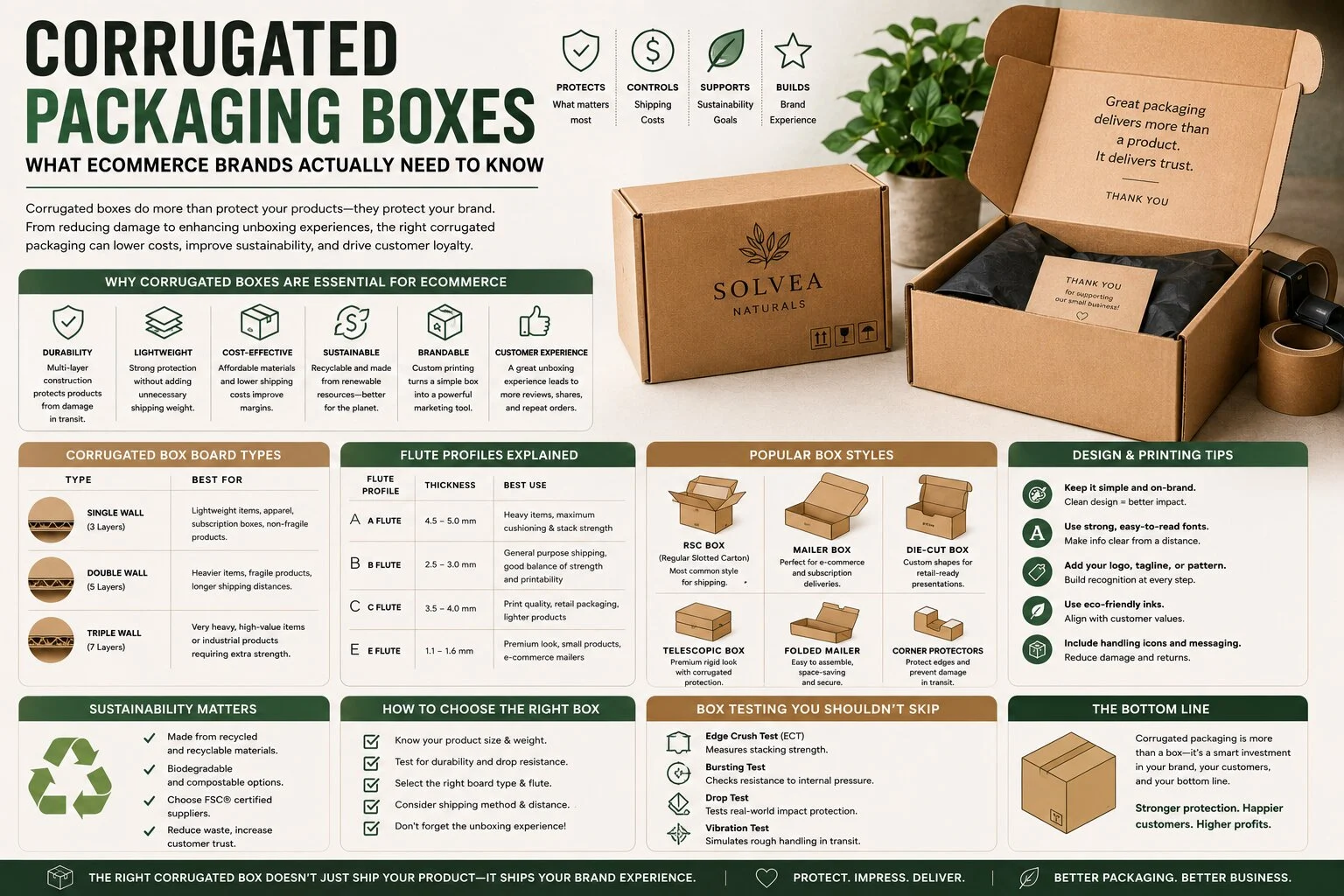
Corrugated Flute Types – Which Does Your Product Need?
Most packaging guides stop at “use corrugated.”
That’s not enough.
The flute profile significantly affects protection, print quality, and cost.
A-Flute
A-Flute is the largest common flute profile.
Best for:
- Glass products
- Ceramics
- Electronics
- Fragile products
Advantages:
- Excellent cushioning
- Strong impact resistance
- Enhanced compression performance
Use when:
Maximum protection is more important than premium printing quality.
B-Flute
B-Flute is smaller and denser than A-Flute.
Best for:
- Retail packaging
- Canned products
- Smaller ecommerce shipments
Advantages:
- Good puncture resistance
- Strong retail performance
- Efficient storage
B-Flute is commonly used in retail-ready corrugated packaging.
C-Flute
If there is a workhorse of ecommerce packaging, this is it.
Best for:
- Ecommerce shipping
- Subscription boxes
- General consumer products
Advantages:
- Balanced protection
- Good printability
- Cost efficiency
Most ecommerce brands should begin their evaluation with C-Flute.
E-Flute
E-Flute is much thinner.
Best for:
- Premium product boxes
- Cosmetic packaging
- Retail cartons
Advantages:
- Cleaner printing surface
- Better graphics reproduction
- Premium appearance
This flute is often chosen when branding matters as much as protection.
F-Flute
F-Flute is extremely fine.
Best for:
- Small retail products
- Point-of-purchase displays
- Lightweight products
Advantages:
- Smooth print surface
- High-quality graphics
- Compact profile
Double-Wall Corrugated
Double-wall combines two flute layers.
Best for:
- Heavy products
- International shipping
- Long-distance ecommerce
Advantages:
- Exceptional strength
- Improved impact resistance
- Better compression performance
Questions to Ask Your Supplier
Before approving packaging, ask:
- Which flute profile is being used?
- What is the board grade?
- Is it single-wall or double-wall?
- What weight range is it designed for?
These questions prevent expensive assumptions later.
Single Wall vs Double Wall vs Triple Wall Corrugated
Flute selection matters.
Wall construction matters just as much.
Single Wall Corrugated
A single wall contains one fluted layer.
Best for:
- Most ecommerce products under 20 lbs
- Retail packaging
- Subscription shipments
Advantages:
- Lightweight
- Cost-effective
- Widely available
For many businesses, a single wall is sufficient.
Double Wall Corrugated
The double wall contains two fluted layers.
Best for:
- Fragile products
- Glass containers
- International shipments
- Heavier products
Advantages:
- Noticeably stronger
- Better stacking performance
- Improved protection
Triple Wall Corrugated
The triple wall uses three flute layers.
Best for:
- Industrial products
- Extremely heavy items
- High-risk shipping environments
It’s rarely necessary for standard ecommerce brands.
When Double Wall Delivers Real Value
Upgrade to double wall when:
- Product weight exceeds 20 lbs
- Damage rates exceed 2–3%
- International shipping volume increases
- Products contain glass or ceramics
The additional material cost is often significantly lower than replacement costs.
Cost vs Protection
One replacement shipment often costs more than upgrading dozens of boxes.
That’s why protection decisions should always be evaluated against actual damage expenses.
Custom Printed Corrugated Packaging
Protection matters.
So does presentation.
How Corrugated Handles Printing
Corrugated materials support several printing methods, but not all techniques perform equally.
Flexographic Printing
This remains the most common method.
Advantages:
- Cost-efficient
- Fast production
- Suitable for large runs
Best for:
- Logos
- Simple branding
- One to four-color designs
Many custom corrugated boxes use flexographic printing because it balances quality and affordability.
Digital Printing
Digital printing offers greater graphic precision.
Advantages:
- Detailed graphics
- Cleaner color reproduction
- Small-run flexibility
Best for:
- Ecommerce brands
- Limited editions
- Highly visual packaging
The tradeoff is higher per-unit cost.
How Flute Type Affects Print Quality
Not all flutes print equally.
Best Printing Surfaces
- E-Flute
- F-Flute
These profiles create smoother surfaces.
Rougher Printing Surfaces
- A-Flute
- C-Flute
The deeper flute structure can slightly affect graphic sharpness.
Finishing Options
Popular upgrades include:
- Matte lamination
- Gloss lamination
- Spot UV
- Kraft exterior with printed interior
Interior vs Exterior Printing
Exterior branding builds recognition.
Interior branding enhances unboxing.
For ecommerce brands focused on customer experience, interior printing often creates a stronger emotional impact than many expect.
This is especially true for brands using custom mailer boxes where customers immediately see the interior after opening.
Corrugated Packaging for Different Ecommerce Categories
Different products require different solutions.
Beauty and Cosmetics
Recommended:
- C-Flute corrugated mailers
- Foam inserts
- Die-cut inserts
Glass containers require stability.
Food Products
Recommended:
- Moisture-resistant corrugated
- E-Flute retail cartons
Protection and presentation must work together.
Electronics
Recommended:
- Double-wall C-Flute
- Foam inserts
Product movement should be eliminated entirely.
Apparel
Recommended:
- Single-wall corrugated mailers
Clothing tolerates movement well but benefits from branded presentation.
Subscription Boxes
Recommended:
- C-Flute corrugated
This category often benefits from the same structural principles discussed in subscription box packaging because contents frequently vary between shipments.
CBD and Wellness
Recommended:
- C-Flute
- Foam inserts for tinctures
Glass bottles require additional protection.
Candles
Recommended:
- Double-wall corrugated
- Foam inserts
Heavy glass vessels and delicate wax surfaces create unique shipping challenges.
Corrugated vs Rigid Packaging – When to Use Each
Many brands eventually compare these two options.
Corrugated Packaging
Best for:
- Ecommerce shipping
- Subscription programs
- High-volume fulfillment
Advantages:
- Lightweight
- Strong
- Cost-effective
- Recyclable
Disadvantages:
- Less premium presentation
Rigid Packaging
Best for:
- Luxury products
- Retail display
- Premium gifting
Advantages:
- Elevated presentation
- Strong perceived value
- Reusable structure
Disadvantages:
- Higher cost
- Increased weight
- Less shipping efficiency
When Using Both Makes Sense
Many premium brands use:
- Outer corrugated shipping box
- Inner rigid presentation box
This approach combines protection with luxury presentation.
Sustainable Corrugated Packaging
Corrugated packaging already offers several environmental advantages.
Why Corrugated Performs Well
Most corrugated materials contain:
- Recycled content
- Renewable fiber sources
They are also:
- Widely recyclable
- Biodegradable
- Material-efficient
FSC-Certified Corrugated
Many suppliers offer FSC-certified options.
This helps brands communicate responsible sourcing practices.
Sustainability Messaging
Simple messaging can help customers recycle properly.
Examples include:
- Recycling instructions
- Material information
- FSC certification references
The Recycling Advantage
Corrugated packaging has one of the highest recycling rates of any packaging material, with over 91% of corrugated boxes recycled in the United States.
That’s one reason many ecommerce brands prioritize corrugated materials when evaluating sustainability initiatives.
Conclusion
Choosing the right corrugated packaging boxes isn’t about selecting the strongest option available. It’s about matching protection levels to your product weight, fragility, shipping distance, and customer experience goals.
For most ecommerce businesses, a C-Flute single-wall structure provides the best starting point because it balances cost, protection, and print quality. If damage rates begin exceeding 2–3%, that’s usually the signal to evaluate double-wall construction, upgraded inserts, or revised box dimensions.
The best packaging decisions are based on data, not assumptions. Track damage rates, review customer feedback, and adjust accordingly.
Explore our custom corrugated boxes in multiple flute configurations and print formats for ecommerce brands across the United States.