

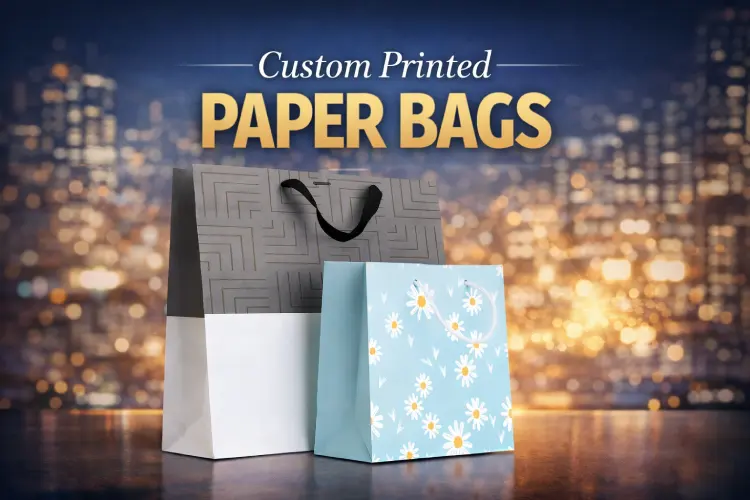
Custom printed paper bags are branded retail or gift bags manufactured from kraft paper, white art paper, or recycled paperboard, printed with a business’s logo, brand colors, and design, and used across retail stores, restaurants, boutiques, e-commerce, and events in the USA. They serve simultaneously as functional carry-out packaging and as mobile brand advertising — displaying a business’s identity to everyone who sees the bag in use.
According to a 2023 Ipsos consumer research study commissioned by Two Sides North America, 67% of US consumers prefer paper bags over plastic alternatives, and 63% say they reuse paper shopping bags after their initial purpose — extending the brand exposure of every bag well beyond the point of purchase. For businesses looking to build brand recognition, communicate sustainability values, and deliver a professional customer experience, custom printed paper bags are one of the highest-return packaging investments available.
This complete guide covers everything you need to know — from paper types, handle styles, and printing methods, to industry applications, design strategy, sustainable options, wholesale ordering, and a step-by-step process to get your custom paper bags produced and delivered.
What Are Custom Printed Paper Bags?
Custom printed paper bags are retail or gift carry bags made from paper-based materials — most commonly kraft paper or white art paper — manufactured to specified dimensions and printed with a brand’s logo, colors, and design elements. They are used by retail stores, restaurants, boutiques, salons, corporate events, and e-commerce brands as branded customer-facing packaging.
Unlike generic brown or white paper bags, custom printed paper bags are purpose-designed around a brand’s visual identity. Every element — the paper material, bag dimensions, handle type, print method, colors, and any additional finishes — is specified by the brand to create a consistent, professional, and memorable packaging experience.
Custom printed paper bags differ from standard stock bags in three key ways: they carry the brand’s visual identity instead of being anonymous; they are sized to fit the brand’s specific products rather than being generic dimensions; and they communicate quality and brand investment to the customer at the point of purchase and beyond.
Key Custom Paper Bag Terms You Need to Know
Kraft Paper: Paper produced through the kraft chemical pulping process, using wood pulp treated with sodium hydroxide and sodium sulfide. Results in a naturally brown, high-strength paper with excellent tear resistance. The most widely used material for retail paper bags in the USA. Available in natural brown (unbleached) and white (bleached) variants.
GSM (Grams per Square Meter): The standard unit for measuring paper weight. Higher GSM equals thicker, heavier, stronger paper. Retail paper bags typically range from 100 GSM (lightweight) to 200 GSM (heavy-duty). A 120–150 GSM bag is standard for most retail applications.
Twisted Paper Handle: A rope-like handle made from twisted kraft or coated paper, glued or stapled to the inside of the bag. The most common handle type for retail paper bags. Available in matching or contrasting colors. Strong enough to carry most retail products.
Flat Paper Handle: A flat strip of paper or card laminated to the bag’s upper edge. More economical than twisted handles and commonly used for lightweight bags such as bakery bags, gift bags, and promotional event bags.
Ribbon Handle: A fabric or satin ribbon threaded through punched holes at the top of the bag. Creates a premium, gift-ready appearance. Popular for boutique retail, luxury brands, and high-end gifting applications.
Die-Cut Handle: A handle cut directly into the bag’s paper material — no separate handle attached. The simplest and most economical handle style, formed by a die-cut opening near the top of the bag. Widely used for grocery and food retail bags.
CMYK Printing: The standard four-color printing process using cyan, magenta, yellow, and black inks. Used for full-color logos, photographs, and complex multi-color designs on paper bags.
PMS (Pantone Matching System): A standardized color system that ensures precise color reproduction across production runs. Critical for brands where specific brand colors — particularly on retail bags produced in multiple runs — must match exactly.
Flexographic Printing: A high-speed rotary printing process using flexible relief plates and fast-drying inks. The most cost-effective printing method for large-volume paper bag production. Best for simple logos and limited color designs.
Digital Printing: A printing process that transfers digital files directly to the bag surface without printing plates. The most flexible method for short runs, variable data, and prototype production. Higher per-unit cost than flexographic but no plate setup fees.
Offset Printing: A high-quality printing process that transfers ink from a plate to a rubber blanket and then to the bag surface. Produces the highest color accuracy and detail of any printing method. Best for premium retail bags with complex designs.
Lamination: A thin film applied to the outer surface of the paper bag for protection and finish enhancement. Available in gloss, matte, and soft-touch variants. Lamination improves moisture resistance, durability, and tactile quality — and is the base for additional decorative finishes.
Spot UV Coating: A high-gloss varnish applied selectively over specific design elements — typically a logo or brand mark — on an otherwise matte laminated surface. Creates a striking visual contrast between gloss and matte areas.
Foil Stamping: A decorative process that applies metallic or pigmented foil to the bag surface using heat and pressure. Gold, silver, rose gold, and holographic foils are commonly used on premium retail paper bags.
Side Gusset: An expandable fold on the side of a paper bag that allows the bag to open wider and accommodate bulkier products. Standard on most retail shopping bags.
Bottom Gusset: An expandable fold at the base of the bag that creates a flat, stable bottom when the bag is filled. Also known as a flat-bottom or square-bottom construction. Provides better stability than a non-gusseted design.
Why Custom Printed Paper Bags Are Essential for Retail Businesses
Custom printed paper bags are essential for retail businesses because they function simultaneously as functional customer packaging, mobile brand advertising, and a tangible signal of brand quality and sustainability commitment — delivering marketing value that extends far beyond the point of purchase.
A 2022 study by the Paper Bag Partnership found that a single branded paper bag generates an average of 976 brand impressions during its usable life — more than most digital advertising formats at a comparable cost per impression. For businesses that invest in well-designed, quality-printed paper bags, this represents a sustained, ongoing return on packaging investment that continues every time a customer reuses the bag.
Here is why custom printed paper bags outperform generic alternatives across every metric that matters to a retail business:
Mobile Brand Advertising at Zero Ongoing Cost
Every time a customer carries your branded bag through a street, shopping center, office building, or public space, your logo and brand identity is visible to everyone around them. Unlike digital advertising that stops the moment you stop paying, a quality paper bag continues delivering impressions for weeks or months after the initial purchase.
Immediate Signal of Brand Quality
The quality of your packaging communicates the quality of your products before a word is spoken. A well-designed, premium-material paper bag tells every customer — and everyone who sees them carrying it — that this brand takes its presentation seriously. Conversely, a flimsy generic bag undercuts the perceived value of even excellent products.
Sustainability Alignment with Consumer Values
Paper bags are the packaging format most strongly associated with environmental responsibility in the US consumer market. A 2023 Two Sides North America survey found that 68% of US consumers view paper bags as more environmentally responsible than plastic alternatives. For brands that communicate sustainability as a core value, custom printed paper bags are the most visible proof point available.
Reuse Extends Brand Exposure
Unlike plastic bags that are typically discarded, paper bags — particularly those with sturdy handles and attractive designs — are reused by consumers for storage, gifting, and secondary carry purposes. Every reuse extends brand exposure without additional cost.
Professional Customer Experience at Checkout
The checkout or dispatch moment is the last physical interaction a customer has with your brand during a purchase. Presenting their items in a branded paper bag creates a professional, complete brand experience — and sends them out into the world as an involuntary brand ambassador.
Types of Custom Printed Paper Bags
The main types of custom printed paper bags are retail shopping bags, boutique bags with ribbon handles, flat-bottom grocery bags, merchandise bags, food and restaurant bags, and luxury gift bags — each suited to different industries, product weights, and brand aesthetics.
Retail Shopping Bags with Twisted Handles
The most widely used format for fashion retail, boutiques, cosmetics stores, and general merchandise. A paper bag with side and bottom gussets for capacity and stability, and twisted paper handles for strength and comfort. Available in a wide range of sizes from small (for jewelry and accessories) to extra-large (for apparel and bulkier goods).
Best for: Fashion retail, boutiques, cosmetics, accessories, gifts, general merchandise.
Boutique Bags with Ribbon Handles
A premium retail bag format with fabric or satin ribbon handles threaded through punched holes. Creates a gift-ready, luxury appearance that elevates the perceived value of the purchase. Popular with independent fashion boutiques, jewelry stores, cosmetic studios, and premium lifestyle brands.
Best for: Luxury retail, jewelry, premium cosmetics, lifestyle brands, gifting occasions.
Flat-Bottom (Square-Bottom) Grocery and Food Bags
A paper bag with a fully flat, square base that stands upright when filled. The most stable bag format for food retail, grocery, organic produce, specialty food, and restaurant carry-out. Side gussets expand to accommodate bulky or irregularly shaped food items.
Best for: Grocery retail, organic food stores, specialty food, bakeries, restaurants, meal kit carry-out.
Die-Cut Handle Bags
A simple, cost-effective bag format with a handle cut directly into the upper edge of the bag paper. No separate handle material required. Widely used for grocery, food service, promotional events, and situations where cost efficiency is the priority.
Best for: High-volume grocery and food retail, promotional events, trade shows, giveaways.
Merchandise Bags (Small Format)
Compact paper bags in small sizes — typically 6 to 10 inches — used for jewelry, cosmetics, small accessories, and single-item purchases. Often used as an alternative to small gift boxes for boutique retail. Frequently produced in premium finishes with foil stamping or spot UV.
Best for: Jewelry, cosmetics, accessories, stationery, single-item boutique purchases.
Luxury Gift Bags
A high-end paper bag format — typically rigid or semi-rigid — with premium ribbon handles, tissue paper lining, and premium decorative finishes including foil stamping, embossing, and spot UV. Used for luxury retail, corporate gifting, event branding, and high-value product launches.
Best for: Luxury retail, corporate gifting, product launches, seasonal premium gifting, event branding.
Restaurant and Food Service Bags
Grease-resistant paper bags designed for food service carry-out and delivery. Available with flat or twisted handles and in a range of sizes for single meals, family orders, and catering. Can be custom printed with restaurant branding, menu highlights, and sustainability messaging.
Best for: Restaurants, cafes, food delivery, catering, food halls, ghost kitchens.
Choosing the Right Paper Material for Custom Printed Bags
The right paper material for custom printed bags depends on your brand aesthetic, required print quality, product weight, and sustainability priorities. The primary options are natural kraft, white kraft, white art paper, and recycled paper.
| Material | Color | Print Quality | Strength | Sustainability | Best For |
|---|---|---|---|---|---|
| Natural Brown Kraft | Brown | Good (white ink base for color) | Excellent | Very good — recyclable, biodegradable | Organic food, artisan brands, eco retail |
| White Kraft | White | Excellent — full color | Very good | Good — recyclable | Fashion, cosmetics, premium retail |
| White Art Paper | Bright white | Excellent — photographic quality | Good | Moderate — coating affects recycling | Luxury retail, premium gifting |
| Recycled Kraft | Grey-brown | Good | Good | Best — post-consumer content | Sustainability-committed brands |
| Laminated Art Paper | White/custom | Excellent | Excellent | Lower — lamination limits recycling | Luxury, premium retail |
Paper Weight Guide for Retail Bags
- 90–110 GSM: Lightweight bags for small items, jewelry, accessories, and promotional giveaways
- 120–150 GSM: Standard retail weight — suitable for most fashion, cosmetics, and general merchandise
- 150–180 GSM: Heavy-duty retail bags for apparel, bulkier goods, and premium boutique applications
- 180–200 GSM: Maximum weight for luxury and gift bags requiring maximum rigidity and presence
Printing Methods for Custom Paper Bags
The right printing method for custom paper bags depends on your order volume, design complexity, and budget. Flexographic printing is most cost-effective for large volumes; digital printing for small runs and variable designs; and offset printing for the highest color accuracy and detail.
Flexographic Printing
A high-speed rotary process using flexible printing plates and fast-drying inks. The industry standard for high-volume paper bag production. Most cost-effective for runs of 1,000 bags or more with relatively simple designs. Available in 1–6 colors. Not suitable for photographic imagery or complex gradients.
Best for: High-volume retail bags with logos and simple brand color designs.
Digital Printing
Transfers digital files directly to the bag surface without printing plates. No plate setup costs make it the most accessible option for small runs, short-run testing, and variable data printing. Higher per-unit cost than flexographic but maximum flexibility for design changes and small quantities.
Best for: Small runs under 500 bags, prototype production, seasonal limited editions, variable personalizations.
Offset Printing
Transfers ink from a plate to a rubber blanket and then to the bag surface. Produces the highest color accuracy and finest detail of any printing method. Used for premium retail bags with complex designs, photographic imagery, and brand-critical color matching.
Best for: Premium boutique bags, luxury retail bags, high-detail photographic designs.
Screen Printing
Pushes ink through a mesh stencil directly onto the bag surface. Produces vivid, opaque colors and is highly effective for simple, bold designs. Particularly popular for natural kraft bags where opaque white or colored inks are required against the brown surface.
Best for: Bold logo designs on kraft bags, specialty retail, artisan brand packaging.
Handle Types: Choosing the Right Handle for Your Custom Paper Bags
The handle type on a custom paper bag significantly affects its perceived quality, carrying comfort, weight capacity, and cost. The five main handle types are twisted paper, flat paper, ribbon, die-cut, and rope handles.
Twisted Paper Handles
Rope-like handles made from twisted kraft or coated paper. The most common handle for standard retail shopping bags. Strong enough to carry 5–10 lbs comfortably. Available in natural kraft, white, black, and custom brand colors. Glued or stapled to the inside of the bag upper edge.
Weight capacity: Up to 10 lbs depending on paper weight and handle diameter.
Flat Paper Handles
Flat strips of paper or laminated card attached to the bag’s upper edge. More economical than twisted handles. Suitable for lighter loads and shorter carry distances. Common in bakery, food, and promotional bags.
Weight capacity: Up to 5 lbs.
Ribbon Handles
Fabric or satin ribbon threaded through punched holes near the top of the bag. Creates a premium, gift-ready appearance. Ribbon color can be coordinated with brand colors for maximum visual impact. Comfortable to carry and visually distinctive.
Weight capacity: Up to 8 lbs depending on ribbon width and attachment method.
Die-Cut Handles
A handle opening cut directly into the top of the bag paper. The simplest and most economical option. No separate material or attachment process. Comfortable for lightweight bags but not suitable for heavy loads.
Weight capacity: Up to 3–4 lbs.
Cotton Rope Handles
Premium handles made from twisted or braided cotton cord. The most durable and comfortable handle option. Associated with luxury retail, high-end boutiques, and premium brand positioning. Available in natural, white, black, and custom dyed colors.
Weight capacity: Up to 15 lbs.
Finishing Options That Elevate Custom Printed Paper Bags
Lamination
Applying a thin protective film to the outer surface of the printed bag. Matte lamination creates a sophisticated, non-reflective finish. Gloss lamination creates vibrancy and moisture resistance. Soft-touch lamination creates a velvety, premium tactile quality — one of the most effective premium signals available for retail paper bags.
Foil Stamping
Metallic foil — gold, silver, rose gold, copper, or holographic — applied to logos or design accents using heat and pressure. Highly effective on both white and kraft bag surfaces. Gold foil on a matte white or kraft bag is one of the most recognizable premium retail bag aesthetics.
Embossing and Debossing
Raises (embossing) or recesses (debossing) a design element into the bag surface for a three-dimensional tactile effect. Effective on laminated bag surfaces where the texture creates a subtle luxury detail.
Spot UV Coating
High-gloss varnish applied selectively over specific design elements on a matte surface. The contrast between gloss and matte areas draws attention to logos and key graphic elements with minimal additional cost.
Hot Stamping Without Foil (Blind Emboss)
A logo or pattern embossed into the bag surface without foil or ink — visible only through texture and reflected light. A subtle luxury detail used by premium brands that prefer restraint over display.
Industry Applications for Custom Printed Paper Bags
Custom printed paper bags are used across fashion and apparel, food and restaurant, cosmetics and beauty, luxury retail, corporate events, grocery, artisan and handmade products, and e-commerce brand activation — anywhere professional branding, customer experience, and sustainability credentials create business value.
Fashion and Apparel Retail
The largest single application for custom printed paper bags in the USA. Fashion retailers use branded bags to extend the in-store brand experience to the street, create desire for their brand among non-customers who see the bags in use, and signal the quality of their merchandise through packaging quality.
Food, Restaurant, and Bakery
Grease-resistant custom printed bags for restaurants, cafes, bakeries, specialty food retailers, and food halls. Food-service paper bags communicate freshness, brand identity, and sustainability simultaneously — particularly important as consumers increasingly favor restaurants that have replaced plastic with paper alternatives.
Cosmetics and Beauty
Boutique paper bags with ribbon handles are a standard format for cosmetics stores, salons, spas, and beauty retailers. The premium handle type, combined with foil-stamped logos and matte lamination, creates a luxury carry experience that reinforces the brand’s quality positioning.
Luxury and Premium Retail
Luxury retailers use rigid or semi-rigid laminated paper bags with cotton rope handles, premium foil stamping, and matte or soft-touch finishes. The bag itself communicates the brand’s luxury positioning before the product is seen — an essential part of the overall customer experience for high-end brands.
Corporate Events and Branded Merchandise
Custom printed paper bags for conferences, trade shows, product launches, employee appreciation events, and corporate gifting. Bags branded with event or company identity serve as functional giveaway packaging and ongoing brand exposure tools for every attendee.
Grocery and Organic Food Retail
Natural kraft paper bags for grocery, organic food, and specialty food retail. Communicates environmental responsibility, natural product quality, and brand identity simultaneously. Increasingly used by independent grocers and organic food brands as a replacement for plastic carrier bags.
Artisan and Handmade Products
Natural kraft or recycled paper bags for handmade soap, artisan food, handcrafted accessories, and farmers market products. The natural texture of kraft paper complements handmade product aesthetics and communicates craftsmanship, authenticity, and environmental consciousness.
Custom Paper Bag Design Strategy: What Works in 2025
The most effective custom printed paper bag designs in 2025 prioritize bold, legible logo placement on a clean background, use one premium finish element — foil, soft-touch, or spot UV — as a statement rather than layering multiple techniques, and treat the bag as a mobile billboard rather than a secondary packaging afterthought.
Design for Visibility at Distance
Unlike packaging that is viewed up close, paper bags are often seen from a distance — across a store, in a crowd, or across a street. Design your bag with high-contrast, large-scale logo placement that is readable from 10 to 20 feet. Intricate fine-detail designs that look impressive in a design file may be invisible in real-world use.
Match Handle Color to Brand Identity
The handle color is a significant design detail that many brands overlook. A natural kraft bag with a black twisted handle, a white bag with a gold ribbon, or a navy bag with a white cotton rope — each combination creates a different brand impression. Coordinate handle color with your brand palette rather than defaulting to the standard brown or white option.
Use the Full Bag Surface
All four sides of a retail paper bag are visible to different audiences at different moments. Design artwork for the front and back panels as primary brand surfaces, and consider using the side gusset panels for secondary branding elements, sustainability messaging, or brand story copy.
Sustainability Messaging on the Bag Itself
Brands that communicate their packaging’s eco-credentials directly on the bag — material sourcing, recyclability instructions, FSC certification mark, recycled content percentage — build trust with environmentally conscious consumers and differentiate from competitors using generic materials without disclosure.
Seasonal and Limited Edition Runs
The combination of digital printing (low minimum quantities) and fast turnaround makes seasonal limited-edition paper bags practical for most retail businesses. Holiday editions, seasonal color variants, and event-specific designs create urgency and freshness without committing to year-round inventory of a single design.
Custom Printed Paper Bags and Sustainability: What Brands Need to Know
Custom printed paper bags are the most sustainable single-use retail bag format currently available in the US market — fully recyclable, biodegradable, produced from a renewable resource, and available with FSC certification, recycled content options, and soy-based inks.
Recyclability
Unlaminated and uncoated paper bags are accepted by virtually all municipal paper recycling programs in the USA. Laminated bags (gloss, matte, or soft-touch) are generally not recyclable through standard programs due to the plastic film lamination. For brands prioritizing recyclability, specify aqueous coating rather than plastic lamination — it provides comparable moisture resistance and surface protection without compromising recyclability.
Biodegradability
Uncoated kraft paper bags will fully biodegrade in soil and composting conditions. Timeline varies by thickness and environmental conditions but is dramatically shorter than any plastic alternative.
FSC Certification
Kraft and art paper sourced from FSC-certified forests carries independent verification that the wood fiber was harvested from responsibly managed forests. For brands making sustainability claims, FSC-certified paper is the credible, verifiable option. Ask your supplier to provide FSC chain-of-custody documentation.
Recycled Content Options
Bags made with post-consumer recycled (PCR) paper content — typically 30% to 100% recycled fiber — reduce demand for virgin paper production. Recycled paper bags are available in kraft and white variants and perform comparably to virgin paper bags in most retail applications.
Soy-Based and Water-Based Inks
Petroleum-based inks reduce the compostability and recyclability of paper bags. Soy-based and water-based inks maintain the full environmental credentials of the paper material and are available for all standard printing methods. Always specify eco-friendly inks when sustainability is a priority.
Plastic Bag Bans and the Business Case for Custom Paper Bags in the USA
As of 2025, more than 12 US states have enacted statewide plastic bag bans or fees, with additional local ordinances in place across hundreds of cities — making the switch to custom printed paper bags not just a brand preference but a regulatory requirement for many US retailers.
States with active plastic bag restrictions include California, New York, New Jersey, Connecticut, Colorado, Delaware, Hawaii, Illinois, Maine, Oregon, Vermont, and Washington. Additional legislation is pending in several other states.
For businesses operating in regulated states, custom printed paper bags are the primary compliant alternative to plastic carrier bags. For businesses in states without current restrictions, proactive adoption of paper bags positions the brand ahead of expected future regulation while communicating environmental leadership to consumers now.
The business case is straightforward: the incremental cost of custom printed paper bags over generic paper alternatives is offset by the brand advertising value they deliver — and in regulated markets, the compliance value they provide.
How to Order Custom Printed Paper Bags in 5 Steps
Ordering custom printed paper bags from U Custom Packaging takes five steps: define your bag dimensions and handle type, choose your paper material and weight, select your printing method and finish, submit your artwork or request free design support, and approve your proof before production begins.
Step 1: Define Your Bag Dimensions and Handle Type
Measure the products your bag will carry and determine the bag dimensions needed — width, depth (gusset), and height. Choose your handle type based on product weight, brand positioning, and budget: twisted paper for standard retail, ribbon for boutique premium, cotton rope for luxury, or die-cut for food and promotional applications.
Step 2: Choose Your Paper Material and Weight
Select your paper type based on your brand aesthetic and printing requirements. Natural kraft for organic and artisan brands, white kraft or white art paper for full-color branded retail bags, or recycled paper for sustainability-committed brands. Then select your GSM — 120–150 GSM for standard retail, 150–180 GSM for heavy-duty applications, 90–110 GSM for lightweight promotional bags.
Step 3: Select Your Printing Method and Finish
Choose your printing method — flexographic for high-volume simple designs, digital for short runs and complex artwork, or offset for maximum color quality on premium bags. Then select your finish — aqueous coating for recyclable bags, matte or gloss lamination for durability and tactile quality, or soft-touch lamination for a luxury feel. Add foil stamping, spot UV, or embossing if your brand positioning calls for it.
Step 4: Submit Artwork or Request Free Design Support
Upload your logo, brand assets, and existing artwork — or contact U Custom Packaging for free design support. Our design team handles artwork setup, print-ready file preparation, color profiling for your chosen material, and revisions at no additional cost. A 3D digital mockup is provided for review before production begins.
Step 5: Approve Your Proof and Place Your Order
Review your flat proof and 3D mockup carefully. Verify logo placement, color accuracy, handle color coordination, bag dimensions, and any text legibility. Once approved, standard production turnaround is 4–8 business days with free shipping to any US address.
Why Choose U Custom Packaging for Custom Printed Paper Bags?
U Custom Packaging is a trusted supplier of custom printed paper bags for retail businesses, restaurants, boutiques, and brands across the USA — delivering consistent quality, genuine design expertise, and flexible ordering at every scale.
- ✅ No Minimum Order Quantity — order as few or as many bags as your business needs
- ✅ Free Custom Design Support — artwork setup, print-ready file preparation, and revisions included
- ✅ All Paper Types Available — natural kraft, white kraft, white art paper, and recycled options
- ✅ All Handle Types Available — twisted paper, flat paper, ribbon, die-cut, and cotton rope
- ✅ Full Range of Printing Methods — flexographic, digital, offset, and screen printing
- ✅ Premium Finishing Options — foil stamping, soft-touch lamination, spot UV, embossing
- ✅ FSC-Certified and Eco-Friendly Options — soy-based inks, aqueous coatings, recycled paper
- ✅ Food-Safe Options Available — grease-resistant paper and food-safe inks for restaurant and food retail bags
- ✅ Free Shipping Across the USA — on all qualifying orders
- ✅ 4–8 Business Day Turnaround — with RUSH production available
- ✅ 3D Mockups and Physical Samples — available on request before bulk production
Frequently Asked Questions About Custom Printed Paper Bags
What are custom printed paper bags used for?
Custom printed paper bags are used by retail stores, boutiques, restaurants, bakeries, cosmetics studios, salons, corporate events, trade shows, and e-commerce brands as branded carry-out packaging. They serve simultaneously as functional bags for customers and as mobile brand advertising that extends the business’s visibility beyond the point of purchase.
What is the minimum order quantity for custom printed paper bags?
U Custom Packaging has no minimum order requirement. You can order as few custom printed paper bags as your business needs — making us suitable for small businesses, product launches, seasonal limited editions, and event-specific runs as well as large-scale wholesale production.
What paper material is best for custom printed bags?
For most retail applications, white kraft paper (120–150 GSM) provides the best balance of strength, print quality, and cost. For organic, artisan, and eco-conscious brands, natural brown kraft is the preferred choice. For maximum sustainability credentials, recycled kraft or recycled white paper with post-consumer content is the best option.
Can I get full-color printing on brown kraft paper bags?
Yes. Full-color CMYK printing is available on natural brown kraft paper bags. A white ink base layer is applied first to create an accurate, vibrant color surface against the brown background. Without a white base, colors appear warmer and more muted — which some brands prefer as a deliberate aesthetic choice for a more natural, artisan look.
Are custom paper bags eco-friendly?
Yes. Paper bags are among the most environmentally responsible packaging formats available. Uncoated kraft paper bags are fully recyclable through standard municipal programs and biodegradable in natural conditions. For maximum eco-credentials, specify FSC-certified paper, recycled content, soy-based inks, and aqueous coating (instead of plastic lamination) when ordering.
What handle type is best for heavy retail bags?
For heavy products — apparel, multiple items, bulky goods — cotton rope handles or reinforced twisted paper handles provide the best weight capacity and carrying comfort. Cotton rope handles are rated up to 15 lbs and are the most durable option for luxury and premium retail applications. Standard twisted paper handles typically support 5–10 lbs depending on paper weight and handle diameter.
What is the difference between flexographic and digital printing for paper bags?
Flexographic printing uses physical printing plates and is most cost-effective for large volumes (typically 1,000+ bags) with simple designs in limited colors. Digital printing transfers files directly to the bag surface without plates — more flexible, lower minimum quantities, and capable of full-color complex designs, but higher per-unit cost than flexographic at scale.
Can custom paper bags be used for food?
Yes, with the right specification. Grease-resistant paper bags printed with food-safe inks are widely used for restaurants, bakeries, cafes, and food retail. Always specify food-safe materials when ordering bags that will be in contact with food or food packaging. U Custom Packaging offers food-safe options for all food service bag applications.
What states have plastic bag bans that require paper bag alternatives?
As of 2026, states with active statewide plastic bag bans or restrictions include California, New York, New Jersey, Connecticut, Colorado, Delaware, Hawaii, Illinois, Maine, Oregon, Vermont, and Washington. Hundreds of additional cities and counties have local ordinances. Check with your state’s environmental agency for current requirements in your specific location.
How long does it take to produce custom printed paper bags?
Standard production turnaround at U Custom Packaging is 4–8 business days from design approval. Rush production is available for urgent orders. Free shipping is included on all qualifying orders to any US address.
What finish is best for premium retail paper bags?
Soft-touch matte lamination combined with gold foil stamping is the most popular premium finish combination for retail paper bags — creating a velvety tactile surface with a high-impact metallic logo accent. For brands that prioritize recyclability, aqueous matte coating with spot UV is an excellent eco-compatible premium alternative.
Can I order paper bags in multiple sizes for different products?
Yes. UCustom Packaging produces custom paper bags in any size configuration. Many businesses order the same printed design across multiple bag sizes small for accessories and jewelry, medium for clothing, large for bulkier goods — maintaining brand consistency across all customer touchpoints.
Conclusion
Custom printed paper bags are not a commodity purchase – they are a brand investment that pays returns every time a customer carries your bag through a public space, reuses it at home, or hands it to someone else as a secondary gift.
In a US retail market where plastic bag bans are expanding, consumer demand for sustainable packaging is growing, and the unboxing and carry-out experience is increasingly a differentiator between comparable brands, investing in well-designed, quality-printed paper bags is one of the clearest strategic decisions a retail business can make.
Whether you need natural kraft bags with twisted handles for an organic food brand, white art paper boutique bags with ribbon handles and gold foil for a luxury cosmetics line, or grease-resistant restaurant carry-out bags with full-color branding for a food service operation, U Custom Packaging delivers custom printed paper bags with free design support, no minimum order quantity, and free shipping across the USA.
Ready to turn your paper bags into brand assets?
Get your free instant quote from U Custom Packaging today.