

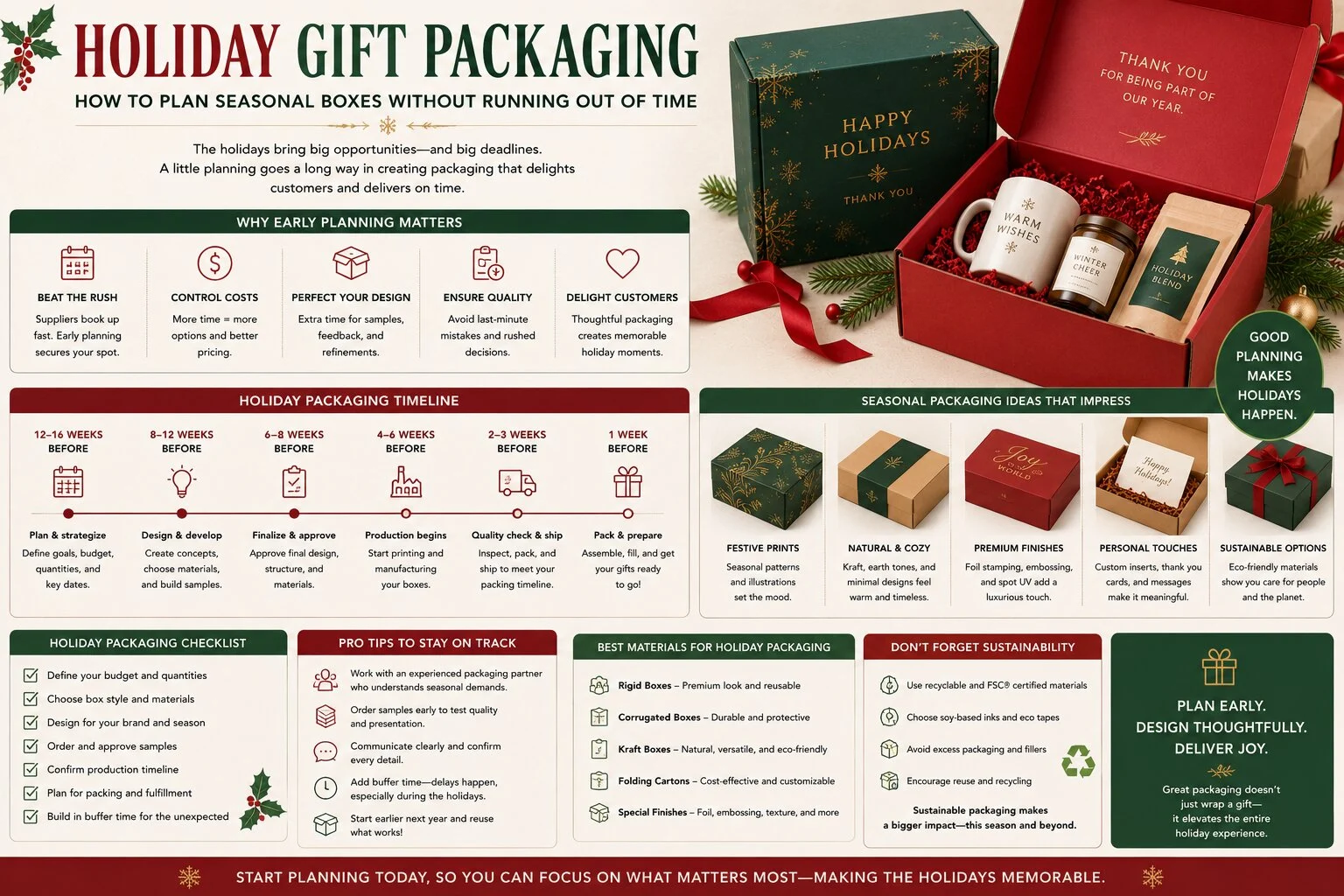
A small ecommerce business owner once discovered a painful reality in early November.
Their holiday gift packaging order wasn’t arriving until mid-December.
By the time the boxes reached their warehouse, most of their holiday shipping window was already gone.
Instead of shipping festive gift orders in branded seasonal packaging, they sent hundreds of Christmas purchases in standard brown shipping boxes with holiday sticker labels attached to the outside.
Meanwhile, competitors had already launched holiday campaigns. Their customers were posting festive unboxing videos on Instagram and TikTok while this business was still waiting for inventory to clear customs and arrive at the warehouse.
Unfortunately, this situation is far from unusual.
Holiday packaging timing remains one of the most common planning failures among small businesses, boutique retailers, subscription box companies, and growing ecommerce brands. Many owners assume packaging can be ordered a few weeks before a holiday and arrive on time. In reality, custom seasonal packaging involves multiple production stages that take far longer than most first-time buyers expect.
Holiday retail sales in the United States exceed $900 billion annually, with packaging presentation playing an increasingly important role in gift purchase decisions and social sharing behavior.
If you’re planning seasonal campaigns this year, understanding the timeline requirements now can save you from expensive mistakes later.
Why Holiday Packaging Requires Earlier Planning Than Most Brands Expect
One of the biggest misconceptions about holiday packaging is that it’s similar to ordering products from a retail supplier.
It isn’t.
Custom packaging follows a completely different process.
Standard Production Timelines
For a relatively simple custom packaging project, you should expect:
4–6 weeks minimum
That timeline assumes:
- Approved artwork
- Standard materials
- No specialty finishes
- Normal production scheduling
Holiday Packaging with Specialty Finishes
Once you introduce premium elements, timelines grow quickly.
Typical turnaround:
8–10 weeks
This often includes:
- Foil stamping
- Embossing
- Soft-touch coating
- Specialty papers
- Complex printing requirements
Large Seasonal Programs
For larger retail or subscription box campaigns:
10–12 weeks
is often the safer planning window.
Why Production Takes So Long
Several stages happen before manufacturing even begins.
Design Approval
Artwork revisions frequently take longer than expected.
Dieline Creation
Structural templates must be finalized.
Proof Approval
Colors, sizing, and print quality require verification.
Production Scheduling
Factories operate on production calendars.
Holiday demand increases scheduling pressure.
Quality Inspection
Finished packaging requires review before shipping.
Shipping to Your Warehouse
Even after production finishes, transportation still takes time.
What Happens When Brands Order Late
The consequences are usually predictable.
You may face:
- Limited finishing options
- Rush production fees
- Higher freight costs
- Delayed deliveries
- Missed sales opportunities
In the worst cases, packaging arrives after the holiday season has ended.
The Competitor Advantage
Brands that start planning early gain several advantages.
They often receive:
- Better pricing
- More design flexibility
- Preferred production slots
- Lower shipping costs
Planning ahead isn’t just about avoiding problems.
It’s often about gaining a competitive edge.
Holiday Packaging by Season – Timelines and Design Guidance
Every holiday follows its own packaging cycle.
The smartest approach is working backward from your delivery deadline.
Christmas Packaging
Recommended Order Date: 10–12 weeks before Christmas delivery
Christmas remains the most demanding seasonal packaging period.
Design themes that consistently perform include:
- Deep forest greens
- Rich reds
- Matte gold accents
- Copper foil details
- Kraft with white printing
- Kraft with gold printing
- Minimal snowflake patterns
- Botanical winter graphics
- White and silver modern aesthetics
For bakeries and specialty food businesses, Christmas-themed custom bakery boxes often become a major sales driver during November and December.
What to Avoid
Avoid generic clip-art-style holiday graphics.
Customers increasingly prefer sophisticated seasonal designs over overly commercial holiday artwork.
Valentine’s Day Packaging
Recommended Order Date: 8–10 weeks before February 14
Valentine’s Day packaging performs best when it feels gift-focused rather than overly themed.
Strong design directions include:
- Deep burgundy
- Blush pink combinations
- Matte black with red accents
- Gold foil on dark backgrounds
- Romantic botanical illustrations
Particularly effective for:
- Jewelry
- Candles
- Cosmetics
- Soap products
- Food gifts
Valentine’s customers are often purchasing gifts, which means presentation matters significantly more than during routine purchases.
Mother’s Day Packaging
Recommended Order Date: 8 weeks before Mother’s Day
Mother’s Day packaging tends to perform best when it feels personal.
Popular design themes include:
- Soft florals
- Pastel palettes
- Clean white backgrounds
- Botanical illustrations
- Personalized message areas
Strong categories include:
- Beauty products
- Wellness products
- Candles
- Food gifts
- Spa products
Customers frequently keep Mother’s Day packaging because of its emotional connection.
Halloween Packaging
Recommended Order Date: 8–10 weeks before October 31
Halloween packaging presents an interesting challenge.
Brands generally perform best when choosing one direction.
Either:
Playful
Fun and family-friendly.
Or:
Sophisticated
Dark, premium, and minimalist.
Popular elements include:
- Matte black
- Orange accents
- Deep purple tones
- Limited-edition graphics
Strong product categories:
- Candy
- Snacks
- Novelty items
- Seasonal launches
Trying to combine playful and luxury aesthetics often creates confusion.
Easter and Spring Packaging
Recommended Order Date: 8 weeks before Easter
Spring packaging typically benefits from lighter visual approaches.
Strong themes include:
- Soft pastels
- Spring florals
- Light color palettes
- Airy layouts
- Fresh botanical elements
Particularly effective for:
- Food products
- Cosmetics
- Gift items
- Children’s products
Spring packaging often transitions well into broader seasonal marketing campaigns beyond Easter itself.
What Makes Holiday Packaging Worth the Investment
A common question small business owners ask is simple:
“Does seasonal packaging actually increase sales?”
In many cases, yes.
Customers Think Differently During Holidays
During holiday periods, customers shift into gifting mode.
When buying gifts, presentation becomes part of the product experience.
Packaging suddenly matters more than it does during normal purchasing behavior.
Seasonal Packaging Photographs Better
Holiday packaging naturally encourages:
- Social sharing
- Gift photography
- Unboxing videos
- User-generated content
That visibility often extends the value of your packaging investment.
Seasonal Designs Create Urgency
Customers understand seasonal packaging is temporary.
That exclusivity matters.
People know Christmas packaging disappears after Christmas.
Limited availability encourages action.
Packaging Reduces Gift-Wrapping Requirements
Gift buyers appreciate convenience.
A well-designed holiday package often eliminates the need for additional wrapping.
That’s a meaningful benefit during busy seasons.
The Social Sharing Multiplier
Holiday unboxing content consistently performs better than standard product unboxing content.
Customers enjoy sharing festive purchases.
Creating FOMO Through Limited Editions
Returning customers frequently purchase limited-edition seasonal versions simply because they know the design won’t return until next year.
Studies show 62% of consumers say packaging design influences their perception of the gift before opening—particularly during holiday purchases.
That makes seasonal packaging a sales tool rather than simply a shipping expense.
Seasonal Packaging Options – From Simple to Premium
Not every business needs luxury packaging.
Budget matters.
The goal is choosing the right level for your products.
Entry Level: Sticker and Label Upgrades
This is the simplest approach.
Add:
- Holiday stickers
- Seasonal labels
- Limited-edition seals
to existing packaging.
Best for:
- Small businesses
- First-time seasonal campaigns
- Budget-conscious brands
Mid-Level: Custom Printed Seasonal Boxes
Dedicated holiday graphics printed directly on packaging.
Benefits include:
- Stronger presentation
- Better brand perception
- Improved unboxing experiences
Best for:
Growing ecommerce brands with established seasonal sales.
Premium: Specialty Finish Seasonal Packaging
Add upgrades such as:
- Foil stamping
- Soft-touch coating
- Embossing
These features create stronger gift appeal.
Best for:
Brands compete heavily on presentation.
Luxury: Rigid Seasonal Boxes
Rigid seasonal packaging delivers maximum impact.
Common upgrades include:
- Specialty paper wraps
- Premium inserts
- Magnetic closures
- Foil detailing
This approach is often used for luxury gifting, executive programs, and high-value holiday products.
For deeper insight into premium structures, see our guide on luxury rigid boxes and premium packaging psychology.
Choosing the Right Tier
As a practical guideline:
- Under $20 products → Entry or Mid-Level
- $20–$75 products → Mid-Level or Premium
- $75+ products → Premium or Luxury
Often, moving up just one packaging tier creates measurable improvements without dramatically increasing costs.
Interior Seasonal Packaging Elements
Many brands focus entirely on the exterior.
That’s a mistake.
Interior upgrades often create stronger emotional reactions at a lower cost.
Seasonal Tissue Paper
Simple but highly effective.
Holiday colors instantly change presentation.
Holiday Crinkle Fill
Adds seasonal personality while protecting products.
Seasonal Ribbon Colors
Small detail.
Big impact.
Limited-Edition Inserts
Customers enjoy seasonal messages and collectible cards.
Holiday Messaging Cards
Particularly effective for gifting purchases.
The Cost-Efficient Strategy
Many successful brands keep their exterior packaging consistent throughout the year.
Then they update:
- Tissue paper
- Ribbon
- Inserts
- Cards
seasonally.
This creates a holiday experience without requiring entirely new box production.
Managing Seasonal Packaging Inventory
This is where planning becomes operational.
Forecasting Seasonal Quantities
Start with data.
Review:
- Previous holiday sales
- Seasonal demand trends
- Growth projections
- New sales channels
Then add a buffer.
The 20% Rule
A practical approach:
Forecast expected demand and add approximately 20%.
This helps absorb unexpected demand spikes.
Managing Leftover Inventory
Seasonal inventory doesn’t always sell perfectly.
Some strategies include:
Transitional Designs
Design packaging that remains usable shortly after the holiday.
Early Inventory Sell-Through
Reduce inventory before introducing the next seasonal collection.
Limited Seasonal Elements
Use inserts instead of fully seasonal boxes when uncertainty is high.
Avoiding Over-Ordering
For your first seasonal launch:
Start conservatively.
You can always scale future orders using real sales data.
Storage Considerations
Seasonal packaging occupies warehouse space for months before use.
Consider:
- Storage costs
- Organization systems
- Inventory rotation
before placing large orders.
Universal vs Multiple Seasonal SKUs
Smaller brands often benefit from one universal seasonal design.
Larger brands may justify multiple SKUs for:
- Different product lines
- Different customer segments
- Different gifting categories
Keep complexity proportional to sales volume.
Conclusion
Holiday gift packaging planning starts much earlier than most businesses expect. Waiting until a few weeks before a holiday almost always limits options, increases costs, and creates unnecessary risk.
A simple rule helps prevent most seasonal packaging problems: count backward from your peak delivery date. For Christmas campaigns, subtract 10–12 weeks. For Valentine’s Day, allow 8–10 weeks. For Mother’s Day, Easter, and Halloween, plan at least 8 weeks ahead whenever possible.
The businesses that consistently succeed with seasonal packaging aren’t necessarily the ones with the biggest budgets. They’re the ones that plan early enough to make smart decisions.
Explore our custom gift boxes and seasonal packaging options designed for holiday campaigns across the United States.