

A skincare founder spent nearly a year perfecting a facial serum.
The formula was excellent.
Customer reviews were positive.
Sales were steady after launch.
Yet something was missing.
Despite dozens of orders every week, customers weren’t posting about the product. No TikTok unboxings. No Instagram Stories. No YouTube reviews. The product was selling, but it wasn’t creating any organic visibility.
Then a friend launched a similar skincare product.
The quality was comparable.
The price point was similar.
The difference was packaging.
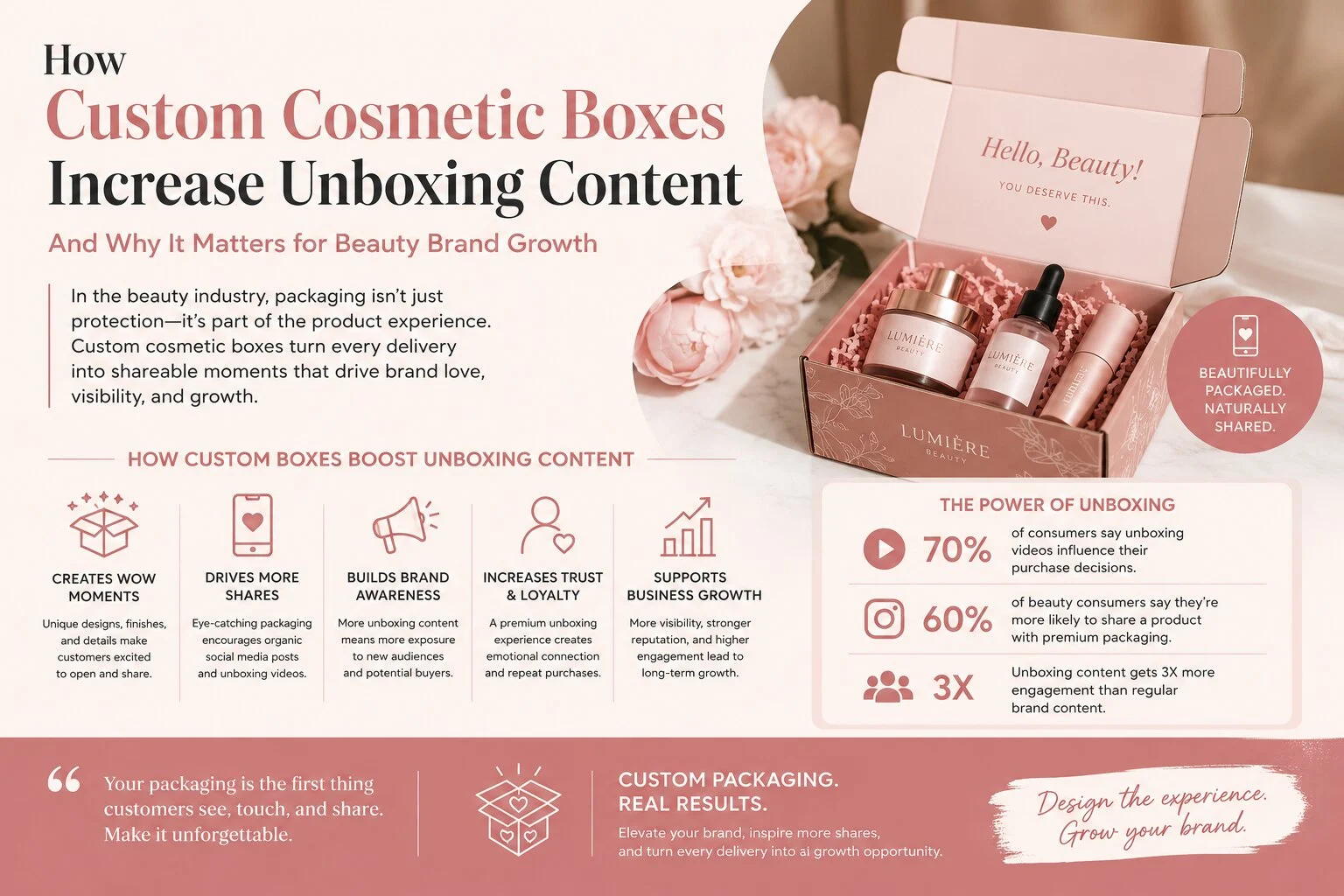
Their product arrived in intentionally designed custom cosmetic boxes featuring printed interiors, a soft-touch finish, and a carefully planned reveal experience. Within weeks, customers were posting unboxing videos without being asked.
Same product category.
Different packaging strategy.
Beauty has become one of the most visual industries in retail. Today, packaging isn’t just a container. It’s part of the marketing system.
Beauty-related unboxing content generates over 10 billion views annually on YouTube alone, making packaging a direct driver of organic brand visibility.
If you’re building a beauty brand, understanding how cosmetic packaging influences content creation can directly impact customer acquisition, retention, and social reach.
This guide explains what makes beauty packaging shareable, which finishes perform best on camera, how creators evaluate packaging, and how to design custom cosmetic boxes that work across retail, ecommerce, and social media channels.
Why Beauty Packaging Has Become a Marketing Channel
Ten years ago, cosmetic packaging had two primary jobs.
Protect the product.
Look attractive on retail shelves.
Today, those priorities still matter—but they’re no longer enough.
Social Media Changed Packaging Forever
Platforms like TikTok, Instagram, and YouTube have transformed how beauty products are discovered.
Consumers no longer encounter products exclusively through retailers or advertising.
They encounter them through content.
Sometimes that content comes from:
- Beauty creators
- Micro-influencers
- Makeup artists
- Skincare reviewers
- Everyday customers
Every one of those people is a potential media channel.
What Customers Actually Photograph
When beauty products appear online, customers rarely photograph only the product itself.
Instead, they document the entire experience.
Common content includes:
- Outer packaging before opening
- The first reveal moment
- Interior arrangement
- Product presentation inside the box
- Close-up shots of finishes and textures
Those details become part of the story.
Packaging Now Competes on Feeds as Much as Shelves
A package that performs well in Sephora, Ulta, or a boutique retailer may not necessarily perform well on TikTok.
Likewise, a package designed purely for social media may struggle in physical retail.
Modern beauty brands must consider both environments simultaneously.
Organic Content Reduces Acquisition Costs
One reason beauty founders invest in cosmetic packaging unboxing experiences is simple economics.
Every customer-created post represents visibility you didn’t pay for directly.
When packaging encourages sharing, brands often reduce dependence on paid acquisition channels over time.
That’s why packaging increasingly belongs in the marketing budget—not just the operations budget.
What Makes Cosmetic Packaging Worth Sharing
Not every package gets posted online.
Some consistently generate content.
Others rarely do.
After reviewing hundreds of beauty launches, certain patterns appear repeatedly.
Unexpected Interior Experiences
Customers share surprises.
Simple as that.
Printed interiors, hidden messaging, branded tissue paper, and inside-lid graphics create moments customers didn’t expect.
That moment of discovery often becomes the most memorable part of the experience.
Premium Finishes Customers Can Feel
Certain finishes naturally encourage interaction.
Examples include:
- Soft-touch coatings
- Foil stamping
- Embossing
- Debossing
Customers frequently hold these details closer to the camera because texture becomes part of the story.
Color Combinations That Break Expectations
Many beauty brands default to similar palettes.
Pastel pink.
Muted beige.
Soft neutrals.
There’s nothing wrong with those choices.
But when every competitor uses the same visual language, differentiation becomes difficult.
Structural Moments
Some packaging formats naturally create stronger content.
Examples include:
Magnetic Closures
The audible click feels satisfying on video.
Drawer Boxes
The slow reveal creates anticipation.
Two-Piece Rigid Boxes
Opening becomes a deliberate experience rather than a simple action.
These are the same principles discussed in our luxury rigid boxes guide, where structure itself becomes part of perceived value.
Custom Details Customers Rarely Expect
Small surprises often outperform expensive upgrades.
Examples include:
- Printed quotes
- Personalized cards
- Limited-edition inserts
- Seasonal messages
- Thank-you notes
The goal isn’t complexity.
The goal is creating something worth sharing.
Studies show 52% of consumers say they are more likely to make a repeat purchase from a brand that delivers products in premium packaging.
That’s one reason beauty packaging influences retention as well as acquisition.
The Unboxing Video Framework – What Beauty Creators Look For
Creators think differently than average consumers.
They’re evaluating whether packaging creates content opportunities.
Questions Creators Ask
When a package arrives, creators subconsciously assess:
- Does it create multiple visual moments?
- Does the exterior photograph well?
- Is the opening mechanism interesting?
- Is the interior organized?
- Does the product presentation feel intentional?
Why Single-Moment Packaging Underperforms
Many beauty boxes have only one visual event.
The package opens.
The product appears.
The experience ends.
That rarely performs well on video.
The Three-Act Unboxing Structure
The strongest unboxing packaging beauty brands use follows a simple framework.
Act 1: Exterior Reveal
This is the first impression.
Focus on:
- Branding
- Color
- Finish quality
- Shape
The exterior should immediately communicate the brand’s personality.
Act 2: Opening Mechanism
This creates anticipation.
Examples include:
- Magnetic closures
- Drawer systems
- Lift-off lids
- Ribbon pulls
The opening process itself should feel deliberate.
Act 3: Interior and Product Reveal
This is the payoff.
The product presentation should feel organized, intentional, and visually rewarding.
When all three acts work together, creators have multiple content opportunities instead of one.
Why PR Packages Generate Better Content
Beauty brands sending influencer mailers often invest heavily in premium cosmetic packaging because content creation is the primary objective.
A PR package that creates three or four visual moments naturally generates stronger creator content.
Packaging Finishes That Perform on Camera and in Photos
One thing many beauty founders learn quickly:
A finish that looks great in person doesn’t always look great on camera.
Soft-Touch Coating
Soft-touch coatings remain one of the strongest performers for beauty packaging social media content.
Why?
They absorb light rather than reflecting it.
Benefits include:
- Improved depth in photography
- Luxury appearance
- Better close-up performance
Soft-touch often appears more premium on camera than gloss finishes.
Gold Foil Stamping
Gold foil catches light naturally.
It creates visual highlights that attract attention in both still photography and video.
Gold foil performs especially well during:
- Natural light shoots
- Golden-hour content
- Lifestyle photography
Spot UV
Spot UV creates contrast.
The difference between matte and gloss surfaces becomes highly visible during close-up filming.
Many creators intentionally capture these details.
Matte Black with Metallic Accents
This remains one of the most consistently successful combinations in cosmetic box design.
Reasons include:
- Strong visual contrast
- Premium appearance
- Excellent photography performance
- Versatility across lighting environments
White with Minimal Typography
Minimal skincare brands frequently use this approach.
White packaging:
- Photographs cleanly
- Works across most backgrounds
- Supports clinical positioning
- Feels modern
What to Avoid
Heavy gloss without contrast.
Glossy surfaces often create:
- Reflection problems
- Glare
- Inconsistent photography results
Video creators frequently struggle with highly reflective packaging.
Color Strategy for Shareable Cosmetic Packaging
Color influences shareability more than many brands realize.
The Oversaturation Problem
When every brand uses the same palette, visibility decreases.
This is particularly common in skincare.
Colors That Consistently Perform Well
Deep Greens
Excellent for:
- Wellness brands
- Botanical products
- Skincare
Matte Black
Strong luxury signal.
Popular for premium beauty collections.
Clean White
Works exceptionally well for:
- Clinical skincare
- Minimal brands
- Dermatology-inspired products
Deep Burgundy
Highly effective for:
- Premium positioning
- Holiday launches
- Gift packaging
Neutral Earth Tones
Ideal for:
- Organic products
- Sustainable brands
- Natural ingredients
Audit Competitors Before Finalizing Colors
Before selecting packaging colors:
Review:
- Competitor websites
- Retail shelves
- Amazon listings
- Social media content
If every competitor uses pastel pink, another pastel pink package probably won’t help.
The Shelf-Feed Parallel
An interesting pattern appears repeatedly:
Packaging that attracts attention on retail shelves often performs well on social feeds too.
The environments are different.
Human attention isn’t.
Designing Cosmetic Packaging for Multiple Sales Channels
Today’s beauty brands rarely sell through one channel.
Most operate across:
- Direct-to-consumer ecommerce
- Amazon
- Boutique retail
- Influencer gifting
- Subscription programs
That creates unique packaging challenges.
Design for Multiple Angles
Packaging should photograph well from:
- Front
- Side
- Top
- Three-quarter views
Customers rarely capture only one perspective.
Ensure Shipping Performance
Beautiful packaging that arrives damaged creates problems.
Structure still matters.
Maintain Retail Presence
The same package should perform:
- On a shelf
- In a shipping box
- In an unboxing video
Gift-Ready Design
Many beauty products become gifts.
Gift-ready packaging reduces the need for additional wrapping.
The PR Kit Opportunity
Beauty brands frequently use custom gift boxes for influencer mailers because presentation directly affects content quality.
The best PR kits create a sense of discovery.
What Makes a PR Mailer Worth Filming
Common elements include:
- Multiple layers
- Premium finishes
- Personalized details
- Organized presentation
- Unexpected reveals
The package itself becomes content.
Practical Steps for Designing Beauty Packaging Around Shareability
If you’re launching or redesigning beauty packaging, here’s a practical framework.
Step 1: Define Your Visual Identity First
Decide:
- Color palette
- Typography
- Logo positioning
Before choosing structures.
Packaging should reinforce identity—not create it.
Step 2: Identify Your Primary Sales Channel
If social media drives growth:
Invest more heavily in:
- Finishes
- Interior printing
- Unboxing moments
If retail is primary:
Prioritize structural performance and shelf visibility.
Step 3: Create Three Intentional Visual Moments
Design:
- The exterior
- The opening
- The interior reveal
Separately.
Each should contribute something unique.
Step 4: Test Under Real Lighting Conditions
Photograph samples using:
- Natural daylight
- Indoor lighting
- Smartphone cameras
Packaging often behaves differently than expected.
Step 5: Coordinate Across the Product Line
Every SKU should feel related.
Consistency strengthens recognition and improves content quality across the product range.
Conclusion
Beauty packaging has evolved into a marketing asset. Today, customers don’t simply purchase products—they document them, share them, review them, and introduce them to new audiences through content.
The strongest cosmetic packaging unboxing experiences aren’t necessarily the most expensive. Often, one premium finish combined with one thoughtful interior branding element creates a greater impact than a costly structural redesign.
If you’re evaluating your packaging strategy, start small. Add a soft-touch coating. Introduce printed interiors. Test a magnetic closure. Measure customer response before investing in more complex upgrades.
Explore our custom cosmetic boxes designed for beauty brands competing across retail, ecommerce, and social media channels across the United States.