

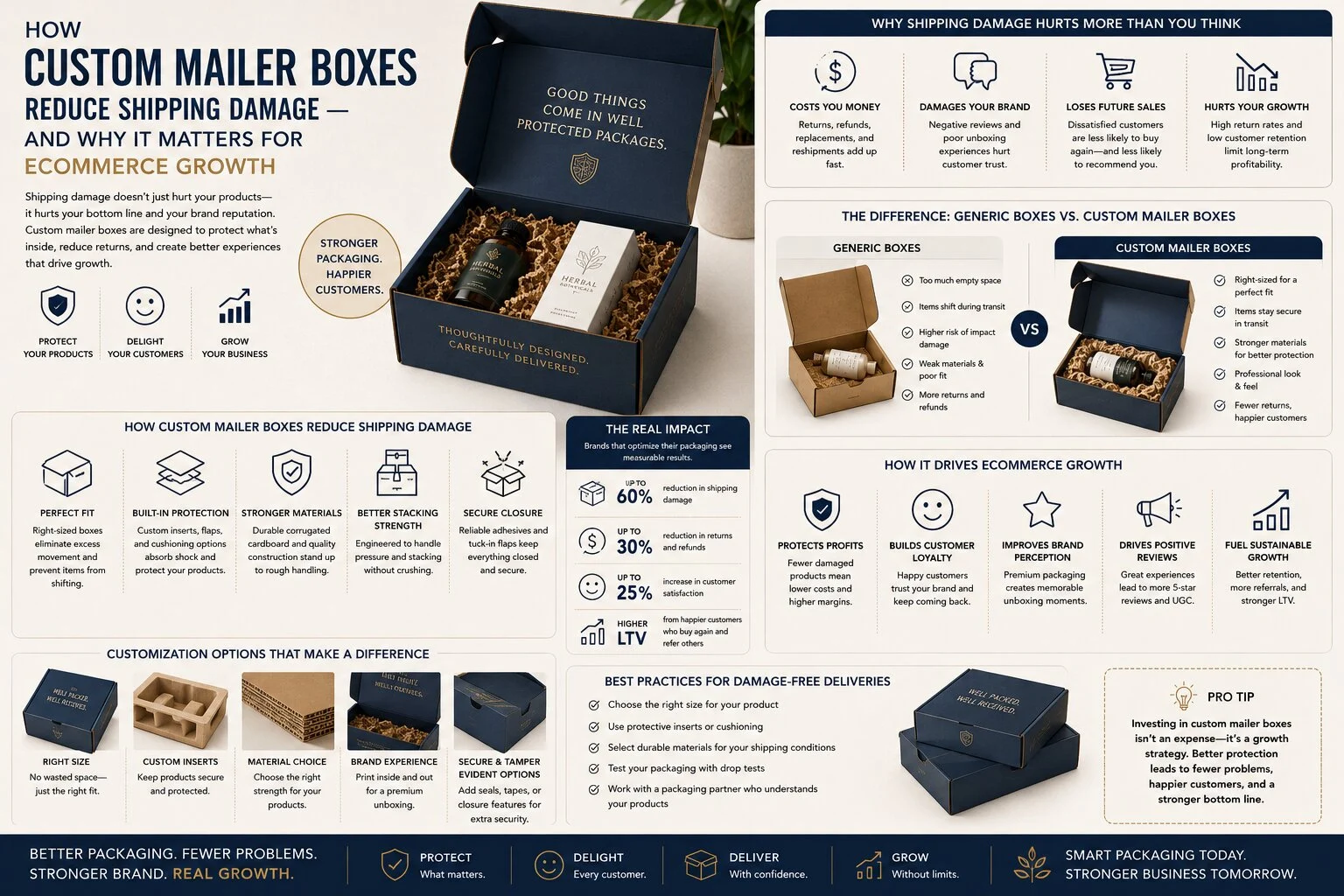
An ecommerce brand recently discovered that nearly 8% of its orders were generating damage complaints.
The surprising part?
The products weren’t particularly fragile.
The problem was the packaging.
The company had been using generic mailer boxes purchased in bulk because they were inexpensive and easy to source. Unfortunately, those boxes weren’t designed around the products they were shipping. Items moved during transit, corners absorbed repeated impacts, and customers occasionally received damaged orders.
Every damaged shipment triggered a chain reaction.
A return request.
A replacement shipment.
A customer service interaction.
Sometimes a negative review.
Sometimes a lost customer.
Multiply those costs across hundreds or thousands of annual orders and the financial impact becomes impossible to ignore.
Ecommerce returns cost US businesses over $800 billion annually, and packaging failures remain one of the largest contributors to avoidable shipping damage.
The good news is that shipping damage prevention is often more achievable than many brands realize.
This guide explains why generic packaging fails, how custom mailer boxes reduce damage, when to upgrade from cardboard to corrugated mailer boxes, which insert systems work best, and how to calculate the real cost of packaging-related losses.
Why Generic Mailer Boxes Fail Ecommerce Brands
Most generic brown mailer boxes aren’t designed specifically for ecommerce products.
They’re designed for broad utility.
That sounds practical until you consider what packages actually experience during transit.
What Generic Mailer Boxes Are Designed For
Their primary objectives are:
- Basic physical protection
- Cost minimization
- Broad compatibility
- Easy mass production
What they’re not optimized for:
- Specific product dimensions
- Premium presentation
- Product immobilization
- Brand consistency
Those limitations become obvious once packages enter real shipping networks.
What Actually Happens During Shipping
Many ecommerce operators underestimate carrier handling conditions.
A package shipped through USPS, UPS, or FedEx may be:
- Dropped multiple times
- Conveyed across automated sorting systems
- Stacked beneath heavier packages
- Loaded into trucks repeatedly
- Moved through multiple distribution centers
By the time it reaches the customer, it may have been handled dozens of times.
Where Generic Boxes Fail
Common failure points include:
Corner Compression
Corners weaken under repeated pressure.
Once structural integrity is compromised, the entire package becomes more vulnerable.
Product Movement
Generic boxes often contain excessive empty space.
When products move, impacts increase.
Movement is one of the leading causes of preventable shipping damage.
Moisture Exposure
Uncoated stock can absorb moisture during transportation and storage.
This weakens the structure and reduces protection.
Stack Pressure
Lightweight boxes often struggle under warehouse and transportation stacking loads.
The Product Fit Problem
We have audited dozens of ecommerce packaging systems over the years.
One issue appears repeatedly:
Products swimming inside oversized boxes.
Every inch of unnecessary movement increases damage risk.
The package may survive.
The product may not.
That’s why sizing matters so much.
How Custom Sizing Reduces Damage
The most underrated factor in shipping damage prevention isn’t board thickness.
Its dimensions.
Why Proper Sizing Matters
When products fit correctly inside mailer box packaging:
- Movement decreases dramatically
- Inserts perform better
- Void fill requirements shrink
- Compression forces distribute more evenly
The result is better protection with fewer materials.
How Proper Sizing Eliminates Movement
A correctly sized box creates:
Minimal Clearance
Products remain stable during transport.
Better Insert Performance
Foam and cardboard inserts function properly when clearances are controlled.
Less Void Fill
Less empty space means fewer opportunities for shifting.
Improved Shipping Efficiency
Smaller boxes often reduce dimensional weight charges.
Practical Sizing Formula
A simple guideline:
Product dimensions + 1-2 cm clearance on each side
This allows room for:
- Foam inserts
- Cardboard inserts
- Tissue
- Cushioning materials
Without creating excessive movement space.
One Universal Box vs Multiple Sizes
Many brands attempt to simplify operations by using a single box size.
That approach can work.
But it often creates problems.
Universal Boxes
Advantages:
- Simpler inventory management
- Fewer SKUs
- Easier purchasing
Disadvantages:
- Poor fit
- Increased void fill
- Higher shipping costs
- More product movement
Multiple Box Sizes
Advantages:
- Better protection
- Lower dimensional weight costs
- Reduced material usage
Disadvantages:
- More inventory complexity
As order volume increases, multiple sizes often become financially justified.
The Hidden Cost of Oversized Boxes
Oversized shipping boxes for ecommerce create three separate expenses:
- More void fill
- Higher shipping costs
- Greater damage risk
Most brands only notice the first two.
The third is usually the most expensive.
Corrugated vs Cardboard Mailer Boxes: Which Provides Better Protection
Not all mailer boxes are built the same way.
Understanding the difference between corrugated and cardboard structures is essential.
Corrugated Mailer Boxes
Corrugated mailer boxes contain a fluted inner layer between outer liners.
This creates cushioning and compression resistance.
Best For
- Products over 500g
- Glass products
- Ceramics
- Subscription boxes
- Electronics accessories
- Long-distance shipping
Protection Advantage
The fluted structure absorbs impact and resists crushing significantly better than standard cardboard.
For many ecommerce brands, corrugated packaging represents the safest long-term solution.
Cardboard Mailer Boxes
Cardboard boxes typically use a single-layer structure.
They’re lighter and more economical.
Best For
- Lightweight products
- Apparel
- Textiles
- Low-fragility products
- Short shipping distances
Protection Advantage
Lower cost and sufficient protection for products that tolerate movement.
When to Upgrade to Corrugated
Upgrade from cardboard when you ship:
- Products over 500 grams
- Glass bottles
- Ceramic products
- Electronics accessories
- Multi-product subscription shipments
- International orders
This isn’t a branding decision.
It’s a risk management decision.
Insert Systems That Prevent Damage
A strong box alone rarely solves shipping damage.
Interior protection matters just as much.
Foam Inserts
Best for:
- Glass bottles
- Electronics
- Cosmetic applicators
- Fragile wellness products
How They Work
Foam absorbs impact energy and holds products in fixed positions.
Movement becomes nearly impossible.
Die-Cut Cardboard Inserts
Best for:
- Structured products
- Predictable dimensions
- Mid-range budgets
How They Work
Custom-cut cavities secure products tightly inside the box.
They’re often significantly more affordable than foam.
Crinkle Paper and Void Fill
Best for:
- Mixed-product shipments
- Irregular shapes
- Subscription box packaging
How They Work
Material surrounds products and cushions impacts from multiple directions.
This solution works particularly well when product combinations change frequently.
Air Pillow Systems
Best for:
- Lightweight items
- High-volume fulfillment operations
How They Work
Inflatable cushions fill empty space and absorb shock.
Many large ecommerce brands rely heavily on air pillows because they balance protection and operational efficiency.
Matching Inserts to Product Risk
Consider two variables:
Product Fragility
How easily does the product break?
Shipping Distance
How many carrier touchpoints will occur?
The more fragile the product and the longer the shipping route, the more robust the insert system should become.
Branded Mailer Boxes and Damage Prevention: Why They Work Together
Many ecommerce operators assume branding and protection are separate decisions.
They’re not.
Why Branded Packaging Often Performs Better
Custom-built branded mailer boxes are typically designed around specific products.
That means:
- Better sizing
- Better material selection
- Better structural engineering
The branding is simply an additional benefit.
How Branded Mailer Boxes Reduce Damage
Custom Dimensions
Movement decreases significantly.
Correct Board Weight
Materials match shipping requirements.
Purpose-Built Structures
Designs reflect actual product needs.
Customer Perception Matters Too
Protection isn’t just about making sure a product arrives without damage.
It also plays a big role in shaping how customers feel about your brand. A well-designed, professionally presented package instantly builds trust and reassurance.
When a branded box arrives neatly packed and in perfect condition, customers naturally assume the product inside is of the same high standard. That first impression can quietly influence their entire experience.
In fact, studies show that 72% of American consumers say packaging quality directly affects how they perceive the product inside.
For ecommerce brands, that’s a powerful reminder, packaging isn’t just a finishing touch, it’s part of the product promise.
How to Calculate Your Damage-Related Costs
Many brands underestimate packaging costs because they don’t calculate damage expenses correctly.
Here’s a simple framework.
Step 1: Calculate Monthly Damaged Orders
Monthly Orders × Damage Rate = Damaged Orders
Example:
500 orders × 5% damage rate = 25 damaged orders
Step 2: Calculate Average Cost Per Damaged Order
Include:
- Product cost
- Replacement shipping
- Customer service time
- Refund costs
Example:
Average damage cost = $30
Step 3: Calculate Monthly Damage Cost
25 damaged orders × $30 = $750 per month
Step 4: Calculate Annual Cost
$750 × 12 = $9,000 per year
That’s often enough to justify a packaging upgrade.
Finding Your Actual Damage Rate
Review:
- Return reasons
- Customer support tickets
- Carrier claims
- Refund records
Look at the last 90 days.
That usually provides a reliable baseline.
When Packaging Upgrades Make Sense
For many ecommerce brands, damage rates above 2-3% justify investigating packaging improvements.
Above 5%, corrective action becomes increasingly difficult to ignore.
Choosing the Right Mailer Box Material for Your Products
Different products require different protection strategies.
Cosmetics and Skincare
Recommended:
- Corrugated mailers
- Foam inserts for glass bottles
Plastic containers may perform adequately with lighter structures.
Apparel and Textiles
Recommended:
- Cardboard mailers
Fabric products generally tolerate movement well.
Electronics Accessories
Recommended:
- Corrugated mailers
- Foam or die-cut inserts
Rigid components benefit from additional protection.
Food Products
Recommended:
- Corrugated structures
- Moisture-resistant coatings
Particularly important for temperature-sensitive items.
Subscription Boxes
Recommended:
- Corrugated always
Multiple products create movement challenges and increase package weight.
This is especially important for brands focused on subscription box packaging where product assortments change regularly.
CBD and Wellness Products
Recommended:
- Corrugated mailers
- Insert systems for tincture bottles
Glass containers require additional stability during shipping.
Conclusion
Shipping damage is not an unavoidable cost of doing business. In many cases, it’s a packaging problem that can be solved through better sizing, stronger materials, and appropriate insert systems.
Before investing in expensive packaging upgrades, it helps to start with a simple audit of what’s already happening.
Look at your current damage rate and identify where things are most likely to go wrong. Are products shifting during transit? Are certain items more prone to breakage than others?
Often, the issue isn’t the material itself but the fit. In many cases, simply improving box dimensions and reducing internal movement can significantly cut down shipping damage, without needing to switch to premium materials right away.
For a lot of brands, this small adjustment is the most cost-effective first step toward stronger, more reliable packaging.
As your operation grows, packaging should support both protection and presentation. Explore our custom mailer boxes engineered for ecommerce shipping performance, product protection, and branded presentation across fulfillment operations in the United States.