

Picture a busy trade show filled with wellness brands, handmade products, and specialty retailers.
Two companies are selling nearly identical products at similar price points.
One uses polished white packaging with vibrant printing and a highly refined retail appearance. The other uses kraft packaging boxes with natural textures, simple graphics, and earthy tones.
Something interesting happens.
Different customers naturally gravitate toward each brand.
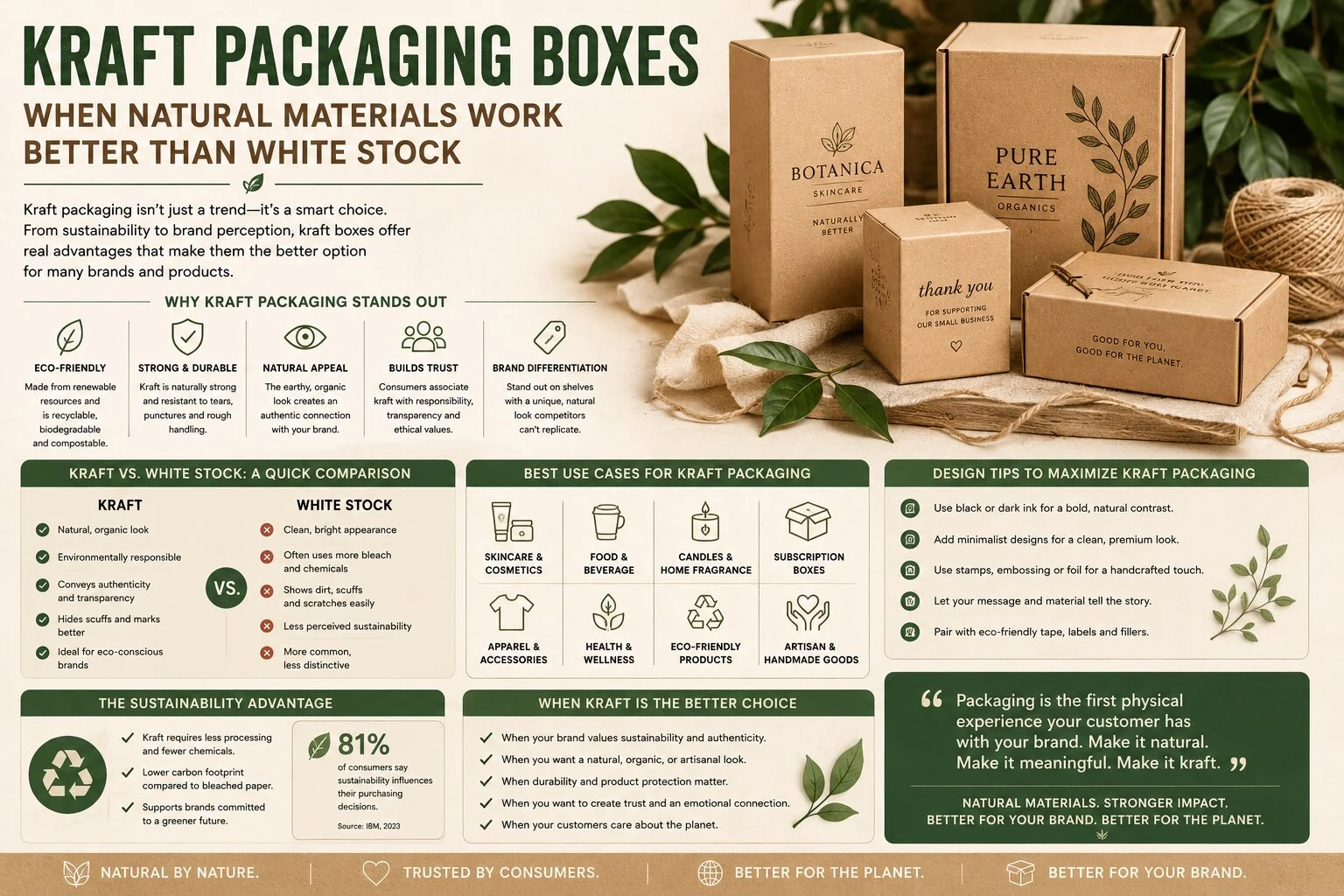
The kraft brand attracts buyers who often don’t need to read the ingredient list first. The packaging has already communicated much of the story. It suggests natural ingredients, small-batch production, and a more personal approach before a single word is read.
That’s why kraft packaging isn’t a default choice.
It’s a strategic one.
Over 60% of consumers say they actively look for brands using sustainable or natural-looking packaging when shopping for personal care and wellness products.
If you’re considering kraft packaging for your business, understanding when it works—and when it doesn’t—can save time, money, and costly design mistakes.
This guide explains what kraft packaging communicates, how it compares to white stock, which packaging formats perform best, how printing behaves on kraft materials, and why so many artisan and sustainable brands continue to choose it.
What Kraft Packaging Actually Communicates
Before customers read your logo, ingredients, or product claims, they’re already making assumptions.
Packaging drives those assumptions.
The Signals Kraft Sends Automatically
Natural kraft materials often communicate:
- Natural ingredients
- Handmade production
- Small-batch craftsmanship
- Environmental responsibility
- Authenticity
- Personal attention to detail
These associations happen quickly.
Most customers don’t consciously analyze them.
They simply feel them.
Why Natural Textures Create Different Reactions
Brown, unbleached materials feel less manufactured than bright white packaging.
The texture matters.
The color matters.
The slight variations in kraft stock create visual cues associated with natural materials rather than industrial production.
That’s why kraft packaging often feels more approachable.
Categories Where Kraft Performs Exceptionally Well
Certain industries benefit more than others.
Artisan Food Products
Customers often associate kraft packaging with handcrafted quality and small-scale production.
Handmade Soap and Skincare
Many brands selling botanical products naturally align with kraft aesthetics. This is especially common among businesses using custom soap boxes for farmers markets and boutique retail.
Organic Supplements
Plant-based formulas and wellness products frequently benefit from natural presentation.
Natural Candles
Soy candles, beeswax products, and botanical collections often feel more authentic in kraft packaging.
Botanical Products
Herbal products and plant-based collections align naturally with kraft materials.
Farmers Market Businesses
Kraft packaging fits the environment perfectly.
CBD and Hemp Products
Many brands choose kraft because it complements plant-focused branding and sustainable positioning.
Sustainable Fashion Accessories
Organic cotton, handmade accessories, and environmentally conscious brands frequently use kraft to reinforce their values.
Kraft Packaging vs White Packaging – Honest Comparison
This isn’t a competition.
They’re different tools designed for different objectives.
Where Kraft Outperforms White
Kraft often works better for:
Natural Product Positioning
Customers expect authenticity.
Kraft helps communicate it.
Artisan Brand Aesthetics
Small-batch and handcrafted products often look more believable in kraft packaging.
Eco-Conscious Markets
Natural materials align with customer expectations.
Photography with Natural Backgrounds
Wood, stone, linen, and natural textures complement kraft beautifully.
Farmers Markets and Craft Fairs
Kraft feels appropriate in these environments.
Budget-Conscious Production
In many situations, kraft can reduce material and printing costs.
Where White Packaging Outperforms Kraft
White stock remains the better choice in several situations.
Complex Color Printing
Bright colors reproduce more accurately on white surfaces.
Clinical or Medical Branding
Healthcare and clinical products often require cleaner, more precise aesthetics.
Luxury Spa Products
Many luxury brands prefer crisp white packaging for a refined appearance.
Bold Graphic Designs
Vibrant graphics perform better on white stock.
Premium Gift Packaging
Certain premium gifting programs rely on bright colors and specialty finishes.
Pharmacy Retail
White packaging generally aligns more closely with clinical retail environments.
The Print Quality Reality
Here’s something many business owners don’t realize.
Kraft stock absorbs ink differently.
Colors appear:
- Slightly warmer
- Slightly softer
- Less vibrant
This isn’t a defect.
It’s simply how the material behaves.
When Muted Colors Help
Muted printing often works well for:
- Botanical products
- Organic brands
- Handmade goods
- Artisan collections
When Muted Colors Hurt
They can become problematic when your brand relies heavily on:
- Neon colors
- Bright retail graphics
- Highly saturated artwork
Understanding this early prevents expensive reprints later.
Types of Kraft Packaging Boxes Available
Different products require different structures.
Fortunately, kraft materials work across almost every major packaging category.
Kraft Folding Cartons
Standard retail packaging produced on kraft stock.
Best for:
- Soap
- Candles
- Food products
- Wellness supplements
Print options:
One-color through four-color printing depending on production requirements.
Kraft Mailer Boxes
Corrugated mailers built with kraft exteriors.
Best for:
- Etsy sellers
- Direct-to-consumer brands
- Subscription services
Why they work:
They combine shipping protection with strong brand storytelling.
Kraft Sleeve Packaging
Minimalist wraps that use less material.
Best for:
- Soap bars
- Chocolate bars
- Artisan food products
Why they work:
Low material usage paired with strong visual presentation.
Kraft Tuck-End Boxes
A dependable structure used across multiple industries.
Best for:
- Retail packaging
- Small consumer products
- Wellness products
Reliable and cost-effective.
Kraft Display Boxes
Designed for merchandising.
Best for:
- Boutique retail
- Countertop displays
- Craft fairs
These structures help products stand out while maintaining a natural aesthetic.
Kraft Gift Boxes
Elevated presentation with natural materials.
Best for:
- Artisan gift collections
- Holiday bundles
- Farmers market gift sets
Many brands combine kraft materials with premium inserts to create memorable gifting experiences.
Printing on Kraft – What Works and What Doesn’t
This is where many packaging mistakes happen.
Not every color behaves well on kraft stock.
Colors That Perform Well
Black
The strongest contrast available.
Clean, readable, and highly versatile.
White Ink
Creates striking highlights and excellent readability.
Dark Greens
Particularly effective for botanical and wellness brands.
Deep Browns and Tans
Natural and cohesive.
Muted Golds
Sophisticated without feeling overly polished.
Colors That Often Lose Vibrancy
Several colors can become disappointing when printed directly on kraft.
Bright Blues
Often appear duller than expected.
Vivid Pinks
Can lose intensity.
Electric Orange
Frequently becomes muted.
Neon Tones
Generally perform poorly.
Finishing Options That Pair Well with Kraft
Matte Lamination
Maintains a natural feel while adding protection.
Spot UV
Creates subtle contrast.
Foil Stamping
Gold and copper foils perform particularly well.
Embossing
One of the strongest finishing techniques for kraft packaging.
Why Embossing Works So Well
Embossing doesn’t rely on ink.
Instead, it uses texture.
Because kraft stock already has a natural tactile quality, raised elements feel more authentic and integrated.
Photography Tips for Kraft Packaging
Kraft packaging photographs best when paired with:
- Wooden backgrounds
- Slate surfaces
- Linen fabrics
- Cotton textures
- Natural daylight
Artificial lighting often reduces the warmth that makes kraft appealing.
FSC-Certified Kraft – When It Matters
Not every customer asks about material sourcing.
Some absolutely do.
What FSC Certification Means
FSC certification helps verify that paper-based materials originate from responsibly managed forests.
For many brands, that matters.
When FSC Matters Most
Particularly important for:
- Sustainability-focused brands
- Eco-conscious customers
- Retail buyers evaluating sourcing
- B-Corp initiatives
- Corporate ESG programs
Displaying FSC Marks Correctly
Certification marks must follow FSC guidelines and approval requirements.
Never add them casually.
Always work through approved certification processes.
FSC vs Recycled Kraft
These are not the same thing.
FSC-certified kraft focuses on responsible sourcing.
Recycled kraft focuses on material recovery and reuse.
Why Some Brands Use Both
Many companies combine FSC-certified sourcing with recycled content.
This creates a stronger sustainability story while maintaining material performance.
Kraft Packaging for Ecommerce Brands
Kraft has become especially popular among ecommerce businesses.
Why It Performs Well in Shipping
Corrugated kraft mailers offer:
- Strong protection
- Lightweight construction
- Good cost efficiency
Performance is comparable to many standard corrugated alternatives.
Why Etsy Sellers Love Kraft
Spend time browsing Etsy and you’ll notice a pattern.
Many successful sellers use kraft packaging.
Reasons include:
Natural Product Photography
Kraft photographs beautifully.
Artisan Storytelling
It supports handmade positioning.
Cost Control
Small businesses appreciate the production efficiency.
The Kraft Unboxing Experience
Customers frequently describe kraft packaging as:
- Intentional
- Thoughtful
- Handmade
Those are valuable brand associations.
Repeat Purchase Impact
Studies show 52% of online shoppers say they are more likely to repurchase from brands that deliver products in attractive, well-considered packaging.
That doesn’t mean expensive packaging.
It means thoughtful packaging.
When to Upgrade to Printed Kraft
Many brands begin with plain kraft mailers.
As order volume grows, printed kraft often becomes worthwhile because it improves recognition without dramatically changing the brand aesthetic.
Industries Where Kraft Packaging Consistently Wins
Some industries simply align better with kraft than others.
Artisan Food
Craft snacks, specialty chocolates, and artisan baked goods benefit because kraft reinforces small-batch quality signals.
Handmade Soap and Skincare
Natural ingredients, botanical formulas, and farmers market positioning make kraft one of the dominant aesthetics in this category.
Organic Supplements
Plant-based wellness products often benefit from the transparency and authenticity kraft communicates.
Natural Candles
Soy, beeswax, and botanical candles align naturally with kraft textures.
Sustainable Fashion
Organic cotton brands, zero-waste companies, and environmentally conscious retailers frequently use kraft to reinforce their values.
CBD and Hemp Products
Many brands default to kraft because plant-based positioning aligns naturally with natural material aesthetics. For a deeper look at sustainable cannabis packaging, our eco-friendly cannabis packaging guide explores material options across multiple cannabis product categories.
Conclusion
Kraft packaging is a strategic decision, not a default one. It performs best when your product, brand story, and customer expectations align with natural aesthetics and authentic presentation.
At the same time, it’s important to recognize where kraft underperforms. If your brand relies on bright graphics, highly saturated colors, or clinical positioning, white stock may be the stronger option.
The key is matching the material to the message. When those two elements align, kraft packaging can communicate your story before customers read a single word.
Explore our custom kraft boxes in sleeve, mailer, folding carton, and display formats for artisan and sustainable brands across the United States.