

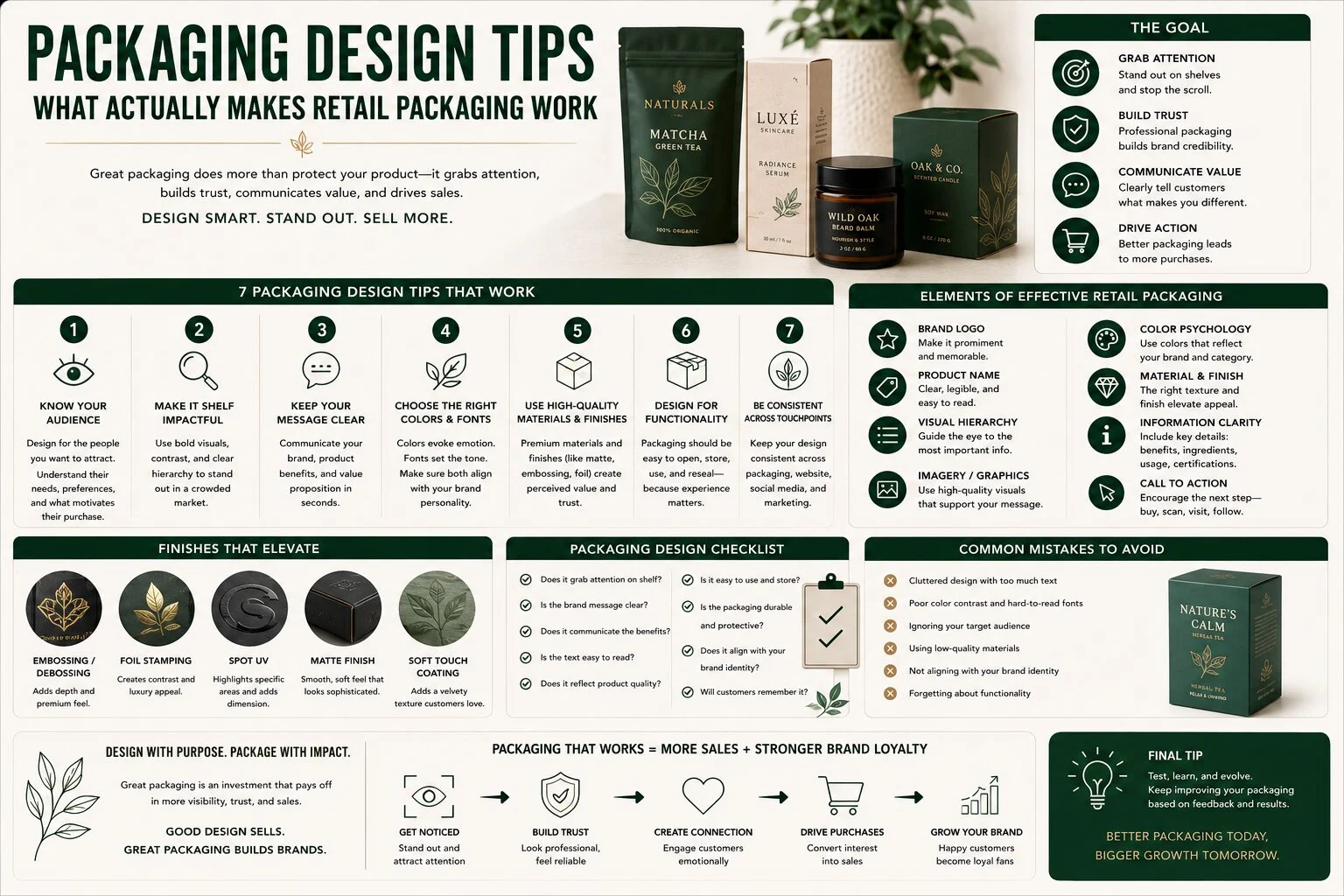
Walk into any grocery store, beauty retailer, or specialty shop and you’ll find shelves filled with products that are remarkably similar.
Two protein powders with nearly identical ingredients.
Two skincare serums using comparable formulations.
Two CBD tinctures with similar cannabinoid profiles.
Yet one product consistently outsells the other by a wide margin.
The difference usually isn’t discovered in a laboratory. It isn’t hidden in an ingredient comparison chart. It’s visible from six feet away.
Packaging design determines which product gets picked up first.
That’s an important distinction because customers rarely buy products they never notice.
Many brand founders think packaging design is primarily about aesthetics. In reality, effective packaging design is about communication. The goal isn’t to make something look attractive. The goal is to communicate the right information to the right customer in the right number of seconds.
Packaging influences purchase decisions within 7 seconds of first visual contact, making design the most powerful marketing tool available at the point of sale.
If you’re making packaging decisions for a startup, ecommerce brand, or retail product line, understanding how customers actually process packaging can help you create designs that support sales rather than simply decorate boxes.
The 7-Second Rule – Designing for How Customers Actually Shop
One of the biggest mistakes brands make is assuming customers study packaging.
Most don’t.
They scan it.
A shopper walking down an aisle is processing dozens of products simultaneously. Their brain is filtering information at remarkable speed.
What Customers Process First
In most retail environments, the sequence looks something like this:
- Color (Instant)
Color is usually the first thing noticed.
Before customers read a word, they register visual blocks of color.
- Shape (Instant)
Package structure and silhouette create immediate recognition.
- Category Recognition (1–2 Seconds)
Customers determine:
“What type of product is this?”
- Brand Name (2–3 Seconds)
Only after category recognition does branding become important.
- Key Product Claim (3–5 Seconds)
Customers begin evaluating benefits.
Examples:
- Organic
- High Protein
- Broad Spectrum CBD
- Anti-Aging Serum
- Price Justification (5–7 Seconds)
Now customers begin evaluating value.
Design for the Sequence
Many brands accidentally reverse this process.
They lead with:
- Logo
- Story
- Secondary messaging
before helping customers understand the product itself.
That’s backwards.
Packaging Is Not a Brochure
This is one of the most important packaging design tips you’ll ever hear.
Customers don’t read packaging.
They decode it visually.
That means:
- The most important message must be largest
- Colors must differentiate from competitors
- Typography must remain readable from a distance
If customers can’t immediately identify your category and primary benefit, the design is working against you.
Color Strategy That Works in Retail
Color is the first packaging element customers notice.
Because of that, color decisions often have a greater impact than logos, illustrations, or structural upgrades.
Understand Your Category First
Every category develops visual conventions.
For example:
CBD Products
Often use:
- Green
- Black
- White
Skincare
Commonly uses:
- White
- Soft pastels
- Neutral tones
Luxury Packaging
Frequently uses:
- Black
- Gold
- Deep jewel tones
Understanding these conventions matters.
Audit Your Competition
Before selecting colors, look at your shelf environment.
If every competitor uses green, choosing another green package may reduce visibility.
The goal isn’t choosing your favorite color.
The goal is choosing a color customers notice.
Choose Differentiating Colors
A useful question:
“What color will be visible when placed next to my competitors?”
Sometimes standing out requires moving away from category norms.
Sometimes it doesn’t.
The answer depends entirely on your shelf context.
Consider Photography Performance
Modern packaging exists in two environments:
- Retail shelves
- Digital screens
Some colors perform differently online than they do in stores.
For example:
- Matte black photographs exceptionally well
- Neon colors can become inconsistent
- Metallic finishes often require careful lighting
Packaging Color Psychology
While context matters, certain associations appear consistently.
Blue
Communicates:
- Trust
- Reliability
- Clinical precision
Common in healthcare and wellness.
Green
Communicates:
- Natural ingredients
- Sustainability
- Health
Popular in CBD and wellness categories.
Black
Communicates:
- Luxury
- Premium quality
- Sophistication
Frequently used in premium packaging.
White
Communicates:
- Simplicity
- Cleanliness
- Clinical positioning
Common in skincare.
Gold
Communicates:
- Celebration
- Luxury
- Exclusivity
Kraft Brown
Communicates:
- Artisan production
- Sustainability
- Natural ingredients
When Breaking Category Rules Works
Breaking conventions only works when customers still recognize the category.
If a skincare product no longer looks like skincare, confusion can outweigh visibility benefits.
Color increases brand recognition by up to 80% according to packaging research, making color consistency one of the highest-ROI packaging investments.
Typography — The Most Underestimated Design Element
Most packaging discussions focus on color.
Typography deserves equal attention.
Poor typography quietly kills sales every day.
Rule 1: Hierarchy Before Aesthetics
The most important information must be the largest.
Always.
Customers should understand:
- What the product is
- Why it matters
before they focus on branding.
Too many brands make the logo the biggest element on the package.
Customers don’t buy logos.
They buy products.
Rule 2: Readability at Distance
Packaging should be readable:
- From at least three feet away in retail
- At arm’s length in ecommerce
Beautiful typography that cannot be read quickly creates friction.
And friction reduces sales.
Rule 3: Three Fonts Maximum
Most successful product packaging design systems use:
- One primary font
- One secondary font
- One accent font
That’s it.
Additional fonts create visual noise.
Common Typography Mistakes
Several mistakes appear repeatedly.
Brand Name Too Large
Customers still need to know what they’re buying.
Decorative Fonts
Fancy scripts often fail readability tests.
Poor Contrast
Gray text on white packaging frequently disappears in retail environments.
Too Much Text
Every line competes for attention.
Typography Creates Personality
Before customers consciously read words, typography communicates:
- Modern vs traditional
- Premium vs affordable
- Clinical vs natural
- Playful vs serious
Font choice influences perception immediately.
Information Hierarchy – Designing What Customers Read First
Every packaging panel requires hierarchy decisions.
If everything is important, nothing is important.
Front Panel Hierarchy Framework
Primary
Largest and most prominent.
Answer:
- What is this?
- Why do I need it?
Examples:
- Protein Powder
- Anti-Aging Serum
- Broad Spectrum CBD
Secondary
Visible but smaller.
Answer:
- Who makes it?
This is typically the brand name.
Tertiary
Supporting information.
Examples:
- Flavor
- Strength
- Variant
- Size
Supporting
Smallest elements.
Examples:
- Certifications
- Net weight
- Compliance details
The Six-Foot Test
A simple exercise:
Stand six feet away from your packaging.
What do you notice first?
That should be your primary message.
If customers notice something else first, hierarchy needs adjustment.
Ecommerce Hierarchy Is Different
Online packaging often appears as a thumbnail.
Complex designs frequently fail.
In ecommerce:
- Simplicity wins
- Contrast wins
- Clarity wins
Many successful ecommerce brands intentionally simplify packaging because small images demand stronger visual prioritization.
Logo Placement and Brand Identity
Logo placement influences how packaging performs.
But not always in the way people assume.
Center Logos
Advantages:
- Strong branding
- Immediate recognition
Best for:
Established brands with significant awareness.
Corner Logos
Advantages:
- Modern appearance
- Cleaner layouts
Popular among premium and minimalist brands.
Repeated Logo Systems
Some brands create identity through repetition.
This works particularly well in luxury packaging and pattern-based design systems.
Bigger Logos Aren’t Always Better
One of the most common mistakes founders make is enlarging logos repeatedly.
Often, product identification matters more.
Customers need to know:
- What the product is
- Why they need it
before brand recognition becomes useful.
Color Builds Recognition Faster Than Logos
Think about major brands.
Many are recognized by color systems before logos are even visible.
That’s why packaging consistency matters so much.
Build a Brand Family
Every SKU should feel related.
Different products can use:
- Different colors
- Different variants
- Different claims
But they should share:
- Typography
- Layout systems
- Design language
Strong packaging families accumulate recognition over time.
Packaging Design for Ecommerce vs Retail — Key Differences
A design that works in retail doesn’t always work online.
And vice versa.
Retail Shelf Design
Retail packaging competes with products directly beside it.
Requirements include:
- Visibility from 3–6 feet away
- Strong contrast
- Clear category identification
Shelf competition is immediate.
Ecommerce Thumbnail Design
Online packaging often appears in a grid.
Sometimes only 200×200 pixels.
Requirements include:
- Simplicity
- Strong hierarchy
- Minimal clutter
Fine details frequently disappear.
Unboxing Experience
Ecommerce introduces another design layer.
The experience doesn’t stop at the exterior.
Customers notice:
- Interior printing
- Inserts
- Finishes
- Structural reveals
This is especially important for beauty brands using custom cosmetic boxes and premium wellness brands using CBD packaging systems.
Luxury brands frequently expand the experience further through premium structures such as luxury rigid boxes where the packaging itself becomes part of the product story.
Prioritize Your Primary Channel
A practical rule:
Optimize first for the channel generating most of your revenue.
Then adapt for secondary channels if necessary.
Common Packaging Design Mistakes That Kill Sales
Let’s be direct.
These mistakes appear constantly.
Mistake 1: Designing for Yourself
You are not your customer.
Your preferences may not reflect market behavior.
Test with real customers whenever possible.
Mistake 2: Too Many Visual Elements
Every:
- Graphic
- Font
- Color
- Badge
competes for attention.
Simple designs often outperform complex ones.
Mistake 3: Ignoring Shelf Context
A beautiful design viewed alone can disappear beside competitors.
Always evaluate packaging within its actual retail environment.
Mistake 4: Poor Contrast
Text must remain readable.
Low-contrast typography consistently underperforms.
Mistake 5: Inconsistent Brand Family
If every SKU looks unrelated, brand recognition never compounds.
Customers should recognize your products immediately.
Mistake 6: Designing for Screen Mockups Only
Digital mockups are useful.
They are not reality.
Colors, textures, and finishes behave differently on actual materials.
Always request physical samples before final approval.
Conclusion
Packaging design is a business decision disguised as a creative decision. The strongest designs aren’t necessarily the most artistic. They’re the ones that communicate clearly, differentiate from competitors, and build recognition over repeated purchases.
Customers make decisions quickly. They scan before they read. They notice color before claims. They evaluate hierarchy before details. Brands that understand this process create packaging that works harder at every customer touchpoint.
Our team works with brands across all categories to create custom packaging boxes designed for retail performance, ecommerce photography, and long-term brand recognition across the United States.