

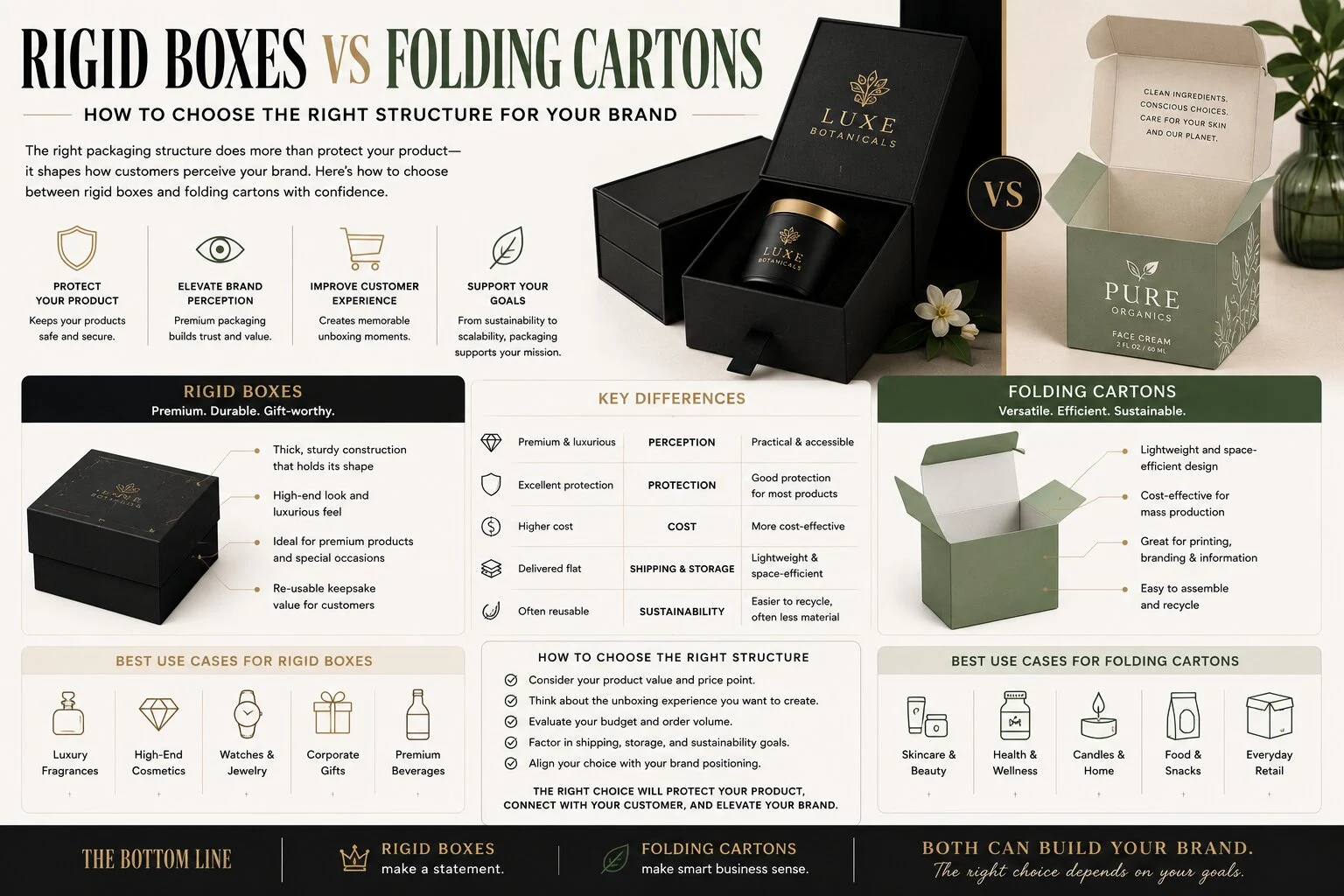
A brand owner recently asked a packaging supplier for what seemed like a simple request:
“I want a premium box.”
A few days later, two samples arrived.
In photos, they looked surprisingly similar. Both had attractive printing. Both carried the brand logo. Both appeared professional.
But the moment they were picked up, the difference became obvious.
One box flexed slightly when pressed.
The other felt solid enough to survive being dropped.
One folded and collapsed when emptied.
The other maintained its shape permanently.
That’s the difference between rigid boxes and folding cartons.
Despite looking similar in product photos, they’re fundamentally different packaging structures designed to solve different business problems. Unfortunately, many brands choose the wrong format because they evaluate packaging through digital mockups rather than handling physical samples.
Studies show 52% of consumers say premium packaging increases their likelihood of repeat purchase, making structural choices a direct business investment.
If you’re deciding between rigid packaging boxes and folding cartons, understanding how each performs in the real world can help you avoid overspending—or underinvesting—in your packaging strategy.
What Makes a Rigid Box Rigid
The word “rigid” isn’t a marketing language.
It’s a structural description.
How Rigid Boxes Are Constructed
Unlike folding cartons, rigid boxes are built around a thick chipboard core.
The process typically involves:
- Thick chipboard construction
- Specialty paper wrapping
- Permanent assembly
- Fixed structural shape
Once manufactured, the box maintains its form.
It doesn’t collapse.
It doesn’t fold flat.
It remains assembled throughout its life cycle.
Why Rigid Boxes Feel Different
The first thing customers notice is weight.
Rigid cardboard boxes feel heavier because they are heavier.
The thicker chipboard structure creates density that customers immediately recognize.
No Fold Lines Means No Weak Points
One reason rigid box packaging maintains its shape so well is that it lacks the scored fold lines found in folding cartons.
Fold lines are practical.
They also create natural structural weakness points.
Rigid boxes avoid this issue entirely.
What Customers Notice Immediately
When someone picks up a rigid box, several sensory signals appear instantly.
Weight
Heavier packaging often feels more valuable.
Resistance
Rigid structures resist pressure.
Customers notice when a box doesn’t flex.
Sound
The sound created when tapping a rigid box feels different from lightweight paperboard.
Surface Feel
Specialty paper wraps often provide a more refined tactile experience.
Why Permanence Signals Quality
There’s a psychological component at work.
A box that maintains its shape after opening often feels more valuable than one that collapses when emptied.
That’s one reason rigid boxes remain popular for premium products and gifting applications.
What Makes a Folding Carton a Folding Carton
Folding cartons solve a different set of business problems.
And for many brands, they’re the smarter choice.
How Folding Cartons Are Constructed
Folding cartons use:
- Lightweight paperboard
- Scored fold lines
- Flat shipping formats
- Various closure styles
Unlike rigid paper boxes, they ship flat and are assembled when needed.
Why Folding Cartons Dominate Retail
There’s a reason folding cartons are everywhere.
They offer practical advantages.
Lower Cost
They’re significantly less expensive than rigid structures.
Flat Shipping
Storage efficiency improves dramatically.
Faster Production
Manufacturing and logistics become simpler.
Easy Recycling
Consumers are familiar with paperboard recycling.
Versatility
They work across countless product categories.
Where Folding Cartons Perform Well
Common applications include:
- Food packaging
- Cosmetics
- Pharmaceuticals
- Personal care products
- Retail consumer goods
- Mid-range product lines
The Natural Upgrade Path
Many brands begin with folding cartons.
As revenue grows and positioning evolves, they selectively introduce rigid packaging.
That’s often the smartest progression.
Not every product needs luxury packaging on day one.
Side-by-Side Comparison
Let’s compare both structures across the factors that matter most.
Cost
This is usually the first consideration.
Rigid boxes typically cost 3–5 times more than comparable folding cartons.
At low volumes, that difference may feel manageable.
At scale, it becomes significant.
For example:
10,000 units can create a substantial packaging budget difference.
Cost alone doesn’t make folding cartons better.
But it absolutely deserves consideration.
Storage and Shipping
Folding cartons ship flat.
Rigid boxes ship assembled.
That affects:
- Warehouse space
- Freight costs
- Inventory management
Folding cartons are dramatically more efficient from a storage perspective.
Assembly Speed
Folding cartons require assembly.
Fortunately, most structures assemble in seconds.
Rigid boxes arrive ready to use but require more careful handling and storage.
Protection Performance
Rigid packaging boxes outperform folding cartons when protection matters.
This is especially true for:
- Jewelry
- Electronics
- Glass products
- Luxury gifts
The thicker structure provides meaningful protection advantages.
Customer Perception
This is where rigid packaging consistently wins.
Customers immediately perceive:
- Higher value
- Better quality
- Premium positioning
Folding cartons can look excellent.
They rarely create the same first impression.
Sustainability
This comparison is more nuanced than many people realize.
Folding cartons:
- Use less material
- Require less shipping space
- Generally have lower transportation impacts
Rigid boxes:
- Use more material
- Require more storage
- Often remain in use longer
Many customers reuse rigid gift boxes for years.
That extended lifespan offsets some environmental concerns.
When Rigid Boxes Are Worth the Investment
Let’s address the most important question.
When do rigid boxes actually make business sense?
Product Categories That Consistently Justify Rigid Packaging
Several categories routinely benefit from rigid structures.
Products Above $50
Higher margins support premium packaging investments.
Gift Purchases
Presentation becomes part of the product experience.
Jewelry and Accessories
Customers expect elevated packaging.
Premium Cosmetics
Luxury positioning often requires luxury presentation.
Cannabis Hardware
Premium vape devices and accessories frequently use rigid packaging.
Electronics Accessories
Strong protection and premium presentation work together.
Luxury Candles
Heavy glass vessels benefit from stronger structures.
Subscription Box Upgrades
Premium membership tiers often justify premium packaging.
When Rigid Boxes Rarely Deliver ROI
Not every product benefits.
Rigid packaging usually struggles to justify itself for:
- Everyday consumables
- Low-margin products
- Commodity items
- Wholesale shipping formats
- High-volume retail basics
In these categories, the additional packaging cost often exceeds the perceived value gain.
The ROI Framework
A practical question:
Can premium packaging support a 10–15% price increase?
If the answer is yes, rigid packaging often pays for itself.
Higher margins frequently offset higher packaging costs.
Rigid packaging consistently increases perceived product value by 30–50% compared to folding cartons in consumer studies.
That’s why structure influences pricing power so directly.
For a deeper look at how structure affects buying behavior, see our guide on luxury rigid boxes and packaging psychology.
Rigid Box Styles and Their Applications
Not all rigid boxes are built the same way.
Different structures create different experiences.
Telescope Boxes (Lid and Base)
The classic rigid box.
Best for:
- Jewelry
- Cosmetics
- Electronics
The separate lid creates a deliberate reveal.
Hinged Lid Rigid Boxes
Single-piece construction with an attached lid.
Best for:
- Technology products
- Specialty gifts
- Presentation kits
The lid remains attached and display-friendly.
Magnetic Closure Boxes
One of the most popular premium formats.
Best for:
- Cannabis products
- Gift sets
- Tech accessories
The magnetic click creates a satisfying user experience.
Drawer Slide Boxes
Products slide outward from the structure.
Best for:
- Candles
- Jewelry
- Specialty goods
The slower reveal increases anticipation.
Clamshell Rigid Boxes
Hinged opening design.
Best for:
- Electronics
- Collectibles
- Display-oriented products
Specialty Rigid Formats
Luxury brands frequently use:
- Round boxes
- Hexagonal structures
- Custom geometric shapes
These formats create strong differentiation but also increase production costs.
Finishing Options for Rigid Boxes
Structure creates the foundation.
Finishing creates the experience.
Specialty Paper Wraps
One of the most common upgrades.
Paper choice dramatically affects perception.
Soft-Touch Lamination
Creates a velvet-like surface.
Customers consistently respond positively to this finish.
Gold and Silver Foil
Adds visual contrast and premium cues.
Embossing
Creates raised details customers can feel.
Spot UV
Adds selective gloss for visual contrast.
Velvet Inserts
Common in luxury gifting and jewelry packaging.
Ribbon Pulls
Frequently used in drawer-style structures.
Finishing vs Structure — Which Matters More?
Here’s something many brands overlook.
A beautifully finished folding carton often outperforms a plain rigid box.
For some businesses, investing in:
- Soft-touch coating
- Foil stamping
- Embossing
May generate more value than upgrading structure alone.
The smartest packaging projects evaluate both together.
The Hybrid Approach
This is what many successful brands actually do.
Instead of choosing one structure, they use both.
Standard Products
Use folding cartons.
Gift Versions
Upgrade to rigid gift boxes.
Premium Product Lines
Introduce rigid packaging selectively.
Wholesale Programs
Continue using folding cartons.
Why the Hybrid Model Works
It maximizes value while controlling costs.
You’re investing in premium packaging only where customers notice and appreciate it most.
Seasonal Upgrades
Many brands introduce rigid packaging during:
- Holiday campaigns
- Limited editions
- Corporate gifting programs
This approach is especially effective for brands offering custom gift boxes and corporate gifting initiatives where presentation significantly influences perceived value.
Premium Pricing Opportunities
An identical product inside a rigid package often supports higher pricing than the same product in a folding carton.
The product hasn’t changed.
The perception has.
That’s why many brands reserve rigid packaging for their highest-margin opportunities.
Conclusion
Choosing between rigid boxes and folding cartons ultimately comes down to product value, customer expectations, and business economics.
A practical framework looks like this:
- Under $30 product: Folding carton is usually the better choice.
- $30–$75 product: Evaluate based on brand positioning and customer expectations.
- Over $75 product: Rigid box investment is often justified.
- Gift purchase: Rigid packaging is generally preferred.
The best packaging decisions aren’t driven by trends. They’re driven by alignment between product value, customer perception, and profitability.
Explore our custom rigid boxes and folding carton options designed for premium brands across the United States.