
Talk to enough new business owners and you’ll hear the same packaging dilemma repeatedly.
One founder is considering generic packaging because it’s affordable and carries almost no inventory risk.
Another is looking at custom packaging options and wondering whether they’re making a mistake by spending money before sales are fully proven.
The fear works both ways.
On one side is the risk of ordering hundreds of custom boxes that sit in storage because sales don’t materialize as quickly as expected.
On the other side is the concern that generic packaging makes a great product look ordinary, limiting growth before the business has a chance to establish itself.
The reality is that small business packaging decisions are fundamentally different from the decisions large brands make. Enterprise companies can absorb inventory mistakes. Small businesses usually can’t. Cash flow, minimum order quantities, storage space, and product testing all matter.
Over 60% of new ecommerce businesses cite packaging costs as a significant early challenge, with many either overspending on premium packaging too early or underspending on generic packaging that limits brand growth.
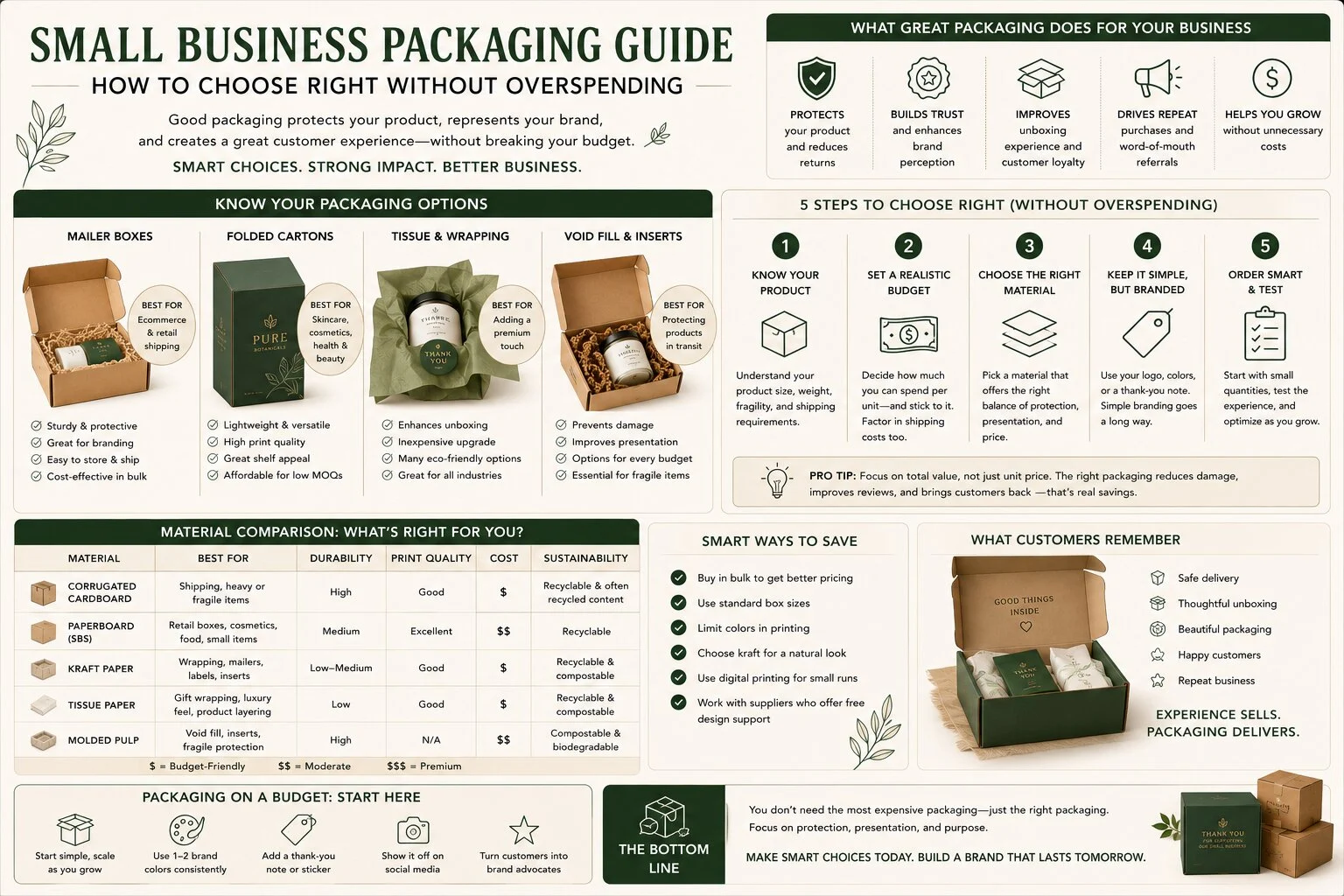
If you’re selling through Etsy, Shopify, Amazon, local boutiques, or farmers markets, this guide will help you make practical packaging decisions without creating unnecessary financial risk.
The Two Mistakes Small Businesses Make with Packaging
Most packaging problems for early-stage brands fall into one of two categories.
Interestingly, they sit on opposite ends of the spectrum.
Mistake 1: Overspending on Premium Packaging Too Early
This usually happens when a founder falls in love with packaging before validating demand.
A common example:
Ordering 1,000 luxury rigid boxes for a product that has only sold 50 units.
The packaging looks incredible.
The problem is everything else.
Now you have:
- Cash tied up in inventory
- Storage requirements
- Limited flexibility
- Pressure to keep using outdated packaging
What happens if your logo changes?
What if the product evolves?
What if sales slow down?
The packaging remains.
Many small businesses learn this lesson the expensive way.
Mistake 2: Using Generic Packaging That Limits Brand Growth
The opposite mistake is just as common.
Plain brown boxes and generic poly mailers seem like the safest option because they cost very little.
And honestly, there are situations where generic packaging is absolutely appropriate.
But it comes with hidden costs.
Customers often perceive:
- Lower product value
- Less professionalism
- Less brand identity
Other consequences include:
- Reduced social sharing
- Fewer memorable unboxing experiences
- More difficulty supporting premium pricing
Eventually, many businesses realize they’ve built sales momentum without building brand recognition.
The Middle Path
Most successful small brands land somewhere in the middle.
They use:
- Low-MOQ packaging
- Basic custom branding
- Limited inventory commitments
This approach creates professional presentation while minimizing risk.
That’s usually the smartest starting point.
Starting Small – What Actually Works for Early-Stage Brands
Fortunately, custom packaging small business options have improved dramatically.
You no longer need enterprise-sized budgets to create branded packaging.
Digital Printed Custom Boxes
Digital printing changed the packaging landscape for small brands.
Today, many suppliers offer custom boxes starting at:
- 25 units
- 50 units
- 100 units
Best for:
- Product testing
- Seasonal launches
- New product introductions
- Market validation
The biggest advantage?
You can test packaging before committing to large quantities.
Branded Tissue Paper and Inserts
This might be the highest-impact upgrade available for small businesses.
A simple branded tissue wrap can dramatically improve the customer experience.
Best for:
- Shopify stores
- Etsy sellers
- Handmade products
- Boutique brands
The investment is modest.
The perceived value increase is significant.
Custom Tape
Many founders overlook this option.
That’s a mistake.
Custom tape allows you to use generic shipping boxes while still creating recognizable branding.
Best for:
- Ecommerce fulfillment
- Subscription products
- Businesses shipping regularly
It works particularly well alongside custom mailer boxes later as the business grows.
Sticker Upgrades
Stickers are one of the most practical bridge solutions available.
Instead of replacing packaging entirely, you upgrade it incrementally.
Benefits include:
- Low upfront investment
- Easy application
- Brand consistency
- Flexibility during product changes
Many successful brands spend months or years using this approach.
Simple Kraft Sleeve Packaging
Kraft sleeves deserve more attention than they receive.
They’re affordable.
They’re visually appealing.
And they require relatively little material.
Excellent for:
- Soap products
- Candles
- Artisan foods
- Handmade goods
This approach is especially common among Etsy sellers and farmers market vendors.
The Natural Progression
Most businesses follow a path that looks something like this:
Generic Packaging + Branding Elements
↓
Low-MOQ Custom Packaging
↓
The key is not skipping steps prematurely.
Understanding Minimum Order Quantities for Small Businesses
MOQ stands for Minimum Order Quantity.
It’s one of the most important concepts small business owners need to understand.
Why MOQ Exists
Packaging suppliers incur setup costs.
These include:
- Artwork preparation
- Plate creation
- Machine setup
- Production calibration
Those costs get distributed across the order quantity.
The larger the order, the lower the cost per unit.
Typical MOQ Ranges
Here are realistic starting ranges:
Digital Printed Boxes
- 25–100 units
Offset Printed Boxes
- 250–500 units
Rigid Boxes
- 50–200 units
Kraft Sleeves
- 50–200 units
Corrugated Mailers
- 50–200 units
These numbers vary by supplier, but they provide a useful planning framework.
How Much Inventory Should You Order?
A practical rule:
Order approximately 4–8 weeks of expected inventory.
Not six months.
Not a year.
Just enough to validate demand.
The Risk of Large Packaging Orders
Large inventory commitments increase exposure to:
- Design changes
- Product updates
- Sales slowdowns
- Branding adjustments
Every packaging box sitting in storage represents tied-up capital.
When It’s Time to Scale
One signal matters more than most.
If you’re reordering the same packaging design within 60–90 days, scaling production often becomes economically sensible.
At that point, larger runs typically reduce overall costs.
Budget Framework for Small Business Packaging
Let’s talk about numbers.
Because this is where many founders struggle.
General Budget Guidelines
For most retail products:
Packaging should represent approximately:
5–15% of product price
This isn’t a hard rule.
It’s a useful starting framework.
Examples
Product Price: $30
Recommended packaging budget:
$1.50–$4.50
Product Price: $50
Recommended packaging budget:
$2.50–$7.50
Premium products can justify higher percentages.
Commodity products usually require lower percentages.
Spending Priorities
When budgets are limited, prioritize in this order:
Priority 1: Functional Protection
Always start here.
Questions to ask:
- Is the product protected?
- Is the box the correct size?
- Will it survive shipping?
Nothing matters more.
Priority 2: Basic Branding
Even a simple logo matters.
Recognition compounds over time.
Priority 3: Presentation Upgrades
Examples:
- Tissue paper
- Inserts
- Interior printing
These upgrades often create meaningful customer experience improvements.
Priority 4: Premium Finishes
Examples:
- Foil stamping
- Embossing
- Spot UV
These should come later.
Not first.
When Premium Packaging Makes Sense
Studies show 52% of consumers say premium packaging increases their likelihood of repeat purchase — making packaging investment a direct retention strategy.
However, premium packaging earns its cost only when:
- Margins support it
- Customers notice it
- Product positioning justifies it
For many small businesses, premium finishes come after growth—not before it.
Packaging Decisions by Sales Channel
Different channels create different priorities.
Understanding this prevents wasted spending.
Etsy and Handmade Markets
Customers often buy stories as much as products.
Visual presentation matters enormously.
Recommended approach:
- Kraft sleeves
- Simple printed boxes
- Branded tissue
Social sharing potential is particularly strong in handmade categories.
This is especially true for artisan soap, candles, and similar products.
Farmers Markets and Craft Fairs
Visibility matters.
Customers frequently make decisions quickly.
Recommended approach:
- Product-visible packaging
- Minimal sleeves
- Simple branded systems
Seasonal demand fluctuates, making low-MOQ packaging especially valuable.
Shopify and Direct-to-Consumer Ecommerce
Protection becomes the priority.
Customers experience the packaging at home.
Recommended approach:
- Corrugated mailers
- Branded tissue
- Exterior logo branding
Many brands benefit from lessons covered in our corrugated packaging guide because shipping performance directly affects customer satisfaction.
Amazon
Amazon creates unique packaging requirements.
Their shipping systems often place products inside additional outer packaging.
Recommended approach:
- Strong corrugated structures
- Correct sizing
- Minimal branding investment
Protection matters more than presentation.
Local Boutique Retail
Shelf appearance drives purchasing behavior.
Recommended approach:
- Tuck-end boxes
- Clean graphics
- Consistent sizing
Here, packaging functions as a silent salesperson.
When to Upgrade Packaging — Clear Signals
Many founders struggle with timing.
Here’s a practical framework.
Upgrade Packaging When:
- You’re reordering within 60–90 days
- Customers mention packaging positively
- Competitors use noticeably better packaging
- You’re increasing prices
- Gift purchases are growing
- Customer social sharing remains low
These signals suggest packaging may be limiting growth.
Don’t Upgrade Packaging When:
- Sales remain inconsistent
- Product design is still changing
- Major selling seasons are approaching
- Existing inventory remains substantial
Packaging upgrades work best when timing supports them.
Practical Packaging Checklist for Small Businesses
When in doubt, use this framework.
Step 1: Define Your Sales Channel
Where does most revenue come from?
That answer should guide packaging decisions.
Step 2: Calculate Your Budget
Use the 5–15% framework.
Start there.
Adjust later.
Step 3: Choose the Right Structure
Protection first.
Presentation second.
The packaging must fit the product properly.
Step 4: Add One Branding Element
You don’t need everything immediately.
Even one improvement helps:
- Logo printing
- Tissue paper
- Custom tape
- Stickers
Step 5: Order Conservatively
Limit initial orders to:
4–8 weeks of expected inventory
This protects flexibility.
Step 6: Measure Customer Response
Pay attention.
Are customers:
- Mentioning packaging?
- Sharing photos?
- Leaving comments?
Those signals help determine future investments.
Conclusion
Small business packaging success rarely comes from buying the most expensive solution available. It usually comes from selecting the right structure, adding the minimum effective branding, and scaling investments only after results justify them.
The smartest founders treat packaging the same way they treat marketing. They test first. They learn what works. Then they scale what works.
That’s how you build a recognizable brand without creating unnecessary inventory risk or cash-flow pressure.
Explore our custom packaging boxes with low minimum order quantities designed for small businesses and growing brands across the United States.