

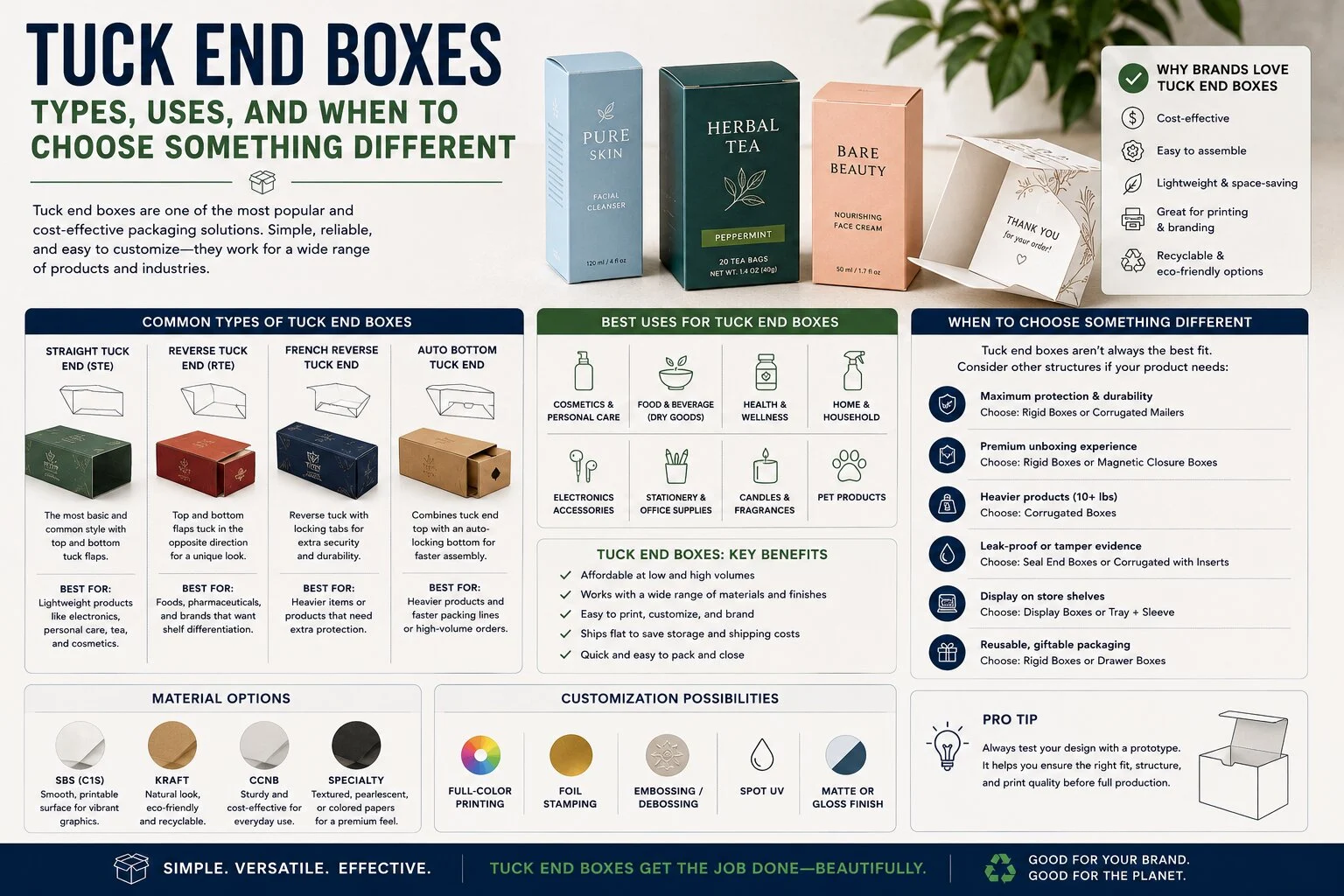
Most people have never heard the term tuck end box.
Yet they’ve probably handled hundreds of them.
The medicine bottle in your bathroom cabinet. The vitamins in your kitchen. The cosmetic product on your vanity. The charging cable you bought online. Even many cereal and food products use variations of the same packaging structure.
The fold-and-tuck closure is everywhere in retail.
That’s because tuck end boxes have become the workhorses of modern packaging. They’re affordable, easy to produce, efficient to ship, and adaptable to an enormous range of products. For many brands, they’re the first packaging structure considered during product development.
But not all tuck end boxes work the same way.
Choosing the wrong style can create unexpected problems. A closure that’s perfect for a vitamin supplement may be frustrating for a cosmetic product. A structure that works well for lightweight retail goods may struggle with heavier items.
Tuck end boxes represent the most widely used retail packaging structure globally, appearing across cosmetics, pharmaceuticals, food, electronics, and consumer goods categories.
If you’re evaluating packaging options, understanding the differences between tuck styles can help you make a smarter decision before production begins.
What Is a Tuck End Box?
At its core, a tuck end box is a rectangular folding carton with closure panels that fold and tuck into place at the top, bottom, or both ends.
The concept is simple.
Instead of requiring separate fasteners, the box uses integrated flaps that slide into the structure to secure the package.
That’s where the name comes from.
The end flaps literally tuck into the box.
Why They’re So Common
Retail packaging buyers choose tuck end packaging because it solves several practical challenges at once.
Fast Assembly
Tuck end structures can be assembled quickly during production and fulfillment.
Flat Shipping
Before use, the boxes ship flat.
This dramatically reduces storage and transportation costs.
Strong Printing Surfaces
The flat exterior panels provide excellent space for branding, product information, and compliance requirements.
Cost-Efficient Production
Compared to rigid packaging, folding cartons are significantly more affordable.
Product Flexibility
Tuck end boxes work for:
- Cosmetics
- Vitamins
- Supplements
- Electronics accessories
- Food products
- Personal care products
- Retail consumer goods
What They Don’t Do Particularly Well
Despite their versatility, tuck end boxes have limitations.
They generally underperform when you need:
- Luxury presentation
- Premium gifting experiences
- Heavy-duty structural support
- Long-term reusable packaging
For those situations, other structures often make more sense.
We’ll come back to that later.
The Four Main Tuck End Box Styles
This is where many packaging guides fall short.
They explain what a tuck end box is but never explain how the major styles differ.
Those differences matter.
Straight Tuck End (STE)
Straight tuck end boxes use top and bottom closures that open from the same side.
How It Works
Both flaps fold inward toward the same side of the box.
The structure creates a consistent opening direction.
Best For
- Pharmaceutical products
- Vitamin packaging
- High-volume retail items
- Automated packaging lines
Advantage
The biggest benefit is assembly efficiency.
Straight tuck end boxes work exceptionally well with automatic filling equipment.
That’s one reason they’re common in large-scale manufacturing.
Disadvantage
The bottom closure can occasionally open during heavy handling if the product places significant stress on the structure.
For lightweight products, this usually isn’t a concern.
For heavier products, it can become one.
Reverse Tuck End (RTE)
Reverse tuck end boxes use opposing closure directions.
How It Works
The top flap tucks toward the back.
The bottom flap tucks toward the front.
The closures move in opposite directions.
Best For
- Cosmetics
- Personal care products
- Consumer electronics
- Retail products customers open frequently
Advantage
The opposing closures create a more secure overall structure.
Many brands prefer reverse tuck designs because customers tend to find them slightly more intuitive during repeated use.
Disadvantage
Assembly becomes marginally more complex.
For most businesses, however, the difference is minimal.
Auto Bottom (Snap Lock Bottom)
Auto bottom boxes introduce a completely different approach.
How It Works
The bottom flaps are pre-glued during manufacturing.
When the box is opened, the base automatically locks into position.
No manual bottom assembly required.
Best For
- Food products
- Heavier retail products
- Bottled items
- Products requiring stronger support
Advantage
The base is dramatically stronger than standard folding closures.
This can prevent costly packaging failures.
Disadvantage
Because of the glued structure, production costs are slightly higher.
The box also requires partial assembly rather than remaining completely flat.
Seal End Boxes
Seal end structures eliminate tuck closures entirely.
How It Works
The ends are permanently sealed using adhesive.
Best For
- Pharmaceutical products
- Food packaging
- Tamper-evident applications
Advantage
The closure is highly secure.
Many regulatory environments prefer this style because it helps support tamper-evidence requirements.
Disadvantage
Customers cannot reopen the package cleanly.
Once opened, the structure is effectively destroyed.
For products intended for repeated access, that’s a significant drawback.
Choosing Between Straight Tuck and Reverse Tuck
This is the question most packaging buyers ask.
And honestly, it’s where many decisions should begin.
When Straight Tuck Makes Sense
Straight tuck end boxes work particularly well when:
- Packaging lines are automated
- Assembly speed is critical
- Products are lightweight
- Pharmaceuticals are involved
- Supplements are involved
Manufacturers often prefer straight tuck designs because they integrate smoothly into automated operations.
When Reverse Tuck Is Better
Reverse tuck end boxes generally perform better when:
- Customers open the package repeatedly
- Closure security matters
- Products sit on retail shelves
- Consumer interaction is frequent
That’s why they’re so common in cosmetics and personal care.
The Practical Test
Here’s a simple decision framework.
Ask yourself:
Will customers open this package repeatedly or only once?
If repeated, reverse tuck is often the better choice.
Once, straight tuck may be perfectly sufficient.
Production Volume Changes the Conversation
Large-scale automated operations sometimes choose straight tuck regardless of preference.
The efficiency gains can outweigh other considerations.
For smaller brands, however, customer experience often deserves greater weight.
When Auto Bottom Boxes Are Worth It
Many brands underestimate the importance of bottom strength.
Until something breaks.
Why Auto Bottom Costs More
The additional expense comes from:
- Extra production steps
- Pre-gluing operations
- More complex manufacturing
The increase is usually modest.
When the Cost Is Justified
Auto bottom boxes become worthwhile when you’re packaging:
- Products over 500 grams
- Liquid products
- Semi-liquid products
- Food items
- Heavy retail goods
A Simple Stress Test
Here’s a practical method.
Fill a standard tuck end box with your product.
Then press firmly against the bottom panel.
If you notice significant flexing, you may need stronger support.
What Happens When Standard Bottoms Fail
A failed box bottom rarely ends with the packaging.
It often leads to:
- Product damage
- Customer complaints
- Returns
- Replacement shipments
The cost of a single packaging failure frequently exceeds the cost difference between a standard and auto-bottom structure.
Why Ecommerce Brands Should Pay Attention
Shipping environments place constant pressure on package bases.
If you’re shipping heavier products, stronger structures may be worth every penny.
In some cases, brands eventually combine stronger folding cartons with custom corrugated boxes for additional shipping protection.
Printing and Finishing on Tuck End Boxes
One reason tuck end boxes remain so popular is their versatility for printing.
Why They Print Well
Several factors contribute.
Flat Exterior Panels
Smooth surfaces improve print consistency.
Four Printable Sides
Every panel can support branding and messaging.
Interior Printing Options
Inside flaps and panels can also be customized.
This creates additional opportunities for branding and customer engagement.
Printing Methods
Offset Printing
Best for:
- Large production runs
- High-quality graphics
- Detailed artwork
Digital Printing
Best for:
- Short runs
- Seasonal products
- Product testing
Popular Finishing Options
Brands frequently enhance custom tuck end boxes using:
- Matte lamination
- Gloss coating
- Spot UV
- Foil stamping
- Embossing
These upgrades can dramatically improve perceived value without changing the structure itself.
Window Cutouts
Window cutouts remain one of the most popular enhancements.
How They Work
A section of the box is removed to reveal part of the product inside.
Best For
- Food products
- Cosmetics
- Candles
- Gift items
Customers often feel more confident purchasing products they can partially see.
That’s one reason window packaging remains effective in retail environments.
When to Upgrade from Tuck End to Rigid Packaging
Let’s be honest.
Tuck end boxes aren’t always the best answer.
Situations Where They Begin to Struggle
You may want to evaluate alternatives when:
- Product prices exceed $50–$75
- Gift purchases become common
- Premium positioning matters
- Unboxing experiences drive sales
Warning Signs
Pay attention if customers say things like:
- “The product feels premium but the packaging doesn’t.”
- “The packaging looks basic.”
- “I expected something more substantial.”
Those comments are valuable signals.
Competitive Pressure Matters
If competitors at similar price points are using premium structures, your packaging may begin to feel out of place.
The Upgrade Path
A practical progression often looks like this:
- Better printing
- Premium finishes
- Enhanced tuck end structures
- Rigid packaging
Many brands don’t jump directly into luxury packaging.
They upgrade gradually.
For a deeper comparison, our guide on rigid boxes vs folding cartons explains where each structure performs best.
If gifting and luxury positioning become increasingly important, luxury rigid boxes often create stronger customer impressions than folding cartons.
Conclusion
For most retail products, tuck end boxes remain the smartest starting point. They’re cost-effective, easy to produce, efficient to ship, and flexible enough to serve hundreds of product categories.
What many brands overlook, however, is that the style decision matters. Straight tuck, reverse tuck, auto bottom, and seal end structures each solve different packaging challenges. Choosing the right one can improve assembly efficiency, customer experience, and product protection at the same time.
Before selecting a structure, think about how your customers interact with the package, how heavy the product is, and whether the box will be opened once or repeatedly.
Explore our custom tuck end boxes in straight tuck, reverse tuck, and auto bottom formats for retail and ecommerce brands across the United States