

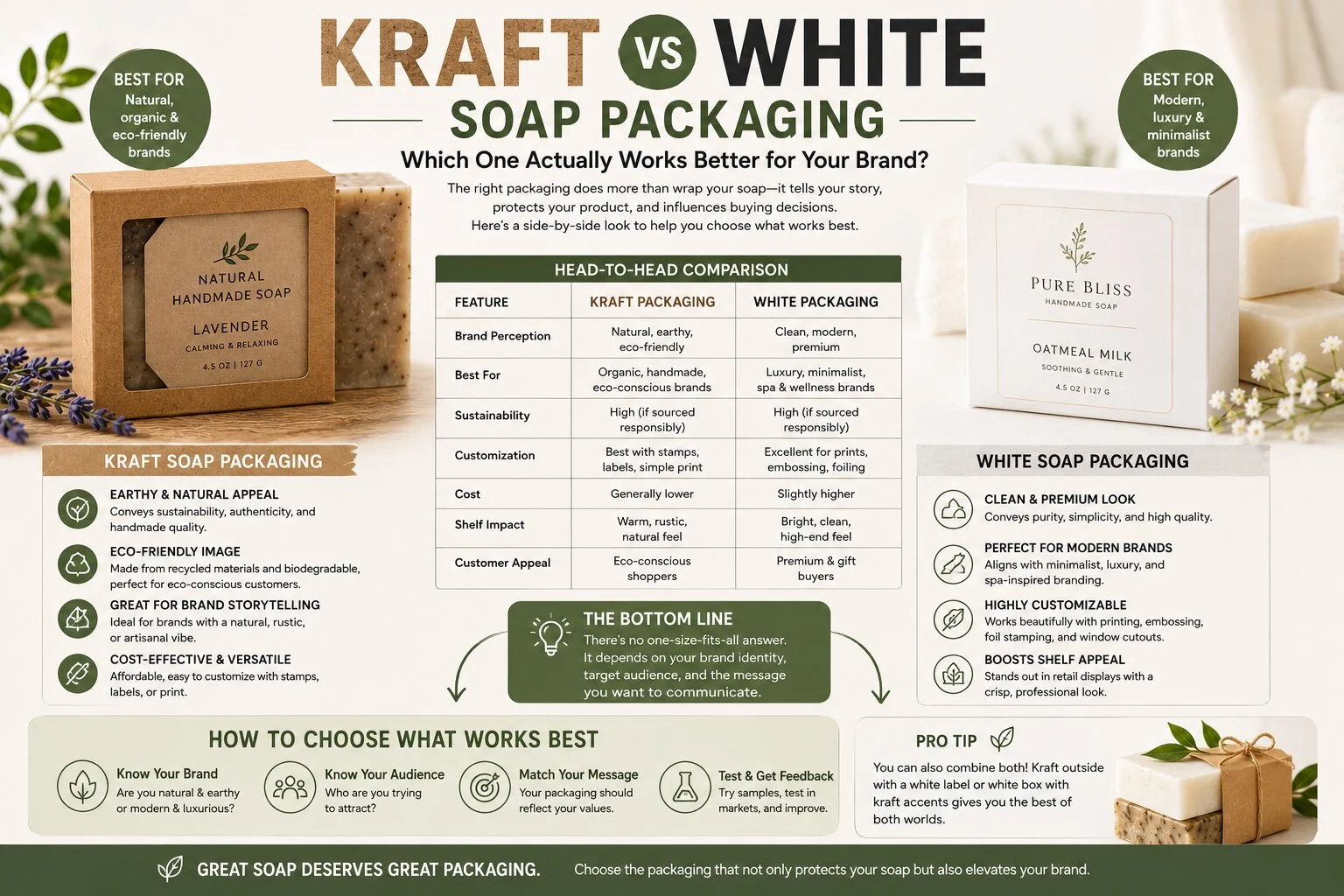
Walk through a busy farmers market and you’ll often see two soap brands selling products that are equally impressive. One displays handmade bars in kraft paper soap packaging with natural brown tones and simple black printing. A few booths away, another brand showcases its soaps in crisp white boxes with clean graphics and vibrant colors.
Both products are high quality.
Yet customers often respond to them differently before they ever pick up a soap bar.
That’s because packaging communicates a message long before a customer reads your ingredients list or brand story.
The challenge for many soap makers is deciding which message they want to send.
Should your packaging emphasize natural ingredients and artisan craftsmanship? Or should it project a clean, premium, spa-inspired image?
The answer depends on your brand identity, your products, and where you sell.
In this guide, you’ll learn how kraft paper soap packaging and white packaging influence customer perception, how they perform in print and photography, where each works best, and which option makes the most sense for your business.
What Kraft Paper Soap Packaging Actually Communicates
Imagine a customer walking through a farmers market looking for natural skincare products.
Without reading a single label, they’ll already make assumptions based on packaging appearance.
That’s where kraft packaging has a unique advantage.
Natural brown paperboard tends to communicate several qualities immediately:
- Handmade craftsmanship
- Natural ingredients
- Sustainability
- Authenticity
- Small-batch production
- Artisan quality
These signals happen almost instantly.
Customers often associate kraft soap boxes with products that feel less commercial and more personal. For artisan soap makers, that’s exactly the perception they’re trying to create.
Kraft works particularly well for:
Botanical Soap Brands
When your formulas feature herbs, flowers, clays, or plant-based ingredients, kraft packaging reinforces that natural positioning.
Organic Ingredient Formulas
Organic-focused brands often find that natural packaging materials support their overall message.
CBD Soap Products
Many CBD skincare brands use kraft packaging because it aligns naturally with wellness and plant-based product categories.
Herbal and Essential Oil Soaps
Customers shopping for lavender, eucalyptus, peppermint, or tea tree soaps often respond positively to earthy packaging aesthetics.
Farmers Market Positioning
At local markets, kraft packaging frequently feels more authentic than highly polished retail packaging.
Eco-Conscious Brands
Many environmentally minded consumers actively look for packaging that appears natural and minimally processed.
The psychology behind kraft is simple.
Natural textures create a perception of honesty and transparency. Some customers actively prefer kraft soap boxes because they feel less mass-produced and more handcrafted.
In fact, over 60% of consumers say they actively look for brands using sustainable or natural-looking packaging materials when shopping for personal care products.
That doesn’t mean kraft is always the right answer. It simply means it sends a very specific message.
What White Soap Packaging Communicates
Now picture a luxury spa gift shop.
The shelves are organized, clean, and minimal. Products feel curated and premium.
In environments like this, white soap packaging often performs exceptionally well.
White stock communicates different qualities than kraft.
Customers frequently associate white packaging with:
- Clean aesthetics
- Professional presentation
- Modern branding
- Luxury positioning
- Clinical quality
- Spa-inspired products
The visual effect is immediate.
White backgrounds create a blank canvas that allows branding and product information to stand out clearly.
White works especially well for:
Luxury Spa Soap Collections
Many premium spa brands rely on white packaging because it reinforces cleanliness and sophistication.
Medical or Dermatologist-Grade Soaps
Clinical skincare products often benefit from white packaging because it supports trust and professionalism.
Minimalist Modern Brands
Simple typography and contemporary branding tend to perform beautifully on white stock.
Premium Gift Packaging
Gift buyers often perceive white boxes as more refined and upscale.
High-End Boutique Retail
Many boutique retailers prefer white soap boxes because they create a clean shelf presentation.
Bold Graphic Printing
Brands using strong colors and complex graphics typically achieve better visual results on white materials.
One major advantage is color reproduction.
White soap packaging provides a neutral surface that allows colors to appear exactly as intended.
For some brands, that’s critical.
Print Quality Differences – Kraft vs White
This is where the conversation becomes highly practical.
A beautiful design on your screen may look very different once printed.
Kraft Packaging Limitations
Kraft stock has natural characteristics that affect printing.
These include:
- Colors appearing warmer and more muted
- Bright colors losing vibrancy
- White ink often required for lighter elements
- Fine details becoming less sharp
- Textured surfaces affecting precision
If your logo depends on bright blues, vivid pinks, or subtle gradients, kraft may not deliver the exact result you’re expecting.
White Stock Advantages
White stock provides far more printing flexibility.
Benefits include:
- Accurate color reproduction
- Vibrant gradients
- Photographic printing capability
- Sharper fine-line artwork
- Better foil adhesion
- Cleaner embossing and debossing
When does print quality matter most?
Choose White Stock When You Have:
- Complex logo systems
- Product photography on packaging
- Bright brand colors
- Luxury foil applications
- Detailed illustrations
Choose Kraft When You Have:
- Minimal branding
- Simple logos
- Ingredient-focused packaging
- Artisan storytelling
- Natural product positioning
Sometimes texture matters more than perfect color accuracy.
Other times, precise printing becomes the priority.
Photography Performance – Etsy and Social Media
If you sell online, photography matters almost as much as packaging itself.
I’ve seen soap makers choose packaging based entirely on how it performs in product photos.
How Kraft Packaging Photographs
Kraft paper soap packaging works beautifully in natural settings.
It pairs particularly well with:
- Wooden tabletops
- Stone surfaces
- Linen fabrics
- Cotton textures
- Natural light photography
These combinations create warmth and authenticity.
Many Etsy sellers prefer kraft because it immediately supports a handmade aesthetic.
How White Packaging Photographs
White boxes excel in controlled environments.
They’re ideal for:
- White marble backgrounds
- Studio photography
- Neutral backdrops
- Ecommerce catalog images
- Modern lifestyle shoots
White packaging often produces a cleaner and more polished appearance.
Instagram vs Etsy
Generally speaking:
- Instagram audiences often respond well to natural, lifestyle-oriented craft photography.
- Etsy product listings frequently perform well with both styles depending on brand positioning.
- Ecommerce websites often benefit from the clean consistency of white packaging.
A simple recommendation: photograph sample packaging before committing to a large production run.
Seeing the packaging through your camera lens often changes your perspective.
Cost Comparison – Kraft vs White
One question comes up repeatedly:
Is kraft more expensive?
The answer is not always.
Pricing depends on several factors:
- Material grade
- Print requirements
- Production quantity
- Finishing options
- Supplier capabilities
For basic packaging projects, the difference between kraft and white stock is often smaller than many people expect.
Where costs increase is in printing.
For example:
- White ink on kraft can add cost.
- Heavy color coverage may increase expenses.
- Specialty finishes affect both materials.
Premium white stock with advanced finishing can sometimes cost more than kraft.
At higher production volumes, the cost gap often narrows further.
When Kraft Delivers Better Value
Choose kraft if:
- Your branding is simple
- Natural aesthetics support your products
- You want strong artisan positioning
When White Delivers Better ROI
Choose white if:
- Branding relies on color accuracy
- Shelf presentation is critical
- Premium retail environments are important
Before placing a large order, request material samples.
Physical samples reveal far more than digital mockups.
Can You Use Both?
Absolutely.
Many successful soap brands do exactly that.
A common packaging strategy looks like this:
- Kraft sleeves for market displays
- White boxes for premium collections
- Kraft holster soap packaging for artisan product ranges
- White rigid boxes for luxury gift sets
The key is maintaining brand consistency.
Your logo, typography, color palette, and messaging should remain recognizable regardless of material choice.
Customers identify brands through visual consistency more than material uniformity.
This is also why many brands combine custom soap boxes, soap sleeves, and holster soap packaging across different product lines without confusing customers.
Which Should You Choose?
If you’re still undecided, here’s a practical framework.
Choose Kraft If:
- You’re an artisan soap maker
- You sell at farmers markets
- Your products emphasize natural ingredients
- You use botanical or herbal formulas
- Your photography style feels organic and lifestyle-focused
Choose White If:
- You’re targeting boutique retail
- You sell luxury spa products
- Your branding relies on vibrant colors
- You want premium gift presentation
- Your photography style is clean and studio-based
For First-Time Packaging Buyers
Start with the material that best reflects your product story.
If you’re selling handmade soap at markets or through Etsy, kraft paper soap packaging is usually the safest starting point because it aligns naturally with customer expectations.
If your goal is luxury retail placement or premium gift packaging, white stock often creates a stronger first impression.
Conclusion
Choosing between kraft paper soap packaging and white soap packaging isn’t about finding a universal winner.
Kraft communicates authenticity, natural ingredients, artisan production, and eco-conscious values. It’s often the best fit for handmade soap brands, farmers market vendors, botanical products, and businesses that want a handcrafted appearance.
White packaging communicates cleanliness, professionalism, luxury, and modern branding. It’s often the stronger choice for spa collections, boutique retail, gift packaging, and brands that rely heavily on graphic design.
Neither option is wrong. They simply tell different stories.
The best packaging is the one that reinforces the message your products already communicate. Explore our full range of custom soap boxes in kraft, white, and specialty paper stock to find the right match for your soap brand, sales channels, and long-term growth strategy.