

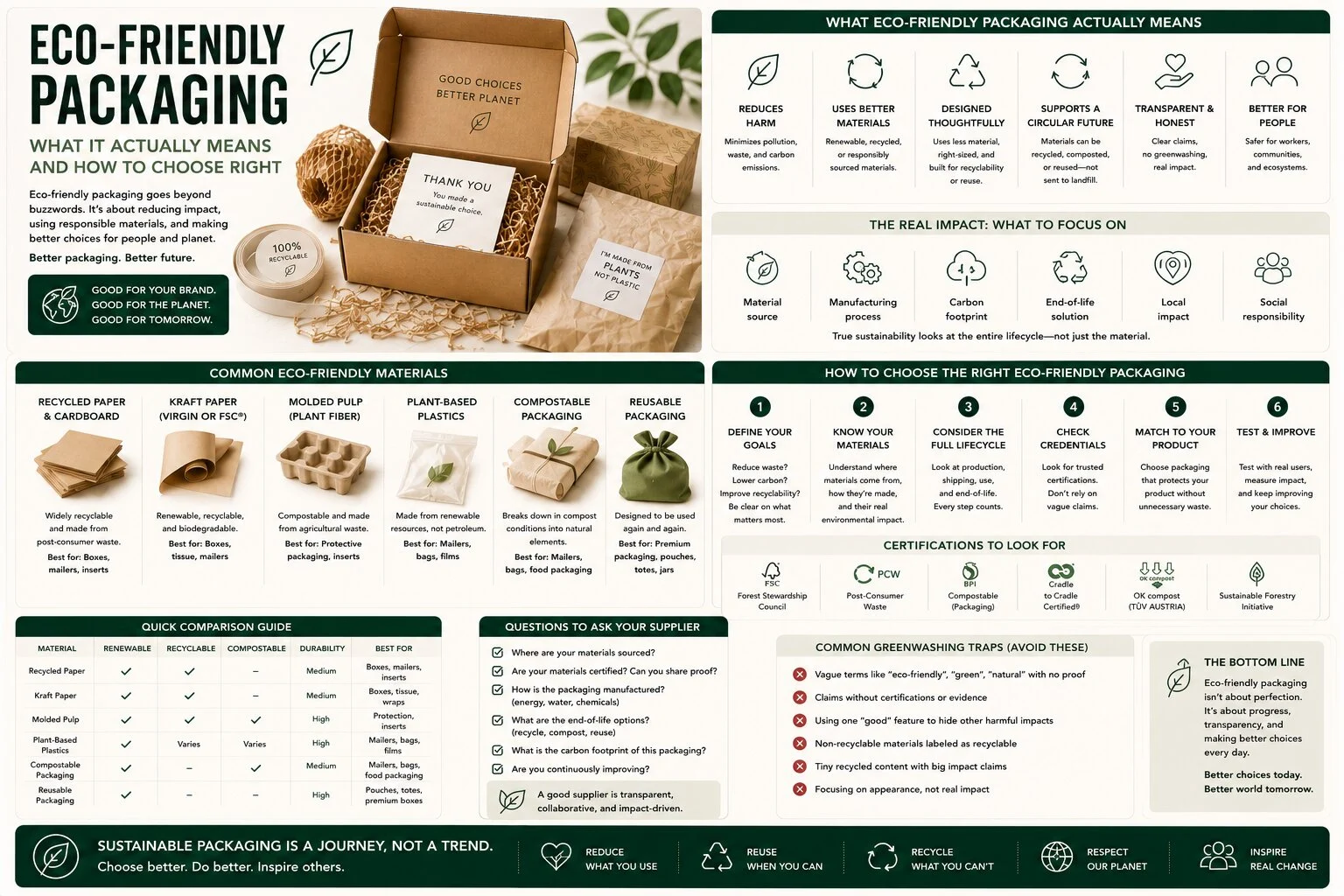
A brand owner recently switched to packaging marketed as “eco-friendly” by a supplier.
The boxes looked the part. They featured natural kraft coloring, sustainability messaging, and environmentally focused branding. Customers were actively choosing the product because of those claims.
A few months later, the company discovered something frustrating.
The packaging included a laminated coating that prevented it from being recycled through many standard recycling programs.
The sustainability message suggested one thing.
The packaging reality suggested another.
This situation is more common than many brands realize. The term eco friendly packaging has become one of the most overused and least specific phrases in the packaging industry. Some products genuinely deliver measurable environmental benefits. Others rely heavily on marketing language while providing limited sustainability advantages.
That distinction matters because customers are paying attention.
Research shows that 72% of consumers say they are willing to pay more for sustainable packaging, but over 40% say they don’t trust brand sustainability claims without verifiable evidence.
If you’re evaluating sustainable packaging options, your goal shouldn’t be finding the packaging with the greenest marketing. Your goal should be finding packaging backed by credible, verifiable claims that stand up to scrutiny.
Why “Eco-Friendly” Packaging Is Often Vague
One of the biggest challenges in sustainability is terminology.
Words like:
- Eco-friendly
- Green
- Natural
- Sustainable
- Biodegradable
sound meaningful, but they often lack precise definitions when used in packaging marketing.
The Terminology Problem
Unlike certifications, many sustainability terms are not universally defined.
Two suppliers may describe entirely different packaging materials as “green packaging” while offering completely different environmental performance.
This creates confusion for buyers and customers alike.
Common Ways Brands Misuse Sustainability Language
Some examples appear regularly throughout the packaging industry:
- Kraft packaging marketed as eco-friendly without FSC certification
- Recyclable claims on packaging containing non-recyclable laminations
- Biodegradable packaging that only breaks down in industrial composting facilities
- Natural paper materials printed using inks or coatings with poor environmental profiles
The issue isn’t always intentional.
Sometimes suppliers simply use broad sustainability language without providing supporting details.
The Credibility Risk of Greenwashing
Customers today are more informed than ever.
Many actively research environmental claims before purchasing.
When sustainability claims prove misleading, customers often share their findings publicly through reviews, social media, and community forums.
The trust lost from greenwashing frequently exceeds any short-term marketing benefit.
What Brands Should Do Instead
Replace vague claims with specific claims.
Instead of saying:
“Environmentally friendly packaging”
Say:
“FSC-certified paperboard printed with soy-based inks.”
Specificity creates credibility.
What Actually Makes Packaging Sustainable – Specific Criteria
Not all sustainability claims carry equal value.
Here are the criteria that matter most when evaluating sustainable packaging.
FSC Certification
Forest Stewardship Council certification verifies that paper-based materials originate from responsibly managed forests.
This remains one of the strongest sustainability credentials available for paper packaging.
FSC certification addresses:
- Responsible forestry practices
- Biodiversity protection
- Sustainable harvesting
- Community and labor standards
Important note:
The FSC logo may only be displayed with proper licensing approval.
Recycled Content
Post-consumer recycled (PCR) content refers to materials recovered from consumer waste streams and reintroduced into manufacturing.
Specific percentages matter.
For example:
- 30% PCR content
- 50% PCR content
- 100% recycled fiber
These claims provide significantly more value than simply stating:
“Made from recycled materials.”
Recyclability
A package is only truly recyclable when:
- The material is accepted within recycling programs.
- Additional components do not prevent recycling.
This is where many sustainability claims become problematic.
For example, certain laminations, coatings, or mixed-material constructions may reduce recyclability despite the paper substrate being recyclable.
There is an important difference between:
- Widely recyclable
- Recyclable where facilities exist
Brands should understand and communicate that distinction clearly.
Compostable and Biodegradable Materials
These terms are often used interchangeably, but they are not the same.
Industrial Compostable
Requires commercial composting facilities operating under controlled conditions.
Home Compostable
Designed to break down in standard backyard composting environments.
Biodegradable
Simply means the material will break down eventually.
Without a specified timeframe or environmental conditions, the term provides very little practical information.
Always ask suppliers:
- Under what conditions?
- Within what timeframe?
Soy-Based Inks
Soy-based inks replace petroleum-derived inks with plant-based alternatives.
Benefits include:
- Reduced VOC emissions
- Renewable raw materials
- Improved environmental profile for print-heavy packaging
For brands relying on extensive graphics, this can be a meaningful sustainability improvement.
Water-Based Coatings
Water-based coatings replace many traditional solvent-based systems.
Advantages include:
- Lower emissions during production
- Better compatibility with recycling streams
- Reduced environmental impact
They are increasingly used across sustainable box packaging applications.
FSC Certification – Why It Matters Most
Among all sustainability certifications available in paper packaging, FSC certification often carries the most weight.
Why FSC Stands Out
- Independently verified
- Globally recognized
- Trusted by retailers
- Widely understood by procurement teams
Many corporate sustainability programs specifically require FSC-certified packaging materials.
What FSC Certification Covers
FSC evaluates more than trees.
Certification includes:
- Forest management standards
- Chain-of-custody tracking
- Worker protections
- Indigenous community considerations
- Environmental stewardship practices
How to Verify FSC Claims
Verification is straightforward.
Ask suppliers for their FSC certification number.
Then verify it directly through:
info.fsc.org
This extra step provides confidence that claims are legitimate.
Displaying FSC Marks Correctly
Many brands do not realize that FSC logos require authorization.
You cannot simply place an FSC mark on packaging.
Proper licensing approval must be obtained before displaying official FSC trademarks.
Research shows that over 60% of consumers say FSC certification increases their trust in a brand’s environmental claims more than any other packaging certification.
That’s why FSC certified packaging remains one of the most valuable sustainability investments available.
Recyclable vs Biodegradable vs Compostable – Important Differences
These three terms are frequently confused.
Understanding the differences helps brands make smarter decisions.
Recyclable Packaging
Recyclable packaging can be collected, processed, and converted into new materials.
Best examples include:
- Corrugated boxes
- Paperboard cartons
- Standard cardboard packaging
- Many recyclable packaging formats
Recyclability performs best when local infrastructure already exists.
Biodegradable Packaging
Biodegradable materials break down through biological activity.
The challenge is that breakdown rates vary dramatically.
Some materials degrade in months.
Others may require years.
Without specific conditions and timelines, biodegradability claims can become misleading.
Common biodegradable packaging materials include:
- Kraft paper
- Uncoated paperboard
- Certain certified bio-plastics
Compostable Packaging
Compostable packaging breaks down into organic matter.
The key distinction is composting infrastructure.
Industrial composting facilities remain unavailable in many regions.
As a result, compostable packaging sometimes delivers less real-world environmental benefit than recyclable packaging.
Why Recyclable Often Wins
For many brands, recyclable packaging creates greater practical sustainability impact.
Why?
Because recycling systems already exist across much of the United States.
Industrial composting infrastructure remains far more limited.
For many ecommerce and retail brands, recyclable packaging is currently the more realistic sustainability solution.
How to Make Genuine Sustainability Claims That Build Brand Trust
The strongest sustainability messaging is usually the simplest.
Be Specific, Not General
Instead of:
“Eco-friendly packaging”
Say:
“FSC-certified paperboard printed using soy-based inks.”
Specificity earns trust.
Match Claims to Reality
If packaging is recyclable only in specialized facilities, explain that honestly.
Customers appreciate transparency.
Include Disposal Instructions
Consumers often want guidance.
Simple instructions help improve actual recycling outcomes.
Examples:
- Recycle curbside where accepted
- Remove insert before recycling
- Compost where facilities exist
Verify Supplier Documentation
Before making claims, ask suppliers:
- Is the packaging FSC certified?
- What recycled content percentage does it contain?
- Are soy inks used?
- Are coatings water-based?
Documentation matters.
Start Small
One verified claim is more powerful than multiple unverified claims.
Credibility compounds over time.
Sustainability and Premium Packaging — Not Opposites
Many businesses still assume sustainable packaging must look plain.
That assumption is outdated.
Today’s sustainable packaging options support premium presentation exceptionally well.
Premium Finishes Available on Sustainable Packaging
Modern eco packaging boxes can include:
- Foil stamping on FSC-certified stock
- Embossing on recycled paperboard
- Matte finishes using recyclable-compatible coatings
- High-quality color printing using soy-based inks
Water-Based Coatings Have Improved Dramatically
Historically, premium visual effects often required solvent-based systems.
Today’s water-based technologies support many of the same visual outcomes with improved sustainability performance.
Sustainability in Premium Categories
Many luxury skincare brands now combine:
- FSC-certified materials
- Premium embossing
- Recycled paperboard
- Soy-based printing
The same trend appears throughout wellness and CBD markets. Brands featured in our Eco Cannabis Packaging guide increasingly balance sustainability goals with premium shelf presentation.
Sustainable packaging and premium packaging are no longer opposing strategies.
Practical Steps for Brands Transitioning to Sustainable Packaging
Transitioning doesn’t need to happen all at once.
A phased approach works best.
Step 1: Audit Current Materials
Review existing packaging specifications.
Identify certifications currently in place.
Step 2: Prioritize High-Volume SKUs
Focus on products generating the most sales volume.
This creates the greatest environmental impact.
Step 3: Start with FSC-Certified Materials
For most paper-based packaging, FSC certification is the easiest and most credible first step.
Step 4: Evaluate Ink and Coating Systems
Ask suppliers whether:
- Soy-based inks are available
- Water-based coatings can replace existing systems
Step 5: Create Specific Claims
Update packaging and website content using verified sustainability statements.
Avoid generic green language.
Step 6: Communicate Disposal Instructions
Help customers understand proper disposal methods.
Small instructions can create meaningful improvements in recycling participation.
Conclusion
Genuine eco friendly packaging is built on specific, verifiable claims not broad environmental marketing language. Terms like sustainable packaging, green packaging, and biodegradable packaging only create value when supported by certifications, documentation, and transparent communication.
For most brands, the strongest starting point is simple: FSC-certified materials combined with soy-based inks and clear recycling guidance on high-volume products. These improvements are practical, credible, and widely recognized by consumers.
Explore our custom packaging boxes with FSC-certified materials, soy-based inks, recyclable packaging options, and sustainable box packaging solutions designed for ecommerce brands, retailers, and sustainability-focused companies across the United States.