

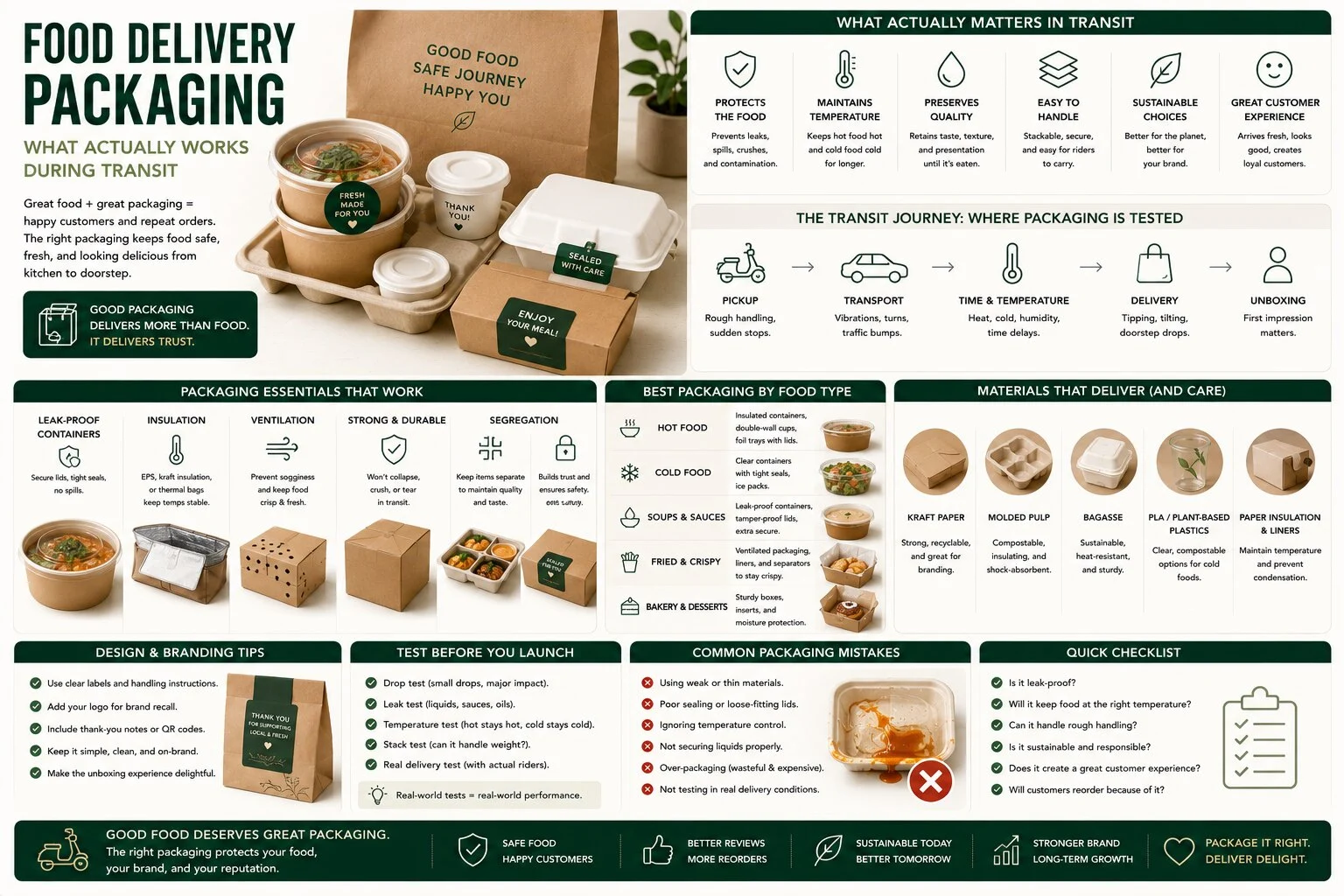
A restaurant owner invested heavily in beautiful printed boxes for their delivery orders.
The packaging looked fantastic in marketing photos. Customers complimented the branding. The boxes matched the restaurant’s identity perfectly.
Then the delivery reviews started arriving.
“Food arrived cold.”
“Packaging was messy when it arrived.”
“Fries were soggy.”
“Burger was crushed.”
The packaging looked great on the counter.
It failed during delivery.
This is one of the biggest mistakes restaurants make when evaluating food delivery packaging. Packaging designed for presentation isn’t always designed for transportation. Once an order leaves the restaurant, it faces conditions that dine-in packaging never encounters: driver handling, delivery bag stacking, vehicle movement, changing temperatures, and transit times that may exceed 30 minutes.
Online food delivery revenue in the United States is projected to reach $473 billion by 2027, making delivery packaging one of the most important operational investments for restaurant brands.
If you’re serving customers through Uber Eats, DoorDash, Grubhub, or your own delivery operation, your packaging is no longer just a container. It’s part of your delivery system.
Why Delivery Packaging Is Fundamentally Different from Dine-In Packaging
Many restaurant owners assume packaging that works inside the restaurant will work during delivery.
Unfortunately, delivery creates entirely different conditions.
Extended Transit Time
Dine-in food travels perhaps 30 feet from kitchen to table.
Delivery food may spend 15, 30, or even 45 minutes inside packaging.
That extra time changes everything.
Heat retention becomes critical.
Steam accumulation becomes problematic.
Grease migration increases.
Structural integrity matters far more than it does inside a dining room.
Driver Handling
Delivery drivers are managing multiple orders simultaneously.
Orders get picked up, stacked, carried, repositioned, and transferred between locations.
Even careful drivers handle packaging far more aggressively than restaurant staff.
Your packaging must survive realistic delivery conditions, not ideal conditions.
Bag Stacking Compression
Inside delivery bags, containers rarely travel alone.
Multiple orders often sit on top of one another.
Weak lids collapse.
Tall containers tip.
Poorly designed structures deform under pressure.
Stack resistance is a delivery requirement, not a luxury feature.
Vehicle Movement
Every acceleration, turn, pothole, and sudden stop creates movement inside packaging.
Without proper containment systems, products slide, sauces spill, toppings shift, and presentation suffers.
Customers often interpret these failures as food quality issues.
Temperature Retention Requirements
Temperature complaints consistently rank among the most common delivery complaints.
Food that arrives cold receives poor reviews even if the recipe itself is excellent.
Packaging becomes your first line of defense.
Packaging Structures That Perform During Delivery
Certain packaging features consistently outperform others in delivery environments.
Tamper-Evident Seals
Customers increasingly expect visible evidence that their order remained secure during transit.
Tamper-evident seals create confidence.
They also reduce customer concerns associated with third-party delivery platforms.
How they work:
- Applied after packaging
- Seal must be broken by customer
- Provides visible evidence of package integrity
Best for:
Vented Packaging for Hot Foods
One of the most overlooked delivery packaging features is venting.
Hot foods generate steam.
Steam trapped inside packaging creates condensation.
Condensation creates soggy food.
Venting solves this problem.
Small ventilation holes allow moisture to escape while maintaining acceptable temperature.
Best for:
- French fries
- Fried chicken
- Onion rings
- Roasted vegetables
- Breaded products
Compartmentalized Packaging
Wet ingredients and dry ingredients rarely belong together during transportation.
Sauce migration ruins texture.
Compartmentalized containers maintain separation until the customer is ready to eat.
Best for:
- Rice bowls
- Meal-prep meals
- Combination platters
- Asian cuisine
- Bento-style meals
Stackable Flat-Lid Structures
Delivery bags are stacking environments.
Flat lids distribute weight evenly.
Dome lids often collapse under pressure.
Flat-top containers create stronger stacking performance and reduce contamination from lid failure.
Best for:
- Family meals
- Multiple-order deliveries
- Catering
- Cloud kitchens
Leak-Resistant Construction
A single leaking container can ruin an entire order.
Leak-resistant systems typically use:
- Interlocking lid designs
- Tight-sealing closures
- Film-sealed tops
- Reinforced container rims
Best for:
- Soups
- Curries
- Sauces
- Pasta dishes
- Oil-based foods
Temperature Retention in Delivery Packaging
Temperature remains the number one delivery-related complaint.
Customers blame restaurants when food arrives cold.
They rarely blame the delivery platform.
How Packaging Affects Temperature
Several packaging characteristics influence heat retention:
- Material density
- Closure security
- Internal air space
- Structural integrity
- Insulation layers
Small improvements often create significant performance gains.
Material Options for Better Temperature Retention
Corrugated Board
Corrugated materials contain air pockets created by fluting.
Those air pockets provide insulation.
This makes corrugated food delivery boxes more effective than single-layer cardboard structures.
Foam-Lined Packaging
Foam-lined packaging provides exceptional insulation.
Although more expensive, it performs extremely well for premium meal delivery programs.
Insulated Liners
Insulated liners add another layer of protection.
Many meal-kit providers use insulated liners for extended delivery routes.
The Delivery Window Reality
Most delivery orders arrive within 15–45 minutes.
Packaging should maintain acceptable food temperature for at least 45–60 minutes.
This creates a safety buffer for traffic delays and route variations.
When Insulated Packaging Makes Sense
Consider insulated solutions if you operate:
- Premium meal programs
- Long-distance delivery zones
- Winter-weather markets
- Specialty food services
Studies show 72% of food delivery customers say food temperature at arrival directly influences whether they reorder from the same restaurant.
That’s a powerful operational metric.
Grease Resistance for Delivery Packaging
Grease resistance becomes much more important during delivery than dine-in service.
Food spends longer inside the package.
That means more time for oils to migrate through packaging materials.
Foods That Require Strong Grease Protection
High-risk products include:
- Fried foods
- Pizza
- Burgers
- Pastries
- Roasted meats
- Oil-based dishes
How to Test Grease Resistance
A simple test works surprisingly well.
Place food inside the packaging.
Wait approximately 30 minutes.
Inspect the exterior.
If grease appears on the outside surface, the packaging needs improvement.
Common Grease-Resistant Solutions
Options include:
- PE-coated paperboard
- Barrier-coated paper materials
- Foil-lined structures
Why Customers Notice
A greasy exterior package creates a negative impression before customers even see the food.
The meal may be excellent.
The packaging already created doubt.
Delivery Packaging for Specific Food Categories
Different foods require different packaging strategies.
Burgers and Sandwiches
Challenges:
- Heat retention
- Bun compression
- Sauce migration
Best packaging:
- Vented burger boxes
- Corrugated insulation structures
- Separate sauce containers
Pizza
Challenges:
- Soggy crust
- Heat loss
- Lid collapse
Best packaging:
- Vented corrugated pizza boxes
- Flat stackable lids
- Air-circulating corrugated bases
Salads and Cold Items
Challenges:
- Maintaining cold temperature
- Dressing contamination
Best packaging:
- Leak-resistant containers
- Separate dressing cups
- Cold-stable materials
Soups and Broths
Challenges:
- Spills
- Temperature retention
Best packaging:
- Double-wall containers
- Film-sealed lids
- Reinforced leak-resistant structures
Sushi and Raw Items
Challenges:
- Temperature control
- Presentation preservation
- Ingredient separation
Best packaging:
- Compartmentalized trays
- Secure sealing systems
- Temperature-managed delivery packaging
Desserts
Challenges:
- Frosting movement
- Structural damage
- Temperature sensitivity
Best packaging:
- Rigid dessert boxes
- Foam inserts
- Separate dessert carriers
Businesses delivering pastries and baked goods should also review our Custom Bakery Boxes solutions and Best Donut Packaging guide for category-specific recommendations.
Building a Delivery Packaging System for Your Restaurant
The highest-performing restaurants rarely rely on individual packaging decisions.
They build systems.
Why Systems Matter
One good container won’t solve every problem.
A delivery experience depends on multiple components working together consistently.
Components of an Effective Delivery Packaging System
Primary Containers
Food-safe packaging selected specifically for each menu item.
Secondary Protection
Corrugated outer packaging when additional structural support is needed.
Sealing Systems
Tamper-evident labels applied consistently.
Temperature Management
Venting or insulation selected based on food type.
Sauce and Condiment Control
Separate containers reduce contamination risk.
Bag Organization Protocol
Heavy items at the bottom.
Fragile items at the top.
Simple but extremely effective.
How to Test Your Delivery Packaging
Many restaurant operators never perform real-world testing.
They should.
Pack actual customer orders.
Have a staff member drive a typical delivery route.
Use normal roads.
Include stops, turns, and realistic travel times.
Open the order at the destination.
Evaluate:
- Temperature
- Presentation
- Structural integrity
- Leaks
- Condensation
- Product movement
The results often surprise restaurant owners.
Packaging and Delivery Platform Ratings
Uber Eats, DoorDash, and Grubhub all rely heavily on customer ratings.
Presentation issues frequently influence:
- Delivery ratings
- Order satisfaction scores
- Repeat purchases
- Review quality
Strong packaging systems directly support stronger platform performance.
Conclusion
Successful food delivery packaging requires thinking about the entire customer journey, not just the moment food leaves the kitchen.
The best delivery packaging protects temperature, controls moisture, prevents leaks, survives stacking, and maintains presentation throughout a 30–60 minute trip. Every delivery challenge—from vehicle movement to condensation—must be considered during packaging selection.
A simple test reveals the truth: if your packaging cannot survive a 45-minute car ride without compromising food quality, temperature, or presentation, it needs improvement.
Explore our custom food packaging boxes including delivery-optimized structures, grease-resistant coatings, insulated solutions, and tamper-evident systems designed for restaurants, cloud kitchens, meal-prep services, and food brands across the United States.