

Imagine a brand that invested heavily in beautiful packaging.
The box has premium finishes. The colors perfectly match the brand identity. The unboxing experience feels intentional and memorable.
Yet the ecommerce conversion rate is lower than expected.
When the team reviews their product listings, the problem becomes obvious.
The product itself is photographed well, but the packaging appears in a small secondary image, slightly out of focus, against a background that doesn’t match the brand aesthetic.
Customers can’t touch the packaging.
They can’t feel the soft-touch finish.
They can’t see the foil reflect light in person.
They can’t experience the unboxing moment.
They can only judge what they see in the photos.
That’s why packaging photography has become one of the most important conversion tools in ecommerce. Strong images communicate quality, attention to detail, and premium positioning before a customer ever reaches checkout.
Research shows that products with high-quality lifestyle and packaging photography convert at rates up to 40% higher than products using basic white-background images alone on major ecommerce platforms.
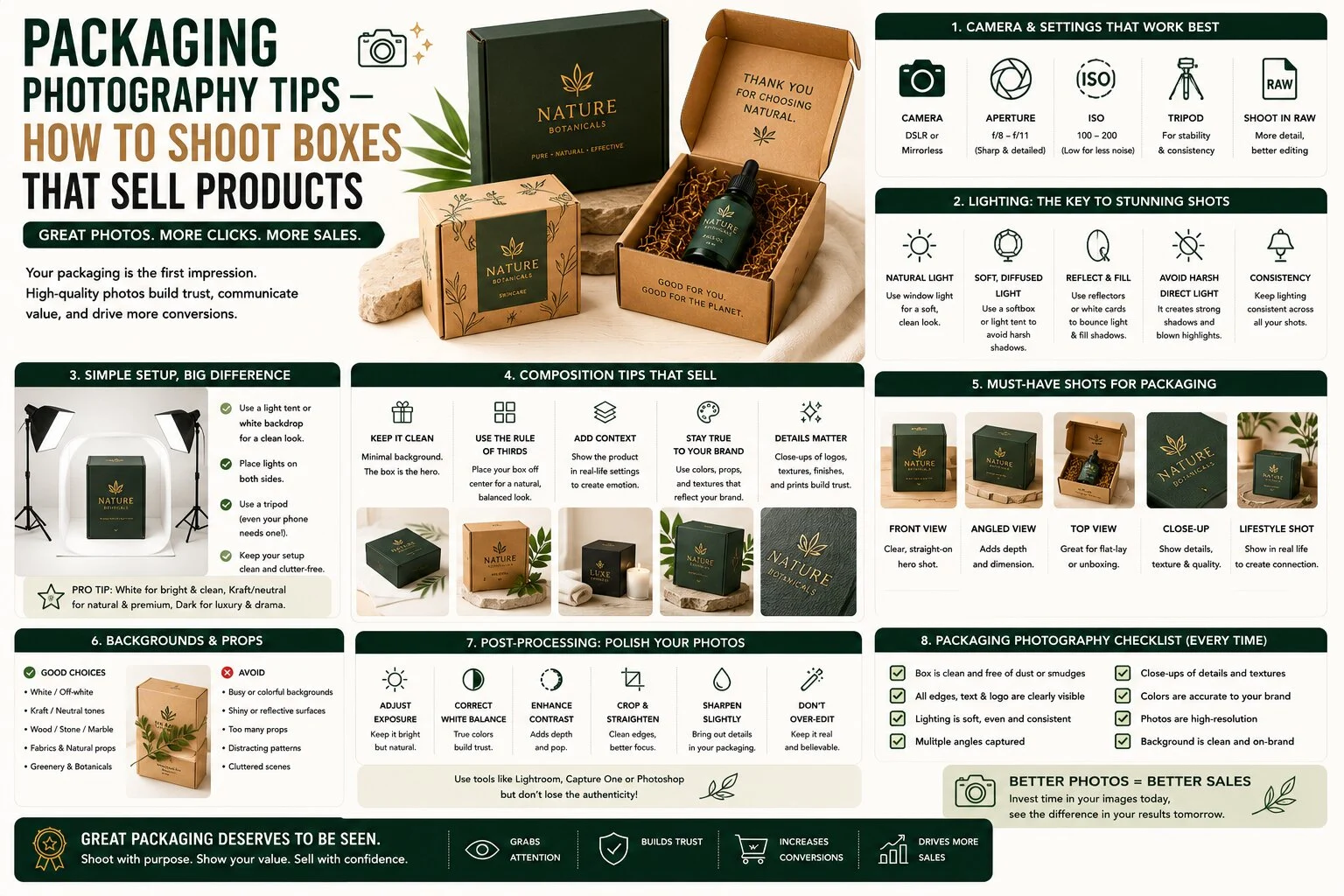
In this guide, you’ll learn how packaging photography affects conversion rates, what equipment you actually need, how to light different packaging finishes, and how to create ecommerce-ready images for Amazon, Etsy, Shopify, and social media.
Why Packaging Photography Matters for Ecommerce Conversion
In physical retail, customers evaluate products using multiple senses.
They pick up the package.
They feel its weight.
They inspect textures.
They examine details from different angles.
Online shopping removes all of that.
The only information customers receive comes from images and descriptions.
This means your packaging photos must communicate everything customers cannot physically experience.
What Packaging Photography Communicates
Strong packaging photography helps customers understand:
- Brand quality level
- Premium versus generic positioning
- Gift-readiness
- Unboxing experience potential
- Attention to detail
- Packaging craftsmanship
These factors often influence buying decisions before product features are evaluated.
The Premium Arrival Question
Many customers reviewing product listings are trying to answer a simple question:
“Will this arrive looking premium?”
Packaging photography answers that question.
If your images suggest quality, customers feel more confident purchasing online.
If packaging appears generic or poorly photographed, uncertainty increases.
The Thumbnail Challenge
On Amazon, Etsy, and Shopify collections, customers often see products as tiny thumbnails first.
Packaging that photographs well tends to stand out even at small sizes.
This is one reason brands investing in strong packaging presentation often achieve better click-through rates before conversion optimization even begins.
Research consistently shows that 72% of consumers say packaging design influences their perception of product quality before purchase, making packaging photography a direct conversion factor.
Equipment You Actually Need – No Studio Required
One of the biggest misconceptions about ecommerce photography is that expensive equipment is required.
For most small businesses, that’s simply not true.
Smartphone Camera
Modern smartphones produce excellent image quality.
For Amazon, Etsy, Shopify, and Instagram, today’s smartphone cameras are more than capable.
The difference between average and excellent packaging photography is usually lighting and composition-not camera price.
Natural Light Source
A large window often produces better packaging images than expensive lighting equipment.
Indirect daylight creates soft shadows and accurate color reproduction.
Avoid direct sunlight because it creates harsh reflections and uneven exposure.
Simple Backgrounds
You don’t need custom photography sets.
Several affordable options work exceptionally well:
White Foam Board
- Clean ecommerce appearance
- Perfect for Amazon-style images
Kraft Paper
- Excellent for artisan brands
- Works well with natural packaging
Marble Contact Paper
- Popular for beauty and luxury products
- Creates a premium feel
Dark Backgrounds
- Strong for luxury packaging
- Excellent for black boxes and metallic finishes
Wood Surfaces
- Ideal for natural, handmade, and boutique brands
Macro Mode for Close-Ups
Most smartphones now include macro or portrait photography modes.
These features allow you to capture:
- Foil stamping
- Embossing
- Debossing
- Soft-touch finishes
- Texture details
These close-ups often become some of the highest-converting images in a listing.
Tripod or Phone Stand
A simple tripod dramatically improves image consistency.
Benefits include:
- Sharper photos
- Consistent framing
- Easier batch photography
- Better low-light performance
It’s one of the lowest-cost photography upgrades available.
Lighting for Packaging Photography
If you’re only going to improve one thing, improve your lighting.
Lighting affects packaging photography more than camera equipment.
Different packaging finishes react completely differently under various lighting conditions.
Natural Window Light
Best for:
- Kraft packaging
- Handmade products
- Artisan brands
- Warm lifestyle photography
Position the packaging approximately 45 degrees from the window.
This creates natural dimension while maintaining soft shadows.
Avoid direct sunlight whenever possible.
Diffused Artificial Light
Best for:
- White packaging
- Cosmetics
- Clinical product aesthetics
- Consistent ecommerce listings
Two soft lights positioned at 45-degree angles generally create professional-looking results.
How Different Finishes React to Light
Matte Finishes
Matte packaging absorbs light.
Benefits include:
- Minimal reflections
- Consistent color appearance
- Easy photography
This is one reason matte packaging performs exceptionally well online.
Gloss Finishes
Gloss surfaces reflect everything.
Without diffused lighting, reflections become distracting.
For gloss packaging:
- Use soft lighting
- Avoid direct flash
- Control surrounding reflections
Foil Elements
Foil is designed to interact with light.
Gold, silver, and holographic foils often look flat under poor lighting.
Use directional light to create intentional highlights and sparkle.
This helps customers see the premium effect.
Embossing
Embossing requires side lighting.
Light hitting from the side creates shadows that reveal texture depth.
Without this technique, embossed details can disappear entirely in photos.
Composition Styles for Different Platforms
Not all ecommerce platforms reward the same image style.
Amazon Main Image
Amazon requires:
- White background
- Product filling most of frame
- Clean presentation
For packaging:
- Show closed packaging clearly
- Use white background
- Maximize visibility
Additional images should showcase:
- Interior presentation
- Open packaging
- Product inside packaging
Etsy Main Image
Etsy buyers respond strongly to lifestyle photography.
Packaging and product together often outperform product-only images.
Natural backgrounds work particularly well.
Many successful Etsy sellers also apply packaging strategies similar to those discussed in Blog 33 on Ecommerce Reviews because presentation directly influences review language.
Shopify and DTC Websites
Shopify offers complete creative control.
Best practices include:
- Consistent backgrounds
- Lifestyle imagery
- Packaging-focused visuals
- Unboxing photography
Brand consistency matters more than strict marketplace compliance.
Instagram and TikTok
Vertical content dominates.
Effective packaging content includes:
- Close-up texture shots
- Unboxing sequences
- Packaging detail videos
- Carousel image sets
The thumbnail should feature the most visually impressive packaging angle.
Essential Packaging Photo Types – What to Capture for Every Listing
Every ecommerce listing should include the following images.
Photo 1: Hero Shot
A clean image of closed packaging.
This becomes the primary visual customers see first.
Photo 2: Open Packaging Reveal
Show the interior.
Customers want to see:
- Inserts
- Tissue paper
- Branding
- Product arrangement
Photo 3: Product + Packaging Together
This image communicates the complete ownership experience.
Customers understand what arrives and how it arrives.
Photo 4: Close-Up Finish Detail
Capture:
- Foil
- Embossing
- Texture
- Soft-touch coating
These details communicate quality that standard images cannot.
Photo 5: Scale Reference
Include:
- Hand interaction
- Common object comparison
- Lifestyle size reference
This reduces customer confusion about dimensions.
Photo 6: Lifestyle Context
Show the packaging in a realistic environment.
Examples include:
- Home settings
- Desk placement
- Shelf styling
Photo 7: Gifting Presentation
For gift-focused products, include a dedicated gift image.
Gift buyers often evaluate packaging separately from the product itself.
Common Packaging Photography Mistakes That Hurt Conversions
Mistake 1: Only Photographing the Product
When packaging receives one weak image, customers assume it isn’t important.
Premium packaging deserves premium photography.
Mistake 2: Using the Wrong Background
Backgrounds should support brand positioning.
Artisan brands rarely benefit from sterile clinical backgrounds.
Luxury packaging often loses impact against casual surfaces.
Mistake 3: Ignoring Finish Details
Customers cannot feel your packaging online.
Finish close-ups become the substitute for touch.
Mistake 4: Inconsistent Lighting
Mixed lighting creates inconsistent colors.
Every image in a listing should appear cohesive.
Mistake 5: Showing Empty Packaging Only
Customers buy the complete experience.
Show products inside packaging whenever possible.
Mistake 6: Skipping the Open Shot
The interior often sells the product.
Not photographing it is a missed opportunity.
Batch Photography Strategy for Small Brands
You don’t need a studio to create professional results.
You need a process.
Setup Once, Shoot Everything
Before starting:
- Prepare backgrounds
- Position lighting
- Set camera height
Then photograph every angle before changing the setup.
Create a Photography Template
Maintain consistency with:
- Same camera distance
- Same lighting
- Same angles
- Same background placement
This creates a professional appearance across all listings.
Editing Basics That Matter
Focus on:
- Accurate color correction
- Consistent exposure
- Background cleanup
- Sharpness optimization
Packaging colors should match the physical product.
When Professional Photography Makes Sense
Consider hiring professionals when:
- Conversion rates remain low despite strong packaging
- Entering premium retail environments
- Launching hero products
- Scaling advertising campaigns
Professional photography becomes most valuable when the packaging itself already supports premium positioning.
Conclusion
Packaging photography is much more than product documentation.
It’s a conversion tool.
Customers use packaging photos to answer a critical question:
“Will this arrive looking premium?”
If your images answer that question confidently, conversions improve.
You don’t need an expensive studio to achieve this. A smartphone, good lighting, simple backgrounds, and a structured photography process are enough for most Amazon, Etsy, and Shopify sellers.
Start by capturing the seven essential photo types outlined above before investing in advanced equipment or professional studios.
And once your photography is ready, make sure your custom packaging boxes deliver on the premium promise your photos create. Explore our packaging solutions designed specifically for ecommerce brands across the United States.