
Imagine two new brands launching in the same product category during the same week.
Brand A launches with premium packaging from day one. Every order arrives in a carefully designed box with branded tissue paper, a personalized thank-you card, and a presentation that feels intentional.
Brand B chooses generic packaging to save money. The founder plans to upgrade later after sales increase.
Six months have passed.
Brand A has accumulated customer reviews mentioning presentation, premium quality, and memorable unboxing experiences. Customers willingly accept higher pricing because the packaging supports the brand’s positioning.
Brand B is still using generic packaging.
The planned upgrade keeps getting delayed. Marketing costs increased. Cash flow became tighter. Customers now associate the brand with lower-priced products because that was the first impression they received.
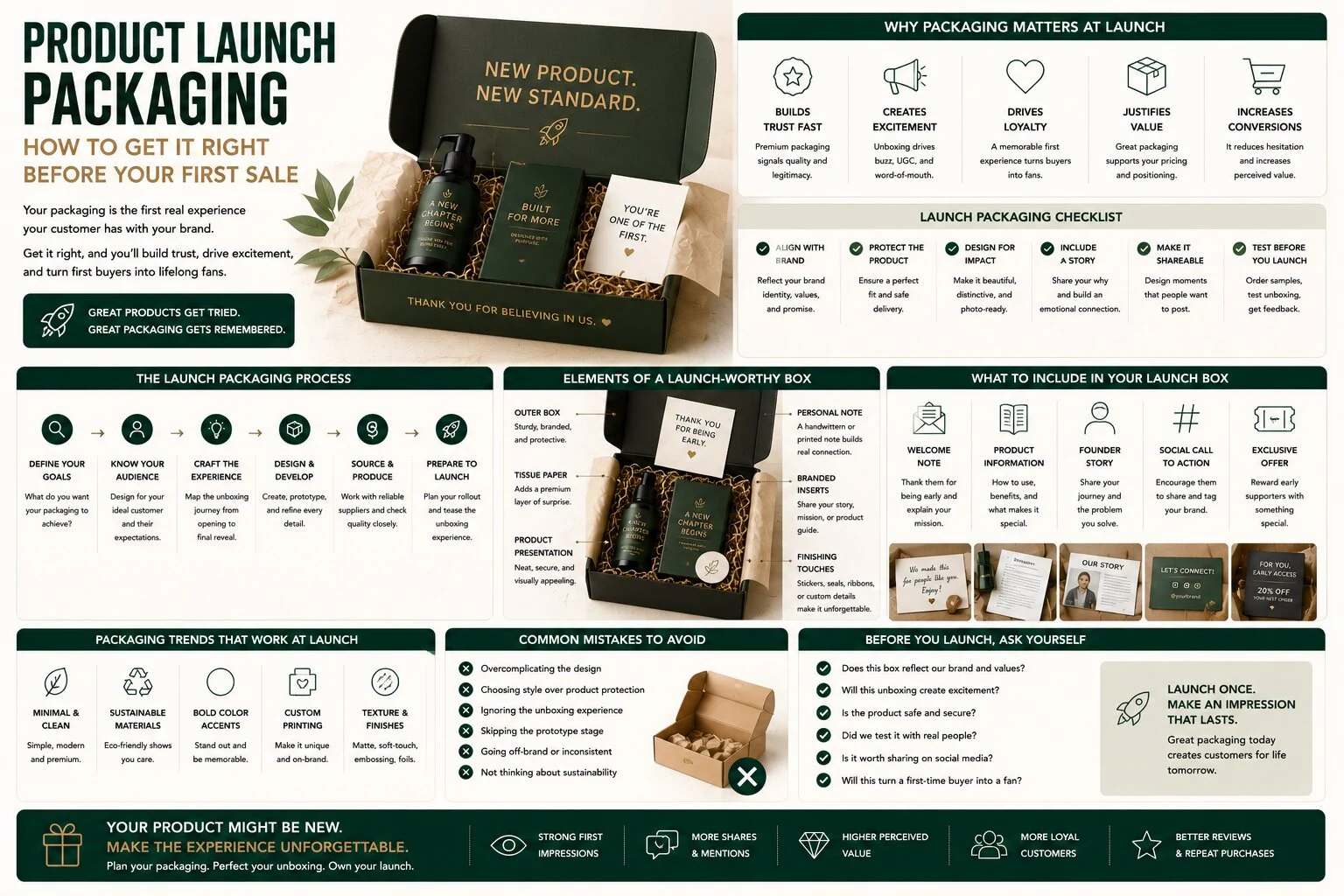
This is why product launch packaging matters so much. Packaging decisions made before launch often influence customer expectations, review language, pricing power, and brand perception long after the first shipment leaves your warehouse.
Research consistently shows that first impressions form within 7 seconds. For product brands, packaging creates that impression before customers interact with the product itself, making launch packaging decisions some of the most consequential brand investments a founder makes.
If you’re preparing a new product launch, the packaging decisions you make today may influence your brand trajectory for years.
Why Launch Packaging Is Different from Ongoing Packaging Decisions
Many founders treat launch packaging as a temporary solution.
The thinking usually sounds like this:
“We’ll start simple and improve later.”
In practice, that strategy rarely works as smoothly as expected.
The Price Anchoring Problem
Customers form pricing expectations immediately.
Packaging acts as a signal.
A premium product packaged in a premium presentation feels consistent. A premium product shipped in generic packaging feels overpriced.
Once customers anchor their expectations around a certain value perception, changing that perception becomes difficult and expensive.
Premium packaging supports premium pricing from the beginning.
Generic packaging often creates discount-brand positioning that is surprisingly difficult to reverse.
The Review Accumulation Effect
Customer reviews don’t disappear when packaging improves.
The comments generated during your first six months can remain visible for years.
Early review language often includes observations such as:
- “Beautiful packaging”
- “Loved the presentation”
- “Arrived looking premium”
Or unfortunately:
- “Generic packaging”
- “Nothing special”
- “Expected more for the price”
These comments continue influencing future buyers long after the original reviews were written.
The Brand Identity Formation Problem
Customers learn to recognize your visual identity quickly.
Colors, structures, materials, and presentation styles become associated with your brand.
Significant packaging changes later can create confusion even when the update is objectively better.
Why “Upgrade Later” Rarely Works
Most founders assume upgrades will happen after revenue grows.
The reality is different.
Launch periods often represent the time when founders have the most energy, focus, and available capital dedicated to brand development.
Once sales begin, attention shifts toward fulfillment, advertising, inventory, customer service, and growth.
Packaging improvements frequently move down the priority list.
Research shows that 52% of consumers say they would not repurchase from a brand that delivered products in poor packaging on first purchase, making launch packaging a direct retention investment.
Defining Your Packaging Position Before Choosing Materials
Before requesting quotes or contacting suppliers, every founder should answer three strategic questions.
Question 1: What Price Point Are You Targeting?
Packaging should support the price you intend to charge.
A $15 product and a $150 product should not arrive in the same packaging experience.
Higher price points justify stronger structural investment, upgraded finishes, and more thoughtful presentation.
Start with pricing.
Packaging decisions become easier afterward.
Question 2: Who Is Your Primary Buyer?
Different audiences expect different experiences.
A 25-year-old streetwear customer values different packaging signals than a 55-year-old luxury gift purchaser.
Consider:
- Age
- Buying motivation
- Lifestyle
- Purchasing frequency
- Gift versus personal use
The buyer influences every packaging decision that follows.
Question 3: Where Will Most Sales Come From?
Your primary sales channel determines packaging priorities.
Retail shelves require visibility.
Ecommerce requires protection.
Social-first brands require shareability.
Farmers markets require visibility and accessibility.
Structure follows channel strategy.
Answering these three questions before contacting packaging suppliers prevents expensive redesigns later.
Launch Packaging Budget — How Much to Spend
One of the biggest concerns founders face is budget allocation.
Most startups cannot spend without limits.
Fortunately, effective launch packaging doesn’t require enterprise-level budgets.
Premium Products ($50+)
Recommended packaging budget:
8–15% of retail price
Structure investment:
- Rigid boxes
- Premium corrugated packaging
- Enhanced presentation systems
Minimum finishing recommendation:
- Matte lamination
- One premium finishing element
Examples include embossing, foil stamping, or spot UV.
Mid-Range Products ($20-$50)
Recommended packaging budget:
5–10% of retail price
Structure investment:
- Folding cartons
- Premium corrugated mailers
Minimum finishing recommendation:
- High-quality printing
- Matte finish where possible
Entry-Level Products (Under $20)
Recommended packaging budget:
3–7% of retail price
Structure investment:
- Standard corrugated mailers
- Folding cartons
Minimum finishing recommendation:
- Clean branding
- Professional printing
- Simple graphics
When to Spend More
Some categories justify higher packaging investment:
- Gift products
- Luxury categories
- Subscription brands
- Social-media-driven businesses
- Premium wellness products
In these categories, packaging often functions as marketing.
Underspending may cost more than the savings generated.
Launch Packaging Structure – What to Choose
Different launch models require different packaging systems.
DTC Ecommerce Launch
Primary need:
Protection and presentation.
Recommended structure:
- Corrugated mailer
- Branded tissue paper
- Insert card
Consistency matters more than complexity.
Every customer should receive the same experience from day one.
Retail Launch
Primary need:
Shelf visibility.
Recommended structure:
- Folding carton
- Strong graphics
- Clear category communication
Customers should understand the product within seconds.
This aligns closely with the principles discussed in our Packaging Design Tips guide.
Social Media First Launch
Primary need:
Shareability.
Recommended structure:
- Premium corrugated mailer
- Rigid box
- Interior branding
Focus on three visual moments:
- Exterior
- Opening experience
- Interior presentation
Farmers Market Launch
Primary need:
Product visibility.
Recommended structure:
- Kraft sleeves
- Holster packaging
Customers should easily see products and ingredients.
Multi-Channel Launch
Primary need:
Versatility.
Recommended structure:
- Branded corrugated mailer
This approach photographs well, ships safely, and maintains premium perception across multiple sales channels.
The Minimum Viable Packaging Checklist for Launch
Every launch packaging system should pass four tests.
Protection Performance
Can the packaging protect products through your primary sales channel?
If not, fix it before launch.
Brand Identity
Can customers identify:
- Brand name
- Product category
within three seconds?
If not, fix it before launch.
Price Point Alignment
Does the packaging feel appropriate for the price being charged?
If not, fix it before launch.
Photography Performance
Does the packaging look attractive in product photography?
If not, fix it before launch.
What Can Be Added Later
Certain improvements can happen after launch without disrupting brand identity:
- Premium finishing upgrades
- Interior branding additions
- Insert card enhancements
- Seasonal packaging variations
What Is Difficult to Change Later
These decisions are much harder to reverse:
- Core color system
- Primary structure choice
- Price positioning signals
Choose carefully.
Timeline Planning for Product Launch Packaging
Packaging almost always takes longer than founders expect.
Design Phase
- Initial design: 2–4 weeks
- Revisions: 1–2 weeks
Total:
3–6 weeks
Supplier Sourcing and Quoting
- Quotes: 1–2 weeks
- Evaluation: 1 week
Total:
2–3 weeks
Sample Production
- Physical samples: 2–3 weeks
- Approval process: 1 week
Total:
3–4 weeks
Production
Depending on complexity:
4–8 weeks
Shipping and Receiving
Domestic delivery:
1–2 weeks
Total Minimum Timeline
Most product launch packaging projects require:
13–23 weeks
from design initiation to packaging arrival.
Many founders underestimate timelines by 50–100%.
What to Do If Time Is Short
If your launch schedule is compressed:
- Simplify designs
- Reduce finishing complexity
- Use digital printing
- Start with lower-MOQ production
These adjustments can reduce lead times significantly.
Launch Packaging Mistakes That Are Expensive to Fix
Mistake 1: Designing for Your Own Taste
Founders are not always their target customers.
Test packaging with actual buyers before production.
Mistake 2: Ordering Too Much on the First Run
Customer feedback often reveals improvement opportunities.
Initial orders should typically cover only 2–3 months of inventory.
This principle is especially important for startups and is discussed extensively in our Small Business Packaging guide.
Mistake 3: Ignoring Photography
Many packaging designs look excellent on screen and disappointing in real photographs.
Always perform photography tests before approving production.
Mistake 4: Choosing Generic Packaging to “Play It Safe”
Generic packaging is not safe.
It is invisible.
Customers rarely remember invisible brands.
Mistake 5: Skipping Physical Samples
Digital proofs cannot accurately demonstrate:
- Color accuracy
- Texture
- Structural performance
- Material quality
Always approve physical samples before production begins.
Conclusion
Product launch packaging decisions create long-term consequences. Strong decisions support premium positioning, positive reviews, customer retention, and brand recognition for years. Poor decisions often create price anchoring problems that become expensive to fix later.
The most effective approach is simple: answer the three positioning questions first. Define your customer, your price point, and your primary sales channel. Then build your packaging strategy around those answers.
Our team works with product brands at every stage of growth, exploring our custom packaging boxes designed for product launches across retail, ecommerce, and social-first brands throughout the United States.