

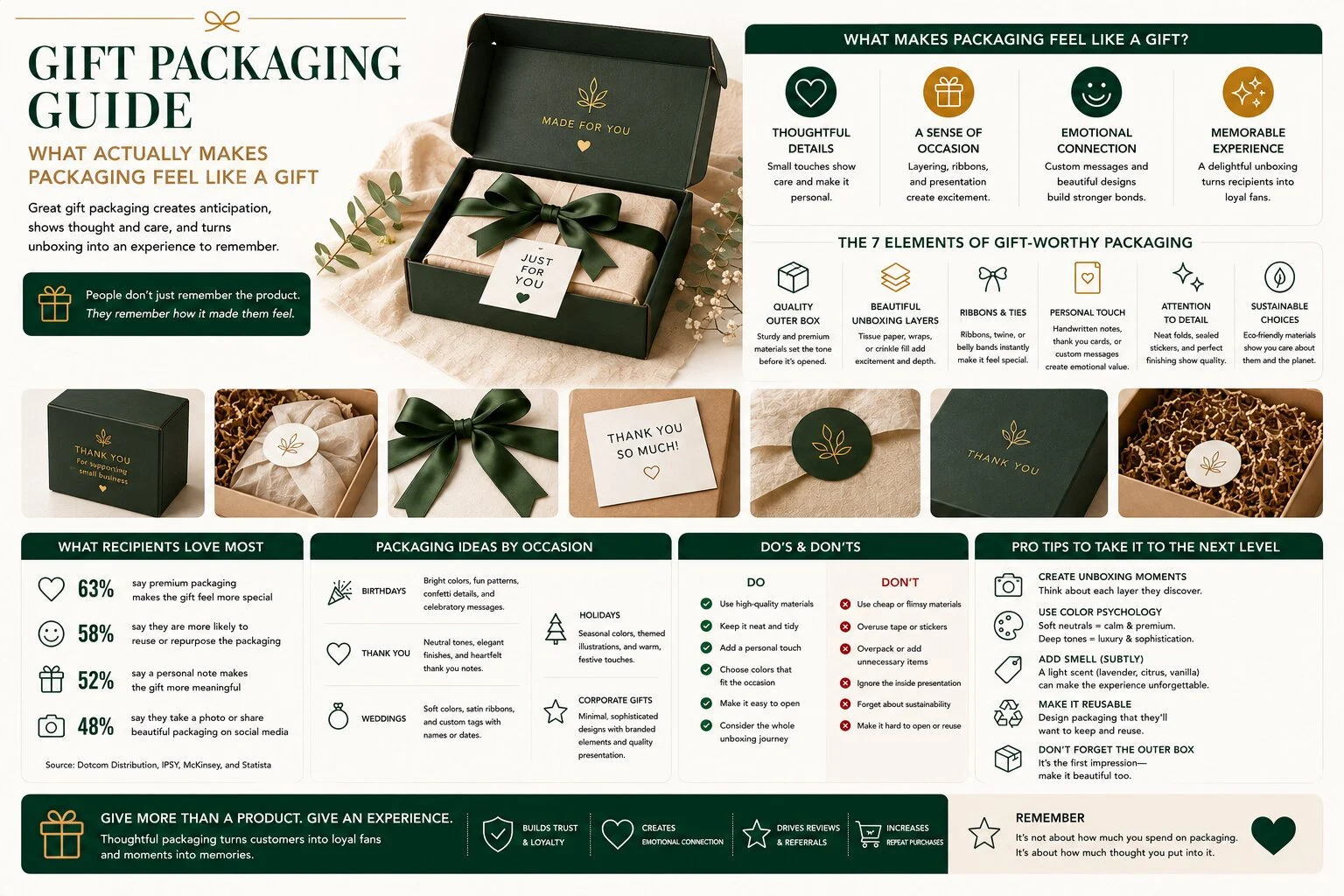
Imagine a customer standing in a boutique looking for a birthday gift.
They’ve narrowed their decision down to two candles.
Both cost $45.
Both smell great.
Both come from reputable brands.
One candle sits inside a standard folding carton with a product photo and basic branding.
The other arrives in a matte black rigid box with gold foil details, a ribbon closure, and a carefully designed interior.
Without hesitation, the customer chooses the second option.
Not because the candle is better.
Not because the scent is stronger.
Because the packaging instantly answers the question every gift buyer asks:
“Can I give this without additional wrapping?”
This is what makes gift packaging boxes different from standard product packaging. Gift purchases involve a completely different decision-making process. Customers are no longer buying only for themselves. They’re buying for someone else, and packaging becomes part of the gift itself.
Research shows that 62% of consumers say packaging design influences their perception of a gift before it’s opened, and gift buyers are 40% more likely to choose a product based on packaging when purchasing for someone else.
If your products are frequently purchased as gifts, understanding gift packaging psychology can directly influence conversion rates, average order value, and repeat purchases.
The Psychology of Gift Purchasing – Why Packaging Matters More
Many brands assume customers evaluate gifts the same way they evaluate personal purchases.
They don’t.
Gift buyers operate under a different set of emotional considerations.
The Proxy Judgment
When someone buys a gift, they mentally place themselves in the recipient’s position.
They ask:
“If I received this, would I feel appreciated?”
Packaging helps answer that question.
A beautifully presented product signals thoughtfulness before the recipient even sees what’s inside.
In many cases, packaging becomes the first proof that the giver made a good choice.
The Eliminating-Extra-Steps Factor
Gift buyers value convenience.
Every additional step between purchase and gifting creates friction.
Products that arrive gift-ready eliminate the need for:
- Additional wrapping paper
- Gift bags
- Bows
- Separate presentation materials
The easier you make gifting, the more likely customers are to choose your product.
The Social Stakes Factor
Gifts are unique because two people evaluate them.
The recipient evaluates the gift.
The giver evaluates how the gift reflects on them.
Poor presentation feels risky.
Premium presentation feels safe.
Gift-ready packaging protects the buyer’s social confidence.
The Price Perception Multiplier
Packaging dramatically affects value perception.
A product worth $40 can feel like a premium gift when presented correctly.
The exact same product can feel underwhelming when presented in generic packaging.
Gift packaging doesn’t merely communicate value.
It multiplies perceived value.
Studies show 81% of gift recipients say they judge the gift giver’s thoughtfulness partly based on presentation before opening the gift.
That’s a powerful responsibility for packaging to carry.
What Makes Packaging Feel Gift-Ready
Not all premium packaging feels like gift packaging.
Certain design elements consistently trigger gift-ready perceptions.
Ribbon and Closure Systems
Ribbon closures immediately communicate gifting.
Options include:
- Satin ribbon
- Grosgrain ribbon
- Raffia ties
- Decorative twine
These simple additions remove the need for separate bows and wrapping.
They also create anticipation before opening.
Tissue Paper Interior
Tissue paper adds a reveal layer.
This may seem small, but it creates an emotional response.
Customers associate tissue paper with intentional preparation.
It feels like someone took time to arrange the gift.
That feeling matters.
Magnetic or Ceremonial Closures
Magnetic closures transform opening into an experience.
The subtle resistance and satisfying close create a sense of occasion.
Many luxury gift brands use magnetic closures because they elevate perceived value without changing the product itself.
Structural Weight and Permanence
Weight influences perception.
A substantial box feels valuable.
Rigid structures communicate permanence and quality.
Lightweight cartons often struggle to create the same gifting impression.
This is one reason premium gift packaging frequently utilizes rigid box construction similar to the formats discussed in Blog 11 on Luxury Rigid Boxes.
Color and Finish Signals
Certain finish combinations consistently communicate gifting.
Examples include:
- Matte black with gold foil
- White with metallic accents
- Navy with silver foil
- Kraft with copper foil
These combinations work because they balance sophistication with presentation value.
Interior Messaging Space
Gift buyers often want to include a personal message.
Built-in message areas eliminate the need for separate cards.
Examples include:
- Interior lid messaging
- Insert cards
- Dedicated card slots
- Personalized note sections
This small detail often becomes the final factor in a purchase decision.
Gift Packaging for Different Product Categories
Different product categories create different packaging expectations.
Jewelry and Accessories
Jewelry buyers expect a premium presentation.
Recommended format:
- Two-piece rigid box
- Velvet insert
- Foam support
- Compact footprint
Customers often judge jewelry brands by packaging quality before evaluating the product itself.
Candles and Home Fragrance
Candles are among the most frequently gifted consumer products.
Effective options include:
- Magnetic closure boxes
- Rigid presentation boxes
- Tissue-lined interiors
- Kraft with foil for artisan brands
The packaging should feel as carefully designed as the fragrance.
Beauty and Skincare
Beauty packaging should align with product pricing.
Under $30
- Premium folding cartons
$30-$60
- Corrugated gift-ready packaging
- Interior branding
Over $60
- Rigid packaging
- Enhanced presentation systems
Gift sets often justify rigid packaging regardless of individual product value.
Food and Specialty Items
Food gifting relies heavily on presentation.
Recommended formats:
- Window boxes
- Gable boxes
- Premium rigid food boxes
Product visibility often improves giving confidence.
Wellness and Supplements
Wellness gifting requires a different approach.
Packaging should feel:
- Clean
- Modern
- Thoughtful
Avoid packaging that resembles pharmaceutical products.
Botanical graphics, kraft finishes, and minimalist layouts work especially well.
Corporate Gifts
Corporate gifting introduces additional expectations.
Executive gifts often require:
- Magnetic rigid boxes
- Premium inserts
- Sophisticated branding
Employee gifting programs frequently benefit from branded corrugated systems that balance presentation with budget efficiency.
Brands managing business gifting initiatives may also find valuable ideas on Corporate Gift Packaging.
Occasion-Specific Gift Packaging
Different occasions create different presentation expectations.
Birthday Gifting
Birthday gifts require versatility.
The best approach:
- Ribbon closures
- Neutral premium colors
- Tissue paper interiors
The packaging should feel celebratory without being overly seasonal.
Holiday Gifting
Holiday purchases often peak during Q4.
Deep greens, reds, golds, and metallic finishes consistently perform well.
Many customers present the package itself rather than adding wrapping paper.
Seasonal strategies similar to those discussed in Blog 24 on Holiday Gift Packaging often help maximize gifting conversions.
Valentine’s Day
Valentine’s gifts rely heavily on emotion.
Effective elements include:
- Deep reds
- Blush pink accents
- Gold foil
- Romantic details
Smaller luxury formats frequently outperform oversized packaging.
Wedding and Bridal Gifts
Wedding gifting emphasizes elegance.
Recommended characteristics:
- White
- Champagne tones
- Personalized messaging
- Premium finishes
Packaging should feel worthy of becoming part of the memory itself.
Baby Shower Gifts
Modern baby gifting has shifted toward softer, more neutral palettes.
Popular choices include:
- Sage green
- Cream
- Mint
- Warm beige
The presentation should feel thoughtful rather than overtly themed.
Building a Gift Packaging System for Your Brand
The most successful brands don’t create one gift package.
They create a gifting system.
Tier 1: Gift-Ready Standard
Everyday packaging should already look presentable enough to gift.
This removes friction for spontaneous gift buyers.
Tier 2: Seasonal Gift Packaging
Seasonal programs allow brands to capitalize on major gifting periods.
Common examples:
- Christmas collections
- Mother’s Day packaging
- Valentine’s packaging
The structure can remain the same while messaging and tissue change.
Tier 3: Premium Gift Experience
Reserved for:
- Gift sets
- Curated collections
- High-value purchases
Features often include:
- Magnetic closures
- Rigid construction
- Enhanced inserts
- Premium finishes
Why Tiered Systems Work
Tiered packaging reduces operational complexity.
Instead of creating entirely new packaging programs for every occasion, brands maintain a consistent system with scalable enhancements.
Identifying Gift Buyers
Many brands already have gifting data without realizing it.
Indicators include:
- Gift notes
- Seasonal purchasing patterns
- Separate shipping addresses
- Gift wrap selections
- Holiday order spikes
These signals help determine where premium gift investments deliver the highest return.
Conclusion
Successful gift packaging comes down to one critical question:
“Can I give this without wrapping?”
If customers immediately answer yes, you’ve solved the biggest conversion challenge in gift purchasing.
Gift buyers aren’t simply evaluating products. They’re evaluating presentation, convenience, social confidence, and perceived thoughtfulness. Packaging becomes the bridge between the giver and the recipient.
Whether you’re selling candles, beauty products, corporate gifts, food items, or subscription products, gift-ready packaging can significantly influence purchase behavior.
Explore our custom gift boxes in rigid, magnetic closure, and premium presentation formats designed for gift brands, seasonal collections, and ecommerce businesses across the United States.